

The Intricate Dance: Unpacking the Distinction Between Art and Science
The human endeavor to comprehend the world manifests in myriad forms, none more fundamental and yet distinct than art and science. While both are profound expressions of our innate curiosity and a relentless pursuit of knowledge, their methodologies, aims, and modes of engagement with reality often stand in stark contrast. This article delves into the crucial distinction between these two pillars of human understanding, exploring how each, in its unique way, illuminates our existence and expands our intellectual and emotional horizons.
A Shared Quest for Understanding, A Divergent Path to Knowledge
At their core, both art and science strive to make sense of the universe – be it the external cosmos or the internal landscape of human experience. They are twin engines of discovery, pushing the boundaries of what we know and feel. However, the paths they traverse to achieve this understanding are fundamentally different, shaping the very nature of the knowledge they impart.
The Realm of Art: Empathy, Experience, and Expression
Art, in its myriad forms – painting, poetry, music, sculpture, dance – primarily engages with the subjective, the aesthetic, and the emotional. It seeks to express, interpret, and evoke rather than to explain or predict. The knowledge gained through art is often experiential, intuitive, and deeply personal. It speaks to the human condition, offering insights into emotions, morality, beauty, and the complexities of individual and collective life. Think of the profound truths conveyed in a Shakespearean tragedy or the emotional resonance of a Beethoven symphony; these are not empirical facts but deeply felt understandings of what it means to be human. Art invites us to feel and to interpret, fostering empathy and expanding our capacity for nuanced perception.
The Domain of Science: Observation, Objectivity, and Explanation
Science, conversely, is largely concerned with the objective, the measurable, and the verifiable. Its primary goal is to explain natural phenomena, establish universal laws, and predict future events based on empirical evidence and rigorous testing. The knowledge derived from science is factual, systematic, and aims for universal applicability, independent of individual bias. From the laws of physics elucidated by Newton to the biological intricacies uncovered by Darwin, science builds a cumulative understanding of how the world works. It demands observation, experimentation, and logical deduction, striving for a detached, verifiable truth.
Methodological Divergence: How They Uncover Truth
The fundamental distinction between art and science becomes clearest when examining their respective methodologies. While both require creativity and disciplined effort, their approaches to inquiry and validation diverge significantly.
| Aspect | Art | Science |
|---|---|---|
| Primary Aim | Expression, interpretation, evocation, aesthetic experience | Explanation, prediction, discovery of universal laws |
| Focus | Subjective experience, emotion, beauty, meaning | Objective reality, measurable phenomena, verifiable facts |
| Methodology | Intuition, inspiration, craftsmanship, personal interpretation | Observation, experimentation, hypothesis testing, logical deduction |
| Validation | Resonance, cultural impact, critical reception, emotional truth | Reproducibility, peer review, empirical evidence, predictive power |
| Nature of Truth | Contextual, interpretive, multi-faceted, often symbolic | Universal, verifiable, falsifiable, often quantifiable |
| Resulting Knowledge | Experiential, qualitative, emotional, philosophical | Factual, quantitative, empirical, theoretical |
Art thrives on ambiguity and multiple interpretations, where a single piece can mean different things to different people across time and culture. Science, on the other hand, strives for clarity and singularity of truth, seeking explanations that hold universally.
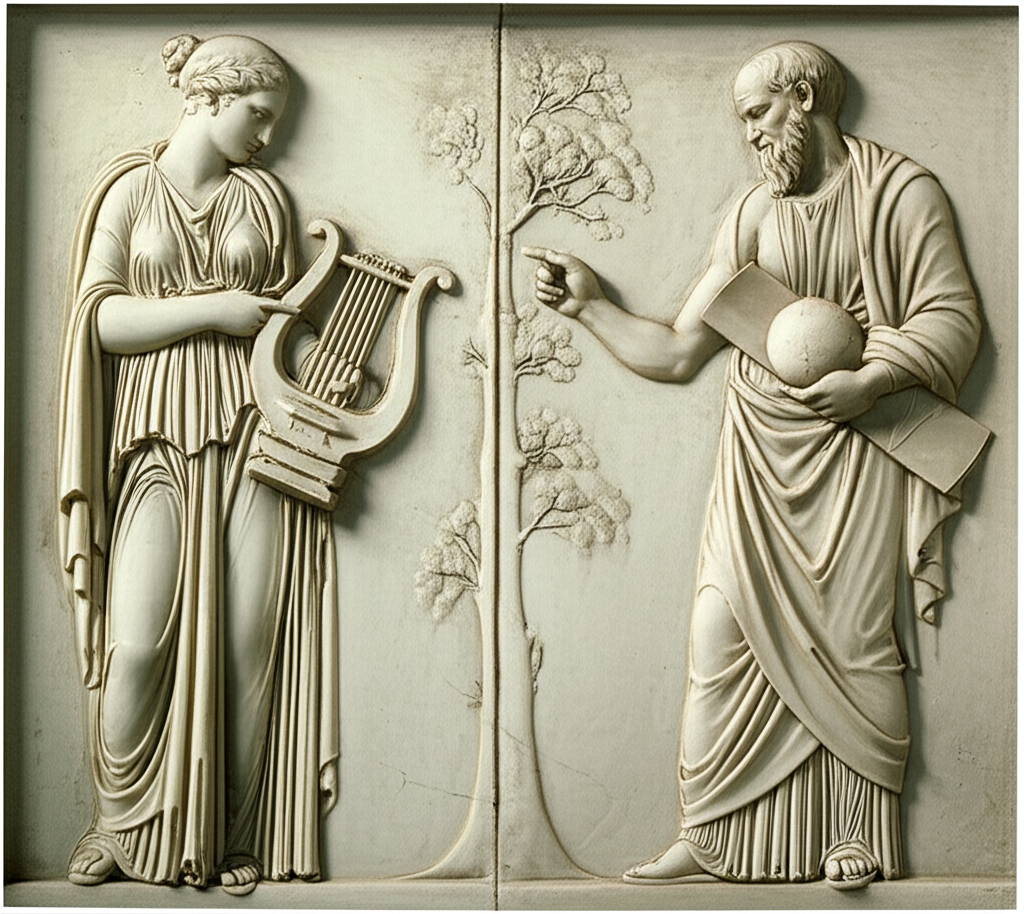
Historical Perspectives on the Distinction
Throughout history, as chronicled in works like the Great Books of the Western World, the lines between art and science were not always as sharply drawn as they are today. Ancient Greek philosophers, for instance, often saw little inherent contradiction between poetic insight and logical reasoning. Aristotle, a towering figure in both logic and biology, also wrote extensively on poetics, exploring the principles of dramatic art. Plato, while wary of art's imitative nature, deeply understood its power to shape perception and morality.
It was often through the Enlightenment and the subsequent rise of the scientific method that the distinction gained its modern clarity. Thinkers began to systematically separate the empirical study of nature from the subjective expression of human experience, leading to the specialized fields we recognize today.
The Interplay and Overlap: Where Boundaries Blur
Despite their fundamental distinction, art and science are not entirely separate universes. They frequently inform, inspire, and even merge with one another in fascinating ways. Scientific illustrations, for example, require immense artistic skill to accurately and beautifully convey complex biological structures. Architecture blends engineering (science) with aesthetic design (art). The imaginative leaps required to formulate a groundbreaking scientific hypothesis often mirror the creative process of an artist.
Moreover, both disciplines require immense creativity, rigorous discipline, and a profound sense of wonder. The beauty of a mathematical proof or the elegance of a scientific theory can evoke an aesthetic appreciation akin to that inspired by a masterpiece of art. Conversely, art can explore the ethical implications of scientific advancements or visualize complex scientific concepts in accessible ways.
Conclusion: Two Lenses, One World
The distinction between art and science is not one of superiority, but of methodology and focus. Art illuminates the depths of human experience, providing knowledge through empathy, interpretation, and emotional resonance. Science unravels the mechanics of the natural world, offering knowledge through observation, experimentation, and objective explanation. Together, these two magnificent human endeavors provide a comprehensive and multifaceted understanding of our existence, painting a rich and intricate portrait of the world we inhabit and the consciousness that perceives it. To truly grasp the breadth of human knowledge, we must embrace the insights offered by both the brushstroke and the equation.
📹 Related Video: What is Philosophy?
Video by: The School of Life
💡 Want different videos? Search YouTube for: ""The Two Cultures C.P. Snow Philosophy" and "Art vs Science Philosophical Debate""