

Bridging the Chasm: The Enduring Distinction Between Art and Science
The human endeavor to understand and interpret the world manifests in myriad forms, with art and science standing as two of its most profound expressions. While both are fundamental to human knowledge and progress, their core aims, methodologies, and the distinction in the knowledge they seek to impart are remarkably divergent. This article explores these fundamental differences, recognizing their unique contributions to our comprehensive understanding of reality and experience.
The Aims and Ends: Truth vs. Experience
At the heart of the distinction lies their ultimate purpose. Science, in its purest form, is a systematic pursuit of objective knowledge about the natural and physical world. Its goal is to uncover universal truths, establish verifiable facts, and formulate laws that describe and predict phenomena. It seeks to answer "how" and "why" through empirical evidence and logical deduction, striving for an understanding that is independent of individual perception.
Art, conversely, often delves into the realm of subjective experience, emotion, and interpretation. Its purpose is not necessarily to discover universal truths in the scientific sense, but rather to express, evoke, challenge, and connect. Art explores the human condition, beauty, meaning, and the infinite nuances of perception. It offers insights into the internal world, often communicating truths that are felt rather than measured, understood through empathy and imagination rather than empirical proof.
Science's Pursuit of Objective Truth
The scientific method is a rigorous framework designed to minimize bias and maximize objectivity. It relies on observation, hypothesis formulation, experimentation, data analysis, and peer review. The knowledge generated by science is cumulative; new discoveries build upon existing frameworks, refining our understanding of the cosmos, from the subatomic to the galactic. Think of the meticulous observations of Galileo, challenging existing dogma and laying the groundwork for modern physics, or the systematic classification efforts of Linnaeus, bringing order to the biological world.
Art's Realm of Subjective Experience
Art, whether through painting, sculpture, music, literature, or performance, aims to create an experience. It invites interpretation, provokes thought, and stirs emotion. The "truth" in art is often multifaceted and personal, resonating differently with each individual. A poignant poem, a breathtaking symphony, or a challenging abstract painting doesn't offer a quantifiable solution but rather a unique perspective, a moment of reflection, or an emotional catharsis. As explored in the Great Books of the Western World, from Homer's epics to Shakespeare's tragedies, art provides a lens through which humanity examines itself.
Methodologies and Modalities of Inquiry
The paths taken by artists and scientists to achieve their respective ends are as distinct as their goals.
The Scientific Method: Hypothesis, Experiment, Conclusion
The scientific process is characterized by its systematic, replicable, and often quantitative approach. It involves:
- Observation: Identifying a phenomenon or asking a question.
- Hypothesis: Proposing a testable explanation.
- Experimentation: Designing and conducting experiments to test the hypothesis, often involving controls and variables.
- Data Analysis: Interpreting results, often using statistical methods.
- Conclusion: Drawing inferences, refining or rejecting the hypothesis, and communicating findings.
This method prioritizes verifiability and falsifiability, ensuring that knowledge can be challenged and improved upon by the broader scientific community.
Artistic Creation: Intuition, Expression, Interpretation
Artistic creation, while often requiring discipline and skill, typically follows a less linear, more intuitive path. It involves:
- Inspiration: A spark of an idea, an emotion, or a concept.
- Expression: Translating that inspiration into a chosen medium, often through a process of trial and error, improvisation, and refinement.
- Interpretation: The audience's engagement with the artwork, bringing their own experiences and perspectives to derive meaning.
The artistic process is deeply personal and often resists strict categorization or replication in the scientific sense. The "truth" of an artwork lies in its impact and resonance, not its empirical proof.
Here's a table summarizing some key characteristics of the distinction:
| Feature | Science | Art |
|---|---|---|
| Primary Goal | Objective Truth, Universal Laws | Subjective Experience, Expression, Beauty |
| Methodology | Empirical, Logical, Replicable | Intuitive, Expressive, Interpretive |
| Focus | Natural World, Measurable Phenomena | Human Condition, Emotion, Aesthetics |
| Output | Theories, Laws, Data, Predictions | Creations, Performances, Narratives |
| Validation | Peer Review, Experimentation, Falsifiability | Critical Acclaim, Emotional Resonance, Cultural Impact |
| Nature of Knowledge | Factual, Predictive, Cumulative | Experiential, Evocative, Transformative |
The Nature of Knowledge: Episteme vs. Techne/Poiesis
Philosophers from antiquity have grappled with different forms of knowledge. Aristotle, for example, distinguished between episteme (scientific knowledge, demonstrable and universal), techne (skill-based knowledge, craft), and phronesis (practical wisdom). While modern science aligns strongly with episteme, art can be seen as encompassing elements of techne (the skill of creation) and poiesis (the act of bringing forth, creating something new).
Scientific Knowledge is built on a foundation of facts and theories that aim for universal applicability. It seeks to explain the world as it is. Artistic Knowledge, on the other hand, often reveals the world as it could be or as it feels. It provides insights not through empirical data, but through aesthetic experience, emotional connection, and imaginative engagement. Both are indispensable for a complete human understanding.
Historical Perspectives and Evolving Boundaries
Historically, the distinction between art and science was not always as sharply defined as it is today. In ancient Greece, philosophy encompassed both scientific inquiry and aesthetic contemplation. Figures like Plato, whose dialogues are seminal texts in the Great Books, often explored the nature of beauty alongside the pursuit of truth. During the Renaissance, polymaths like Leonardo da Vinci seamlessly blended artistic mastery with scientific investigation, viewing the human body and the natural world with both an artist's eye and a scientist's curiosity.
It was with the Enlightenment and the Scientific Revolution that the specialization of knowledge began to solidify, leading to the more distinct fields we recognize today. The emphasis on empirical evidence and methodical inquiry in science diverged from the more expressive and subjective pursuits of art.
Where the Streams Converge: The Overlap and Interplay
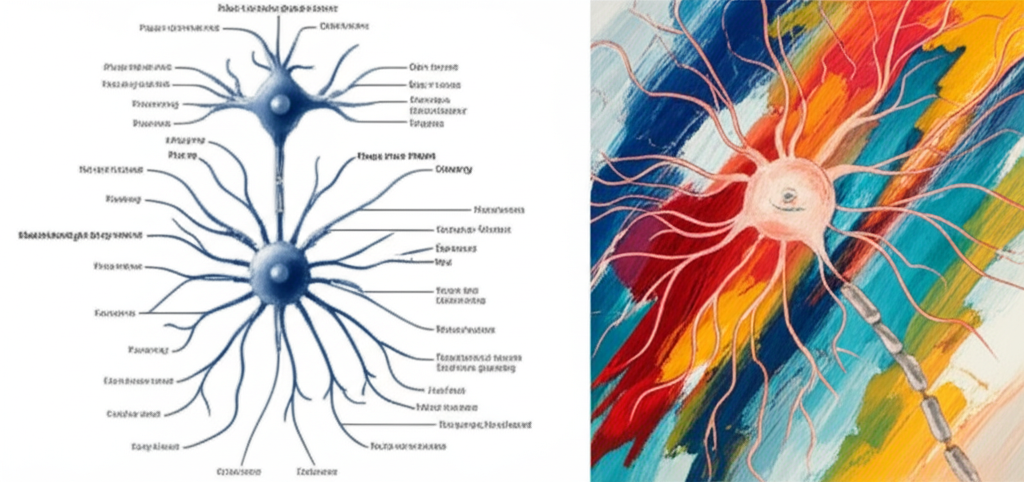
Despite their fundamental distinction, art and science are not entirely separate spheres; they often inform and enrich one another. Scientific illustration, for instance, requires artistic skill to accurately and beautifully depict biological structures. The aesthetic principles of design are crucial in engineering and architecture. Conversely, scientific discoveries have often inspired artistic movements, from the awe of astronomical phenomena influencing Romantic painting to quantum physics informing abstract art.
Both disciplines are driven by curiosity, creativity, and a desire to make sense of the world. They represent two complementary ways of knowing, each offering unique perspectives that contribute to the tapestry of human knowledge. The scientist seeks to explain the mechanism of a bird's flight; the artist seeks to capture the feeling of soaring. Both are valid, both are vital.
Conclusion
The distinction between art and science is not merely academic; it reflects two distinct yet equally powerful modes of human engagement with reality. Science offers us the tools to understand the world objectively, to predict and control, providing a foundation of verifiable knowledge. Art offers us the means to explore our subjective experience, to find meaning, beauty, and connection, enriching our internal world. Together, they form a comprehensive framework for understanding both the universe around us and the universe within us, proving that true wisdom lies in embracing both the measurable and the immeasurable.
📹 Related Video: What is Philosophy?
Video by: The School of Life
💡 Want different videos? Search YouTube for: ""The Art of Science vs The Science of Art" philosophy"
📹 Related Video: PLATO ON: The Allegory of the Cave
Video by: The School of Life
💡 Want different videos? Search YouTube for: ""Plato's Theory of Forms and Beauty" explained"