

The Enduring Distinction Between Art and Science: A Journey Through Knowledge
At its heart, the distinction between art and science lies in their fundamental approaches to understanding the world and generating knowledge. While both are profound human endeavors driven by curiosity and a desire to comprehend existence, science primarily seeks objective, verifiable truths through empirical observation and logical deduction, aiming for universal laws. Art, conversely, explores subjective experience, emotion, and interpretation, offering insights into the human condition through expression and aesthetic engagement. Despite their divergent methods, both disciplines ultimately enrich our collective knowledge and expand our perception of reality.
Unpacking the Foundational Divide
For centuries, thinkers from the Great Books of the Western World have grappled with the unique contributions of artistic and scientific pursuits. From Plato's exploration of Forms and mimesis to Aristotle's emphasis on empirical observation, the seeds of this distinction were sown early. Understanding this divide isn't about declaring one superior to the other, but rather appreciating their distinct yet complementary roles in the grand tapestry of human understanding.
Science: The Pursuit of Objective Truth
Science is characterized by its systematic methodology, aiming to uncover objective, verifiable truths about the natural world. Its core tenets include:
- Empirical Observation: Relying on data gathered through the senses or with instruments.
- Hypothesis Testing: Formulating testable predictions and subjecting them to rigorous experimentation.
- Logical Deduction and Induction: Drawing conclusions from premises and generalizing from specific observations.
- Falsifiability: The capacity for a theory or hypothesis to be proven wrong.
- Replicability: The ability for experiments to be repeated by others with similar results.
The knowledge derived from science seeks universality, aiming to explain phenomena in a way that is independent of individual perspective. Think of Isaac Newton's laws of motion, which provide a framework for understanding the physical universe, applicable regardless of who observes them. This pursuit of objective understanding has profoundly shaped our modern world, from medicine to technology.
Art: The Expression of Subjective Experience
In stark contrast, art delves into the realm of subjective experience, emotion, and interpretation. It is less concerned with universal laws and more with the individual's perception, the nuances of feeling, and the exploration of meaning. Key aspects of artistic endeavor include:
- Expression: Conveying emotions, ideas, or experiences through various mediums (painting, music, literature, dance).
- Interpretation: Engaging the audience in a personal understanding and response to the work.
- Aesthetics: Exploring beauty, harmony, and the principles that govern sensory perception.
- Symbolism and Metaphor: Using indirect representation to evoke deeper meanings.
- Exploration of the Human Condition: Reflecting on identity, morality, relationships, and existence.
From Shakespeare's profound explorations of human nature in Hamlet to the evocative power of a Beethoven symphony, art offers a form of knowledge that is experiential and often deeply personal. It provides insights not through empirical proof, but through empathy, reflection, and the expansion of our emotional and imaginative capacities.
Core Differences: A Comparative Look
To further clarify the distinction, let's examine some core differences between art and science:
| Feature | Art | Science |
|---|---|---|
| Primary Aim | Expression, interpretation, aesthetic experience | Explanation, prediction, objective truth |
| Methodology | Creation, intuition, subjective engagement | Observation, experimentation, logical analysis |
| Nature of Knowledge | Experiential, interpretive, personal insight | Empirical, verifiable, universal principles |
| Criterion of Success | Resonance, beauty, emotional impact, insight | Falsifiability, accuracy, consistency, utility |
| Focus | The particular, the individual, the unique | The general, the universal, the repeatable |
| Primary Value | Empathy, imagination, critical reflection | Accuracy, precision, predictive power |
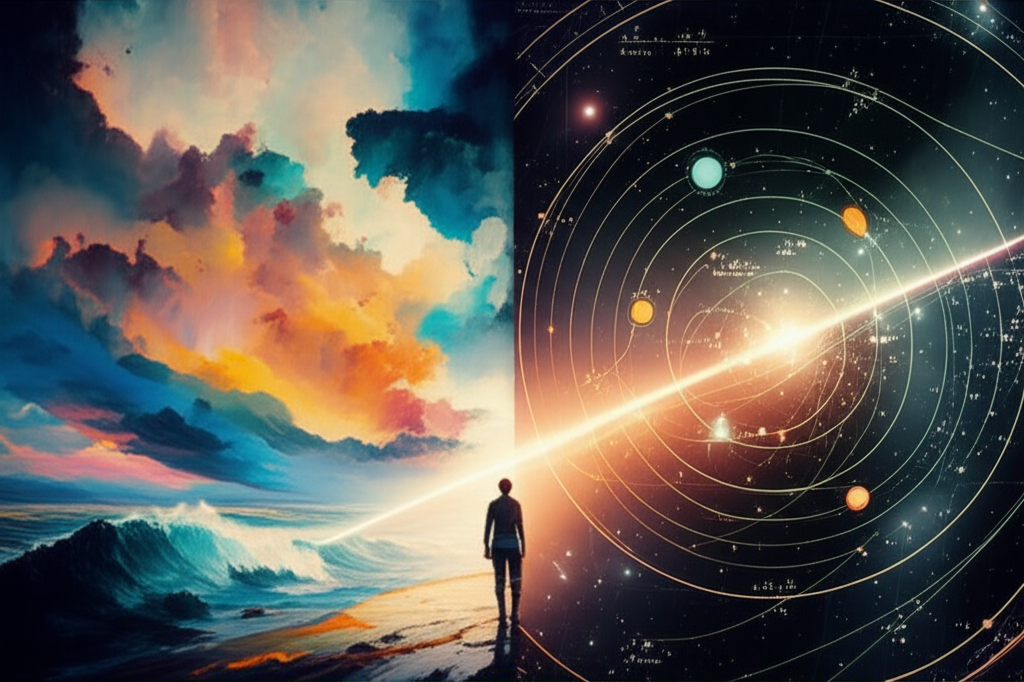
Beyond the Binary: Art, Science, and the Shared Quest for Knowledge
While the distinction between art and science is clear in their primary objectives and methodologies, it's crucial to acknowledge their profound interplay and shared contribution to human knowledge. Many great minds, such as Leonardo da Vinci—a painter, sculptor, architect, musician, scientist, inventor, and anatomist—embodied this synthesis. His anatomical drawings were both scientifically accurate and artistically masterful, demonstrating how keen observation (scientific) could inform and be expressed through aesthetic skill (artistic).
Both disciplines require creativity, curiosity, and rigorous dedication. Scientists often rely on intuition and imaginative leaps to formulate hypotheses, much like artists innovate new forms of expression. Artists, conversely, frequently employ scientific principles in their work, from understanding the chemistry of pigments to the physics of sound in music. Ultimately, both endeavors seek to illuminate the world around us and within us, offering different, yet equally vital, pathways to understanding and wisdom.
The human quest for knowledge is multifaceted. Science provides the framework of objective reality, allowing us to build, heal, and predict. Art offers the subjective lens, allowing us to feel, interpret, and connect. Together, they offer a complete, rich, and deeply human understanding of existence.
YouTube: "Plato's Theory of Art and Mimesis Explained"
YouTube: "The Scientific Method: Crash Course History of Science"
📹 Related Video: What is Philosophy?
Video by: The School of Life
💡 Want different videos? Search YouTube for: "The Distinction Between Art and Science philosophy"