

The Perennial Dance: Unpacking the Distinction Between Art and Science
Summary:
The distinction between art and science is a foundational topic in philosophy, prompting us to examine how humanity understands, interacts with, and transforms the world. While both disciplines are profound expressions of human creativity and a relentless pursuit of knowledge, they diverge significantly in their definition, methodologies, and ultimate aims. Science fundamentally seeks objective truth through empirical observation and logical deduction, striving for universal, verifiable laws. Art, conversely, often delves into subjective experience, emotion, and interpretation, offering unique perspectives and fostering understanding through aesthetic expression. This article explores these critical differences, acknowledging their occasional overlaps, to better appreciate the unique contributions each makes to our comprehensive grasp of reality.
The Quest for Understanding: Defining Art and Science
At the heart of the matter lies the very definition of what constitutes Art and what constitutes Science. These are not mere labels but frameworks that shape our perception and engagement.
-
Science: The Pursuit of Objective Truth
- Science, derived from the Latin scientia meaning "knowledge," is a systematic enterprise that builds and organizes knowledge in the form of testable explanations and predictions about the universe. Its primary goal is to uncover universal laws and principles that govern the natural world, operating under the assumption of an objective reality independent of human perception. Think of the rigorous logical structures explored by Aristotle or the systematic empirical inquiry championed by Bacon, foundational figures whose ideas resonate through the Great Books of the Western World.
- Key Characteristics of Science:
- Objectivity: Aims to eliminate personal bias.
- Empiricism: Relies on observable, measurable evidence.
- Falsifiability: Theories must be capable of being proven wrong.
- Universality: Seeks truths applicable across all contexts.
-
Art: The Expression of Subjective Experience
- Art, from the Latin ars (skill, craft), is a diverse range of human activities involving the creation of visual, auditory, or performing artifacts (artworks), expressing the author's imaginative or technical skill, intended to be appreciated for their beauty or emotional power. Unlike science, Art often embraces ambiguity, celebrates individuality, and seeks to evoke rather than explain. It's about expressing the ineffable, the beautiful, the sublime, or even the grotesque, often reflecting the human condition in ways that objective data cannot. Plato's discussions on mimesis and beauty, or Kant's exploration of aesthetic judgment, provide rich historical context for understanding art's philosophical underpinnings.
- Key Characteristics of Art:
- Subjectivity: Rooted in individual interpretation and experience.
- Expression: Conveys emotions, ideas, or beauty.
- Creativity: Emphasizes innovation and imagination.
- Interpretation: Open to multiple meanings and perspectives.
The Nature of Knowledge: Different Paths to Understanding
Both Art and Science are powerful conduits for knowledge, yet the kind of knowledge they impart and the methods by which they acquire it differ profoundly.
| Feature | Science | Art |
|---|---|---|
| Primary Goal | Explanation, Prediction, Control | Expression, Interpretation, Experience |
| Methodology | Scientific Method (observation, hypothesis, experiment) | Creative Process (inspiration, intuition, craft) |
| Type of Knowledge | Factual, Verifiable, Cumulative, Generalizable | Experiential, Emotive, Interpretive, Contextual |
| Validation | Peer review, replication, empirical evidence | Audience reception, critical discourse, cultural impact |
| Language | Mathematics, logical propositions | Metaphor, symbolism, form, narrative |
-
Scientific Knowledge: This form of knowledge is built brick by brick, verifiable through repeatable experiments and rigorous logical scrutiny. It aims for a cumulative understanding, where new discoveries build upon and refine existing theories. When a scientist publishes findings, the expectation is that another can replicate the experiment and achieve similar results, reinforcing the objective truth being sought.
-
Artistic Knowledge: Art offers a different kind of knowledge—one that is often deeply personal and experiential. A painting might reveal the anguish of a historical moment, a symphony might convey the depths of human joy, or a novel might illuminate the complexities of moral choice. This knowledge isn't about universal laws but about particular insights, emotional resonance, and shared human experience, often challenging our preconceived notions and expanding our empathy. It's knowledge gained through feeling, seeing, and interpreting, rather than measuring or calculating.
The Overlap and Intersections: Where Worlds Collide
Despite their fundamental distinctions, Art and Science are not entirely isolated. History is replete with examples of their interplay, demonstrating that the human mind often seeks to integrate different modes of understanding.
Consider the detailed anatomical drawings of Leonardo da Vinci, where artistic skill served scientific inquiry. Or the breathtaking images from the Hubble Space Telescope, which are both scientific data and objects of profound aesthetic beauty. The precision required in scientific illustration, the mathematical symmetries found in natural forms (like fractals), or the architectural marvels that blend engineering prowess with aesthetic vision—all point to areas where the two disciplines enrich each other.
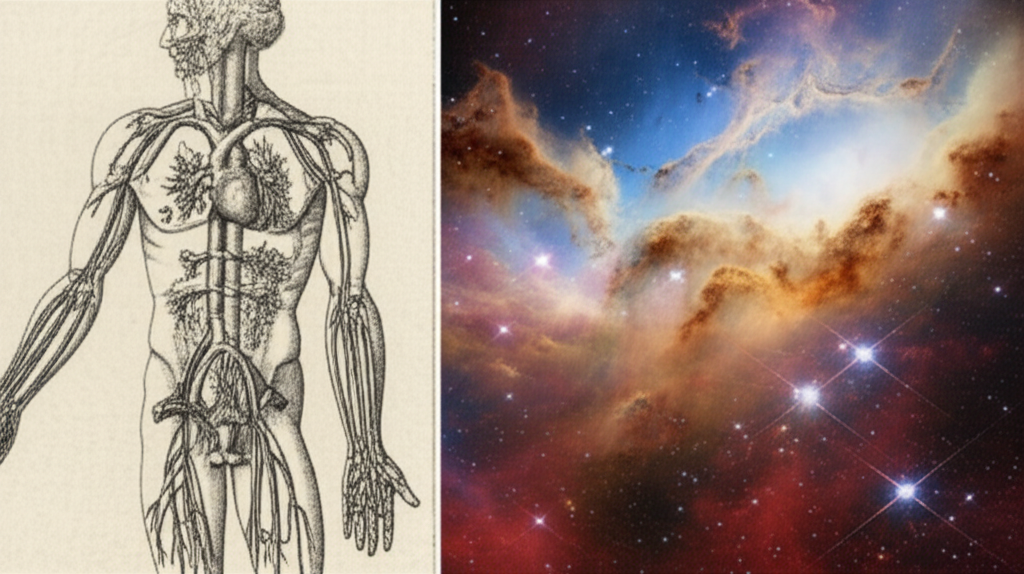
The philosophical discourse itself, as seen in the Great Books, often grapples with these convergences. From the ancient Greek integration of mathematics and music to the Enlightenment's faith in both reason and artistic expression, thinkers have long explored how these seemingly disparate realms contribute to a holistic human experience.
Why the Distinction Matters: Valuing Each Pursuit
Maintaining a clear definition of Art and Science is not about creating an insurmountable barrier, but about appreciating the unique and indispensable contributions each makes to human civilization.
- Science empowers us with predictive power, technological advancement, and a rational framework for understanding the physical universe. It helps us cure diseases, build bridges, and explore distant galaxies.
- Art enriches our inner lives, fosters empathy, challenges our perspectives, and provides meaning and beauty. It helps us understand ourselves, connect with others, and find solace or inspiration in a complex world.
Both are vital for a complete and flourishing society. One without the other leaves us either technically advanced but emotionally barren, or deeply expressive but practically vulnerable. The perennial dance between Art and Science is, in essence, the dance of humanity's full potential—reason and imagination, objective truth and subjective meaning, both striving for a deeper form of knowledge.
YouTube Video Suggestions:
-
📹 Related Video: PLATO ON: The Allegory of the Cave
Video by: The School of Life
💡 Want different videos? Search YouTube for: ""The Art of Science vs The Science of Art" TED Talk"
2. ## 📹 Related Video: KANT ON: What is Enlightenment?
Video by: The School of Life
💡 Want different videos? Search YouTube for: ""Neil deGrasse Tyson on Art and Science""


