

Unveiling the Nuances: The Philosophical Distinction Between Art and Poetry
A Concise Overview
While often intertwined in creative expression, the distinction between art and poetry is a fascinating philosophical inquiry, revealing fundamental differences in their definition, medium, and primary mode of engagement. At its core, art broadly encompasses any human endeavor that creates an aesthetic object or experience, utilizing diverse media from paint to sound. Poetry, conversely, is a specific form of literary art that primarily uses language, often with rhythm, meter, and evocative imagery, to convey ideas and emotions. Understanding this distinction allows for a richer appreciation of each form's unique power and purpose.
The Broader Canvas: Defining Art
The definition of art has been a subject of perennial debate among philosophers, from Plato's concept of mimesis to contemporary aesthetic theories. In its most expansive sense, art refers to the expression or application of human creative skill and imagination, typically in a visual form such as painting, sculpture, music, or architecture, producing works to be appreciated primarily for their beauty or emotional power.
- Art's Multifaceted Nature: Art can be tangible, like a marble statue, or intangible, like a performance piece. It can be functional, like a beautifully crafted piece of pottery, or purely aesthetic, like an abstract painting. The medium is incredibly diverse, ranging from pigments and clay to digital pixels and ephemeral light installations.
- Purpose and Perception: The purpose of art can vary widely: to provoke thought, evoke emotion, document reality, or simply create beauty. Its perception is often sensory, engaging our sight, hearing, or even touch, and its interpretation can be deeply personal, shaped by individual experience and cultural context.
The Crafted Word: Defining Poetry
When we turn to poetry, we narrow our focus considerably. Poetry is a literary art form where language is used for its aesthetic and evocative qualities in addition to, or in lieu of, its ostensible meaning. It is characterized by its reliance on specific linguistic structures, sound patterns, and rhetorical devices.
- The Essence of Poetic Language: Unlike prose, which aims for clarity and direct communication, poetry often thrives on ambiguity, metaphor, and symbolism. Its definition emphasizes the deliberate manipulation of words to create rhythm, rhyme, meter, and vivid imagery, aiming to compress meaning and intensify emotional impact.
- Forms and Functions: From epic narratives like Homer's Odyssey (a cornerstone of the Great Books of the Western World) to the concise haiku, poetry takes many forms. Its function is often to explore the human condition, express profound truths, or celebrate the beauty and complexity of existence through the unique power of the word.
Intersections and Divergences: Where Art and Poetry Meet and Part
While all poetry is a form of art, not all art is poetry. This crucial distinction is where the philosophical inquiry truly begins.
Table 1: Key Distinctions Between Art (General) and Poetry (Specific)
| Feature | General Art (e.g., Painting, Sculpture, Music) | Poetry (Specific Literary Art) |
|---|---|---|
| Primary Medium | Diverse (visual, auditory, tactile, digital – e.g., paint, stone, sound, light) | Language (words, sentences, stanzas) |
| Core Expression | Aesthetic object/experience; sensory engagement; emotional/intellectual provocation | Aesthetic arrangement of language; linguistic craft; compression of meaning; rhythmic/sonic qualities |
| Modality | Can be visual, auditory, performative, conceptual | Primarily linguistic and conceptual, often with auditory (sound of words) and visual (form on page) elements |
| Interpretation | Often relies on visual/auditory perception; can be immediate or contemplative | Requires linguistic decoding; often demands close reading of metaphor, symbolism, and syntax; contemplative and analytical |
| Scope | Vast, encompassing nearly all creative human endeavors beyond purely utilitarian functions | Specific subset of literary art; focused on the expressive potential of language |
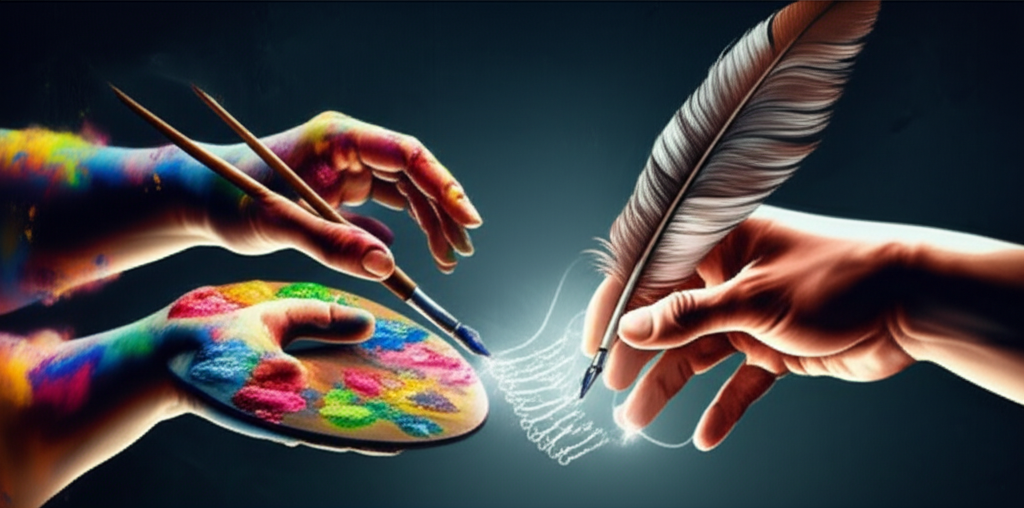
The Overlap: Both art and poetry share the fundamental goal of communicating human experience, emotion, and ideas in a heightened, aesthetic manner. Both require skill, imagination, and intention. A beautifully composed piece of music can be "poetic" in its structure and emotional resonance, just as a painting can tell a story with the evocative power of a verse.
The Divergence: The distinction becomes clear when we consider the primary vehicle. A painter uses color and form; a sculptor uses mass and space; a musician uses sound and silence. A poet, however, must use words. The constraints and possibilities of language define poetry in a way that the constraints of pigment or stone define painting or sculpture. This makes poetry a highly specialized form of art, one that grapples with the very tools of thought and communication.
Philosophical Echoes: Why This Distinction Matters
Philosophers from Aristotle, who discussed the nature of poetic imitation in Poetics, to later aestheticians have grappled with the categories of creative expression. Understanding the distinction between art and poetry is not merely an academic exercise; it enriches our understanding of human creativity itself. It allows us to:
- Appreciate Specific Craft: Recognize the unique mastery involved in manipulating language to achieve poetic effect, separate from the mastery of, say, sculpting marble.
- Refine Critical Analysis: Apply appropriate critical frameworks. We analyze a poem for its meter, rhyme, and metaphor in ways we wouldn't a landscape painting, though both might evoke similar feelings.
- Explore Medium-Specific Strengths: Understand what each form can do uniquely well. Poetry can articulate abstract ideas and complex emotions with a precision and conciseness often unmatched by other art forms, while visual art can convey immediate, non-verbal impressions.
The distinction between art and poetry, therefore, is not about creating a hierarchy, but about recognizing the diverse paths human creativity takes and the specific tools each path employs to illuminate the world around and within us.
📹 Related Video: ARISTOTLE ON: The Nicomachean Ethics
Video by: The School of Life
💡 Want different videos? Search YouTube for: ""Aristotle Poetics Explained Philosophy""
📹 Related Video: What is Philosophy?
Video by: The School of Life
💡 Want different videos? Search YouTube for: ""What is Art? Philosophy of Aesthetics Explained""