

The Distinction Between Art and Beauty: Unraveling the Aesthetic Knot
Often conflated, the concepts of Art and Beauty are distinct philosophical entities, each possessing its own definition and characteristics. While beauty is frequently considered a quality of an object or experience, eliciting a particular sensory or intellectual pleasure, art refers to the human act of creation, expression, and the resulting artifact. This article will explore these fundamental differences, clarifying why something can be art without being beautiful, and beautiful without being art. Understanding this distinction enriches our appreciation for both aesthetic experiences and creative endeavors.
Defining Our Terms: Art vs. Beauty
To navigate the nuanced landscape of aesthetics, we must first establish clear working definitions.
-
Beauty: Historically, Beauty has been conceived in various ways. For Plato, as explored in the Great Books of the Western World, beauty was an ideal Form, an intrinsic quality that objects partake in, leading to delight and admiration. Later, philosophers like Kant posited beauty as a subjective experience, a "disinterested pleasure" arising from a harmonious interplay of our cognitive faculties. In essence, beauty is an attribute, a perceived excellence, a sensory or intellectual resonance that evokes pleasure or admiration. It is often linked to harmony, proportion, truth, or a profound emotional impact.
-
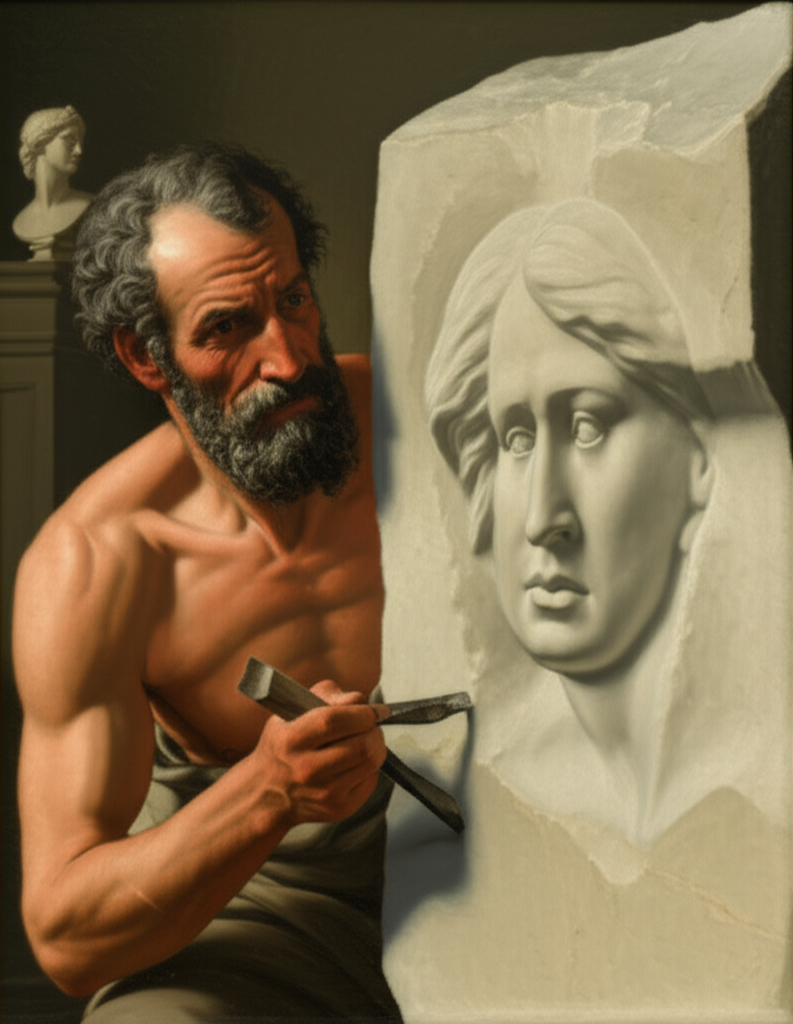
Art: In contrast, Art is fundamentally a human activity or the product of that activity. It is the conscious application of skill and creative imagination, typically in a visual, auditory, or performing medium, to express ideas, emotions, or to produce an aesthetic object. As Aristotle discussed in his Poetics (a cornerstone of the Great Books), art often involves mimesis – the imitation or representation of reality – but extends far beyond mere replication to encompass invention, transformation, and communication. Art is an intention, a process, and a resultant artifact.
Beauty: A Quality of Experience
Beauty is primarily a characteristic or a quality that we perceive in something. It can be found in nature, in human creations, or even in abstract concepts.
- Subjectivity vs. Objectivity: The debate over whether beauty is an objective quality inherent in things or a subjective response of the observer is ancient. While some argue for universal standards of beauty (e.g., mathematical proportions, symmetry), others emphasize the cultural and personal variability of aesthetic judgment. Regardless, when we speak of beauty, we are referring to an attribute that is experienced.
- Emotional and Intellectual Impact: A beautiful sunset, a perfectly composed piece of music, or a logically elegant proof can all evoke a sense of beauty. This experience often involves a feeling of pleasure, wonder, or contentment.
Art: The Human Act of Creation
Art, on the other hand, is an intentional human endeavor. It is not merely a quality but an action and its outcome.
- Purpose and Intent: An artwork is created with purpose, whether it's to express, to provoke, to document, to challenge, or simply to exist. The artist's intent is crucial to its definition as art.
- Skill and Craft: While not all art requires traditional craftsmanship, the concept of art often implies a level of skill, technique, or conceptual prowess in its execution.
- Expression and Communication: Art serves as a powerful medium for communication, allowing artists to convey complex ideas, emotions, and perspectives across time and culture.
The Interplay, Not the Identity
The confusion between art and beauty arises because much of what we consider Art aims for or achieves Beauty. However, the two are not synonymous.
Consider the following distinctions:
| Feature | Art | Beauty |
|---|---|---|
| Nature | A human endeavor, a creation, a process | A perceived quality, an attribute, an experience |
| Origin | Intentional human agency | Can be natural or human-made |
| Goal/Purpose | Expression, communication, provocation, etc. | Elicits pleasure, admiration, harmony |
| Requirement | Skill, concept, intention | Does not require human creation |
| Existence | An artifact, an event | A characteristic, a judgment |
An avant-garde sculpture made of industrial waste might be considered profound Art for its social commentary, despite being perceived as "ugly" by many. Conversely, a natural wonder like a rainbow is undoubtedly beautiful, but it is not Art because it lacks human intent and creation.
Conclusion: A Deeper Appreciation
Understanding the distinction between Art and Beauty is crucial for a richer engagement with both the world around us and the vast human creative legacy. While beauty often draws us in, it is the deeper philosophical definition of Art as an intentional human act that allows us to appreciate works that challenge, provoke, or even disturb us, recognizing their artistic merit beyond mere aesthetic pleasure. By separating these concepts, we open ourselves to a more nuanced and profound appreciation of human creativity and the diverse qualities that enrich our lives.
📹 Related Video: PLATO ON: The Allegory of the Cave
Video by: The School of Life
💡 Want different videos? Search YouTube for: ""Plato's Theory of Beauty Explained" and "What is Art? Philosophy of Aesthetics""


