

Unraveling the Threads: The Distinction Between Art and Beauty
At first glance, the concepts of Art and Beauty seem inextricably linked, almost synonymous. We often praise a work of Art for its Beauty, and find Beauty in things we might consider artistic. Yet, to truly understand the rich tapestry of human expression and aesthetic experience, it is crucial to recognize and articulate the fundamental distinction between these two profound concepts. While they frequently intersect and enrich one another, Art and Beauty are not interchangeable; one is often a human endeavor involving skill and intention, while the other is a perceived quality capable of evoking pleasure or awe, irrespective of its origin.
Defining Our Terms: What is Art?
Art, in its broadest definition, is primarily a human activity involving the imaginative or technical skill to create something. It is an intentional act of making, expressing, or communicating. From the ancient cave paintings of Lascaux to the intricate symphonies of Mozart, from the dramatic narratives of Shakespeare to the abstract canvases of Pollock, Art is characterized by:
- Human Agency: Art requires a creator, an artist, who imbues the work with purpose, meaning, or emotion.
- Skill and Craft: Whether through painting, sculpting, writing, composing, or performing, Art often demands a mastery of technique and a deep understanding of its chosen medium.
- Expression and Communication: Art serves as a vehicle for ideas, feelings, narratives, and critiques, transcending mere utility.
- Cultural Context: Art is invariably shaped by, and in turn shapes, the culture and historical period in which it is created.
The quality of an artwork is often judged by its originality, technical proficiency, emotional resonance, or intellectual depth. It is a testament to human ingenuity and our innate drive to make sense of, and add to, the world around us.
Defining Our Terms: What is Beauty?
Beauty, by contrast, is primarily a quality that evokes a pleasurable or appreciative response in the observer. It is often associated with harmony, proportion, balance, and a certain radiance that captivates the senses or the intellect. Unlike Art, Beauty does not inherently require human creation. Consider the following aspects of Beauty:
- Perceptual Experience: Beauty is fundamentally about how something is perceived and the effect it has on an individual.
- Subjectivity and Universality: While often deeply subjective ("Beauty is in the eye of the beholder"), there's also a recurring philosophical debate, stretching back to Plato and Kant, about whether certain forms of Beauty possess a universal appeal, perhaps hinting at objective truths or ideal forms.
- Natural Occurrence: A sunset, a pristine mountain range, the intricate pattern of a snowflake, or the elegant symmetry of a mathematical equation can all be profoundly beautiful without any human intervention.
- Emotional and Intellectual Resonance: Beauty can evoke feelings of joy, serenity, wonder, or even melancholic contemplation. It can also stimulate intellectual appreciation for complexity or perfection.
The quality of Beauty is often assessed by its capacity to move us, to inspire awe, or to simply provide aesthetic pleasure.
The Intertwined, Yet Separate, Nature
The core of the distinction lies in their origin and essence. Art is a verb, an action, a creation; Beauty is an adjective, a descriptor, a perceived attribute.
| Feature | Art | Beauty |
|---|---|---|
| Origin | Human creation, intention, skill | Natural occurrence or perceived quality |
| Essence | Expression, communication, making | Harmony, proportion, sensory pleasure |
| Requirement | An artist, a medium, a concept | An observer, a perceived attribute |
| Scope | Limited to human works | Applicable to both natural and artificial |
| Primary Goal | To express, provoke, interpret, create | To be perceived as pleasing or admirable |
While Art often strives for Beauty, it is not beholden to it. Many powerful artworks are intentionally unsettling, provocative, or even "ugly" in a conventional sense, yet they possess immense artistic quality and significance. Think of Picasso's Guernica, a devastating portrayal of war, or the raw emotionality of a blues lament; these works are profound Art without necessarily being "beautiful" in the traditional sense of pleasing aesthetics. Their quality derives from their truth, their impact, or their innovative form.
Conversely, something can be exquisitely beautiful without being considered Art. A perfectly formed rose, a clear night sky filled with stars, or the elegant solution to a complex scientific problem are all instances of Beauty that exist independently of human artistic endeavor.
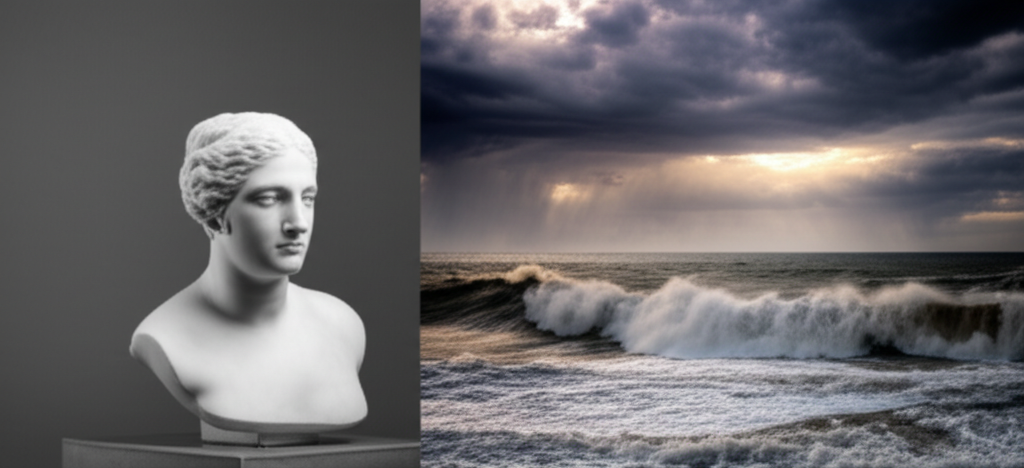
Philosophical Echoes from the Great Books
This distinction echoes through centuries of philosophical inquiry. From Plato's concept of Beauty as a transcendent Form, an ideal existing independently of the material world, to Aristotle's emphasis on mimesis (imitation) as the essence of Art, philosophers have wrestled with these concepts. Kant, in his Critique of Judgment, further explored the subjective nature of aesthetic judgment, arguing that while the judgment of Beauty is subjective, it carries with it a certain claim to universality, a "disinterested pleasure" that is distinct from merely agreeable sensations. Each perspective, in its own way, underscores that while Art can be a vessel for Beauty, and Beauty can inspire Art, they remain distinct categories of experience and creation. The quality of one does not automatically confer the quality of the other.
Conclusion
Understanding the distinction between Art and Beauty enriches our appreciation for both. It allows us to recognize the skillful intention behind a challenging artwork, even if it doesn't conform to traditional notions of Beauty. It also permits us to marvel at the inherent quality of Beauty found in the natural world, untainted by human design. Art is a testament to human creativity and spirit; Beauty is a fundamental aspect of existence that resonates with our senses and souls. While they dance together in a perpetual waltz, each maintains its unique identity, offering distinct paths to wonder and understanding.
📹 Related Video: PLATO ON: The Allegory of the Cave
Video by: The School of Life
💡 Want different videos? Search YouTube for: ""Plato's Theory of Beauty and the Forms explained""
📹 Related Video: KANT ON: What is Enlightenment?
Video by: The School of Life
💡 Want different videos? Search YouTube for: ""Kant's Aesthetics: The Judgment of Beauty""


