

The Canvas and the Gaze: Untangling Art and Beauty
Summary: While often conflated, art and beauty are distinct concepts in philosophy. Art refers to the intentional human creation, expression, or skilled production, often driven by concept or emotion. Beauty, conversely, is primarily a perceived quality, an experience of pleasure, harmony, or aesthetic satisfaction that can arise from anything, whether natural or man-made, and is often subjective. Understanding this distinction enriches our appreciation for both the creative act and the aesthetic experience, revealing that while art can be beautiful, beauty is not a prerequisite for art, nor is art the sole domain of beauty.
More Than Meets the Eye: Unpacking Art and Beauty
It's a common, almost instinctual, leap. We see a breathtaking painting, a masterful sculpture, or a poignant piece of music, and our immediate reaction is often, "That is beautiful!" And indeed, much of what we consider art strives for, or achieves, beauty. Yet, to equate the two is to miss a crucial philosophical nuance, one that has occupied thinkers from Plato to Kant and beyond, echoing through the very pages of the Great Books of the Western World. As curious minds on planksip.org, let's untangle this knot and explore why distinguishing between art and beauty is not just an academic exercise, but a pathway to a deeper understanding of human creativity and aesthetic experience.
Defining Our Terms: The Elusive Nature of Art
What, precisely, is art? This question, deceptively simple, has no singular, universally accepted definition. Historically, the term "art" (from the Latin ars) initially encompassed any human skill or craft, from shoemaking to rhetoric. Over centuries, particularly since the Enlightenment, its definition narrowed to what we now call the "fine arts" – painting, sculpture, music, poetry, dance – emphasizing expression, aesthetics, and conceptual depth over mere utility.
- Intentionality: A key quality of art is its intentional creation by a human agent. It is a product of will, skill, and often, a conceptual framework.
- Expression: Art often serves as a vehicle for ideas, emotions, or social commentary. It communicates.
- Context: What is considered art is also heavily influenced by cultural and historical context. A urinal might be art in one context (Duchamp's Fountain), but not in another.
Ultimately, art is about the act of creation, the object created, and the context in which it exists, challenging us to engage intellectually and emotionally. Its quality is often judged by its originality, execution, impact, and conceptual depth.
Defining Our Terms: The Subjectivity and Objectivity of Beauty
Unlike art, beauty is less about creation and more about perception and effect. From ancient Greek philosophers like Plato, who saw Beauty as an objective Form, to Enlightenment thinkers like Kant, who explored its subjective yet universal appeal, the definition of beauty has been a perennial philosophical quest.
- Perception: Beauty is primarily an experience. It is what we perceive, feel, or judge as aesthetically pleasing, harmonious, or sublime.
- Affective Response: It evokes an emotional response, often one of pleasure, admiration, or wonder.
- Sources: Beauty can be found everywhere: in a sunset, a mathematical equation, a human face, a piece of music, or indeed, a work of art. It is not confined to human creation.
- Quality: The quality of beauty often lies in its perceived order, symmetry, proportion, vibrant color, or emotional resonance. However, what one finds beautiful, another might not, highlighting its subjective component.
| Aspect | Art | Beauty |
|---|---|---|
| Origin | Human creation; intentional act | Perceived quality; can be natural or artificial |
| Nature | A noun (a thing, a practice) | An adjective (a characteristic) |
| Purpose | Expression, communication, exploration | To evoke pleasure, admiration, harmony |
| Necessity | Does not have to be beautiful | Does not have to be art |
| Judgment | Based on concept, skill, impact | Based on sensory and emotional response |
The Crucial Divide: Where Art and Beauty Diverge
The fundamental distinction lies in their very essence. Art is an act of making, a product of human agency. Beauty is a quality that can be perceived in an object or experience.
Consider a stark, challenging piece of conceptual art – perhaps a pile of bricks arranged in a gallery. Is it art? Yes, by the artist's intention and the context provided by the institution. Is it beautiful? Not in the traditional sense for most viewers. Its quality as art might lie in its ability to provoke thought, question assumptions, or comment on societal structures, rather than its aesthetic appeal.
Conversely, think of a magnificent, untouched mountain range. It is undeniably beautiful, evoking awe and wonder. But is it art? No. It lacks human intentionality and creation. Its beauty is inherent (or perceived as such) in its natural form and scale.
This distinction allows us to appreciate the quality of a piece of art even if we don't find it beautiful, recognizing its conceptual depth, technical skill, or historical significance. Similarly, we can marvel at natural beauty without needing to categorize it as a human creation.
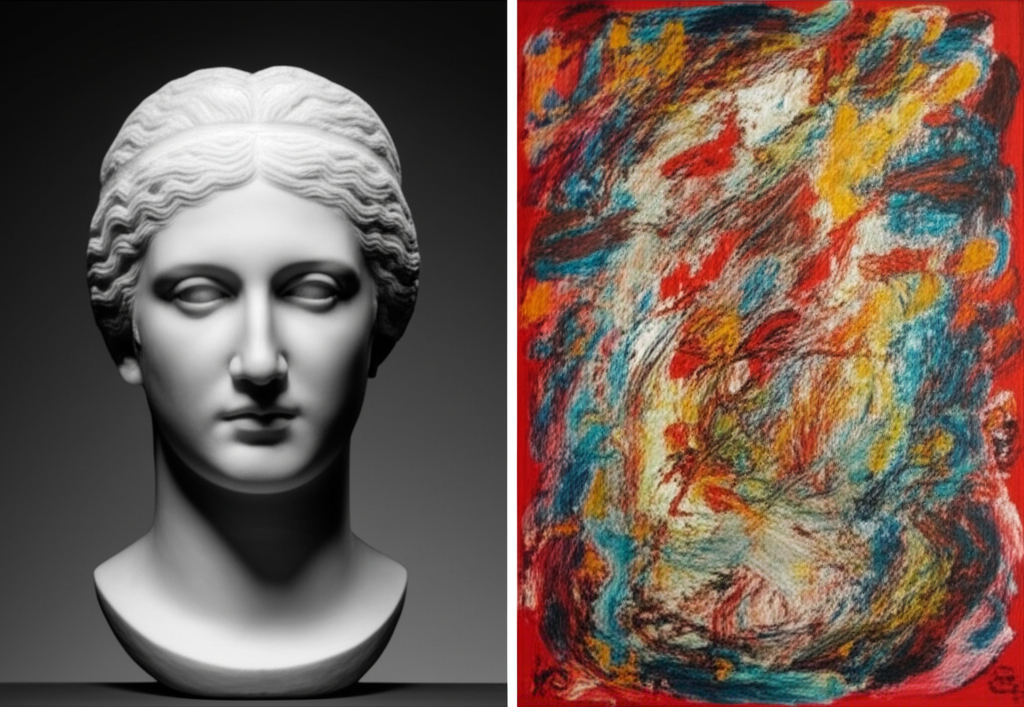
The Intersections: When Art Embraces or Rejects Beauty
Of course, art and beauty often intertwine. Many artists throughout history have striven to create beautiful objects, believing that aesthetic pleasure is a high aim of their craft. From Renaissance masters to Romantic composers, the pursuit of harmonious forms, evocative melodies, and pleasing compositions has been central. In these cases, beauty becomes a quality that art possesses, enhancing its impact and appeal.
However, the 20th century, in particular, saw many artistic movements deliberately challenging the traditional association of art with beauty. Dadaism, Surrealism, Abstract Expressionism, and Conceptual Art often prioritized shock, intellectual provocation, or raw emotional expression over conventional aesthetic appeal. Here, the quality of the art lies in its ability to disrupt, question, or innovate, demonstrating that art has a broader palette of purposes than merely being beautiful.
Beyond the Aesthetic: The Philosophical Implications
Understanding this distinction is vital for a comprehensive philosophical approach to aesthetics. It allows us to ask more precise questions: What makes this art? What makes this beautiful? How does the art's intention relate to its perceived quality? Does the absence of beauty diminish the quality of art?
By separating these concepts, we gain a richer framework for analyzing both the creative impulse and our responses to the world around us. It empowers us to appreciate the conceptual richness of a challenging artwork, the technical mastery of an unappealing sculpture, and the profound beauty of a natural landscape, without forcing them into a single, restrictive mold.
Conclusion: A Richer Appreciation
The distinction between art and beauty is not a semantic quibble but a fundamental philosophical insight. Art is the human endeavor of creation and expression, while beauty is a perceived quality that can inspire pleasure and admiration. While they frequently coexist and enrich one another, they are not co-dependent. Embracing this difference allows us to engage with both the man-made and the natural world with greater discernment, fostering a more nuanced and profound appreciation for the myriad ways in which they challenge, delight, and provoke us.
YouTube: "What is Art Philosophy"
YouTube: "The Philosophy of Beauty and Aesthetics"
📹 Related Video: What is Philosophy?
Video by: The School of Life
💡 Want different videos? Search YouTube for: "The Distinction Between Art and Beauty philosophy"


