

The Distinction Between Aristocracy and Monarchy
Political philosophy, from its earliest Greek origins, has grappled with the fundamental question of who should rule and how that rule should be exercised. Among the myriad forms of governance explored in the Great Books of the Western World, two terms frequently arise: aristocracy and monarchy. While both represent forms of non-democratic rule, their underlying principles, justifications, and potential outcomes are distinct. This article aims to clarify these differences, delving into their classical definitions and highlighting why these distinctions remain pertinent in understanding the evolution of political thought. In essence, monarchy signifies rule by a single individual, often by birthright, while aristocracy denotes rule by a select few deemed "the best" based on virtue, intellect, or merit.
Monarchy: The Enduring Rule of One
At its most fundamental, monarchy is a system of government where supreme authority is vested in a single individual, the monarch. This position is typically held for life or until abdication and is often hereditary, passing down through a royal lineage.
- Defining Characteristics:
- Single Ruler: Power is concentrated in one person.
- Hereditary Succession: The most common form, where the ruler's child inherits the throne.
- Divine Right (Historically): Many monarchies claimed their authority was granted by a higher power.
- Personal Rule: The monarch's will often dictates policy, though sometimes advised by councils.
Classical thinkers like Aristotle, in his Politics, categorized monarchy as one of the "true" forms of government when the single ruler governs for the common good. However, he also noted its corrupt form: tyranny, where the monarch rules solely for personal gain and self-interest. The idea of the "philosopher-king" in Plato's Republic, while advocating for a singular, wise ruler, represents an idealized form of monarchy guided by reason and virtue, far removed from the more common hereditary or despotic forms.
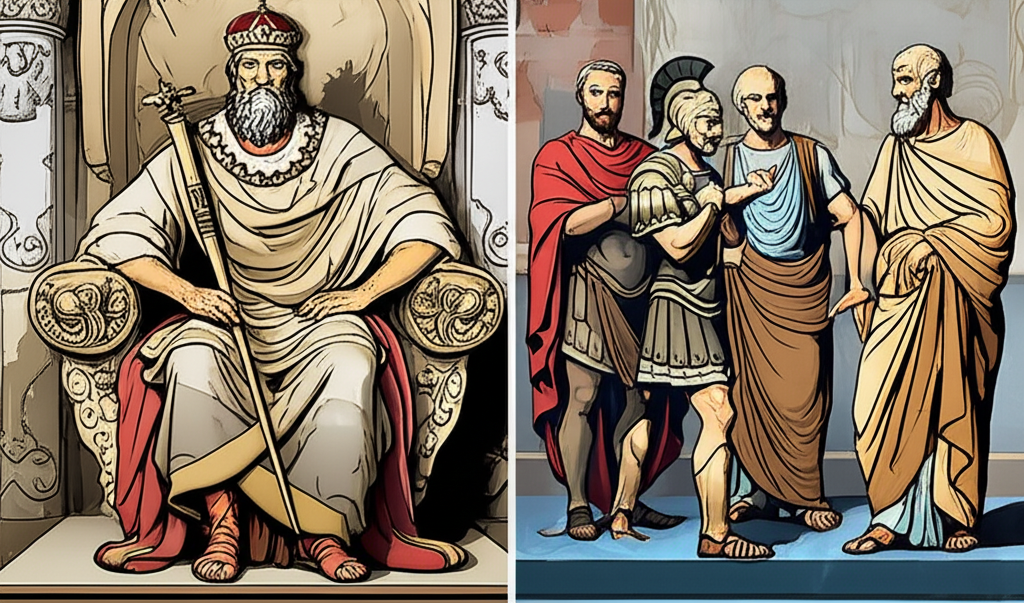
Aristocracy: The Rule of the Best
The term aristocracy derives from the Greek aristoi (meaning "the best") and kratos (meaning "power" or "rule"). Thus, in its original and ideal definition, aristocracy refers to government by a small group of individuals deemed "the best" – whether in terms of wisdom, virtue, military prowess, or noble birth.
- Defining Characteristics:
- Rule by a Select Few: Power resides with a minority, not a single individual.
- Merit-Based (Ideally): Rulers are chosen or emerge based on perceived excellence or superior qualities.
- Focus on the Common Good: The "best" are presumed to govern for the benefit of all citizens, not just their own class.
- Non-Hereditary (Ideally): While often associated with noble families, the philosophical ideal of aristocracy emphasizes merit over birth.
Plato's vision of the Guardians in The Republic is perhaps the quintessential example of an idealized aristocracy. These rulers, trained from childhood in philosophy and statecraft, possess the wisdom and selflessness to govern justly. Aristotle also viewed aristocracy as a "true" form of government when the virtuous few rule for the good of the entire community. Its corrupted form, oligarchy, arises when the few rule for their own selfish interests, often based on wealth rather than genuine merit.
Drawing the Lines: A Comparative Analysis
To further solidify the distinction between aristocracy and monarchy, let's examine their core differences:
| Feature | Monarchy | Aristocracy |
|---|---|---|
| Number of Rulers | One (a king, queen, emperor) | A select few (the "best") |
| Basis of Authority | Often hereditary, divine right, conquest | Merit, virtue, wisdom, nobility (ideally) |
| Succession | Typically hereditary | Selection based on qualification, election, or inherited status (less ideally) |
| Focus of Rule | Personal will, dynastic interest (can be for common good in ideal form) | Common good, justice, societal well-being (ideally) |
| Corrupted Form | Tyranny (rule for self-interest) | Oligarchy (rule by the wealthy few for self-interest) |
| Key Principle | Unity of command, stability of lineage | Excellence, wisdom, collective virtue |
The Slippery Slope: From Ideal to Corruption
Both aristocracy and monarchy, in their ideal forms, were considered by classical philosophers to be potentially beneficial governments for the state. A benevolent monarch could provide strong, unified leadership, ensuring stability and swift decision-making. An aristocratic council of the wise and virtuous could deliberate thoughtfully, bringing diverse talents and perspectives to governance, ensuring the common good.
However, the path from ideal to corruption is a recurring theme in political philosophy. A monarch can easily devolve into a tyrant, wielding absolute power without accountability, leading to oppression and injustice. Similarly, an aristocracy, intended to be rule by the best, can quickly transform into an oligarchy – rule by the few for their own selfish ends, often exploiting the populace based on wealth, birthright, or privilege rather than genuine merit. This degeneration highlights the fragility of ideal government forms when unchecked human nature and self-interest prevail.
Echoes in Modern Governance
While pure monarchies are now largely constitutional or ceremonial, and overt aristocracies are rare, the philosophical distinction between aristocracy and monarchy continues to resonate. Debates about the role of expert leadership (a form of meritocratic aristocracy), the dangers of concentrated power (monarchical tendencies), and the balance between individual authority and collective wisdom are perennial. Understanding these ancient classifications, drawn from the wellspring of the Great Books, provides a crucial framework for analyzing contemporary political structures and the enduring challenges of good government.
YouTube Video Suggestions:
-
📹 Related Video: ARISTOTLE ON: The Nicomachean Ethics
Video by: The School of Life
💡 Want different videos? Search YouTube for: "Aristotle Politics Monarchy Aristocracy Oligarchy"
2. ## 📹 Related Video: PLATO ON: The Allegory of the Cave
Video by: The School of Life
💡 Want different videos? Search YouTube for: "Plato Republic Philosopher King Guardians Explained"