

The Enduring Chasm: Unpacking the Distinction Between Animal and Man
A Philosophical Journey Through Our Unique Nature
From the earliest stirrings of human consciousness, the question of what sets us apart from the beasts of the field has captivated the greatest minds. This article delves into the profound philosophical distinction between animal and man, exploring the core attributes that define each, and why this age-old inquiry remains crucial to understanding our place in nature. Drawing from the rich tapestry of the Great Books of the Western World, we will navigate the realms of instinct, reason, morality, and self-awareness to illuminate the enduring chasm that separates humanity from the rest of the animal kingdom.
The Foundations of Difference: A Summary
At its core, the philosophical distinction between animal and man rests on the human capacity for reason, self-awareness, moral agency, and the creation of complex culture. While animals operate primarily on instinct, sensation, and immediate environmental stimuli, humans possess the unique ability to reflect, abstract, question, and transcend their immediate biological imperatives. This faculty, often termed the rational soul or mind, empowers us to seek meaning, establish ethical frameworks, and shape our environment in ways far beyond mere survival.
The Animal Realm: Sensation, Instinct, and Immediate Nature
To understand man, we must first understand the animal. In the philosophical tradition, animals are often characterized by their remarkable adaptability, keen senses, and sophisticated instinctual behaviors.
- Sensation and Perception: Animals navigate the world through their senses – sight, sound, smell, touch, taste. As Aristotle elaborates in De Anima, the sensitive soul allows for perception, pleasure, pain, and locomotion. An animal knows its environment directly through its sensory input.
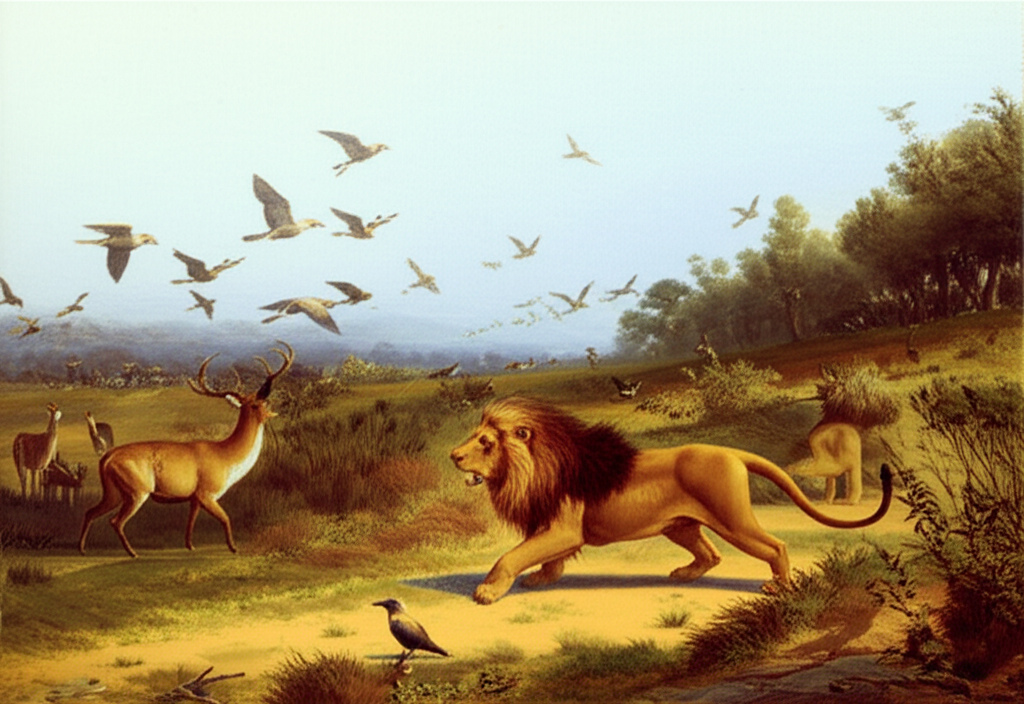
- Instinct and Drive: Animal behavior is largely governed by innate, unlearned patterns essential for survival and reproduction. The deer flees from danger, the bird builds its nest, the wolf hunts in packs – these actions are deeply embedded in their nature.
- Absence of Abstract Thought: While animals can learn through conditioning and exhibit problem-solving skills, there is little evidence of abstract reasoning, self-reflection, or the contemplation of universal truths. Their world is concrete, immediate, and bound by the present moment.
The Human Condition: Reason, Morality, and the Ascent of Man
The distinguishing features of man are multifaceted, extending beyond mere biological complexity to encompass profound cognitive and ethical dimensions.
Key Attributes of Humanity:
-
Reason (Logos):
- Abstract Thought: The ability to form concepts, understand principles, engage in logic, and contemplate ideas independent of sensory experience. Plato's Forms and Aristotle's metaphysics are products of this faculty.
- Language: Not merely communication, but a system of symbols and grammar that allows for the articulation of complex ideas, history, and foresight.
- Self-Reflection: The capacity to turn inward, examine one's own thoughts, emotions, and motivations. This leads to self-awareness and the pursuit of self-knowledge.
-
Moral Agency:
- Conscience: The inner voice that distinguishes right from wrong.
- Free Will: The ability to choose between alternative courses of action, often in defiance of instinct, and to be held accountable for those choices. This is central to Kant's ethics.
- Ethical Systems: The development of laws, moral codes, and justice systems, as explored in Aristotle's Nicomachean Ethics and Plato's Republic.
-
Culture and Creativity:
- Art and Aesthetics: The creation of beauty for its own sake, transcending utility.
- Philosophy and Science: The systematic pursuit of knowledge and understanding about the universe and our place within it.
- Technology: The deliberate modification of nature to suit human purposes, far beyond simple tool use.
-
The Search for Meaning:
- Unlike animals, humans grapple with existential questions: Why are we here? What is the purpose of life? What happens after death? This drive is uniquely human.
A Comparative Glance: Animal vs. Man
| Feature | Animal | Man |
|---|---|---|
| Primary Driver | Instinct, Sensation, Survival | Reason, Morality, Meaning, Self-actualization |
| Cognition | Concrete, Associative, Present-focused | Abstract, Logical, Reflective, Past & Future-oriented |
| Communication | Signals, Cries, Body Language | Complex Symbolic Language, Grammar, Written Word |
| Tool Use | Instinctive, Simple, Limited Adaptation | Deliberate, Complex, Progressive, Transformative |
| Moral Agency | Operates on biological imperative | Possesses Conscience, Free Will, Creates Ethical Systems |
| Self-Awareness | Limited, if any (recognition) | Profound, Reflective, Self-critical, Conscious of Mortality |
| Relationship to Nature | Part of Nature, Subject to its Laws | Seeks to Understand, Control, and Transcend Nature |
| Culture | Limited learned behaviors | Complex, Cumulative, Transmissible, Evolves through generations |
Navigating the Nuances: Blurring Lines and Affirming Distinction
Modern scientific advancements, particularly in ethology and cognitive science, have revealed astonishing capabilities in certain animal species – tool use, complex communication, even rudimentary empathy. These discoveries have, for some, blurred the traditional philosophical lines.
However, the philosophical distinction remains robust when focusing on the qualitative leap rather than mere quantitative similarities. While a chimpanzee may use a stick to extract termites, it does not invent the wheel, build cities, write symphonies, or ponder the infinite. The nature of human reason allows not just for problem-solving within given constraints, but for the creation of new constraints, new worlds of thought, and new moral obligations.
The Great Books consistently highlight that man is the rational animal, the political animal, the meaning-making animal. Our capacity for self-legislation, for living not just by natural law but by laws we freely create, for pursuing truth and beauty for their own sake, marks a profound departure from the animal realm. It is this capacity that burdens us with responsibility, but also elevates us to a unique position within the cosmic order.
Conclusion: The Enduring Significance of Our Humanity
The distinction between animal and man is not a mere academic exercise; it is fundamental to how we define ourselves, our responsibilities, and our potential. It underpins our understanding of ethics, law, art, and philosophy itself. While we share a biological heritage with the animal kingdom, our capacity for reason, self-awareness, moral choice, and the creation of culture sets us on a path uniquely our own. This profound distinction continues to challenge us, reminding us of the immense power and responsibility that comes with being human in the vast tapestry of nature.
Further Exploration
📹 Related Video: ARISTOTLE ON: The Nicomachean Ethics
Video by: The School of Life
💡 Want different videos? Search YouTube for: ""Aristotle De Anima explained""
📹 Related Video: PLATO ON: The Allegory of the Cave
Video by: The School of Life
💡 Want different videos? Search YouTube for: ""Plato's Republic summary and analysis""