

Beyond Instinct: The Enduring Philosophical Distinction Between Animal and Man
The question of what truly separates man from animal is not merely a biological inquiry but a philosophical cornerstone that has shaped our understanding of consciousness, morality, and our place in nature. From the ancient Greeks to contemporary thought, thinkers have grappled with this profound distinction, seeking to delineate the unique attributes that elevate human existence beyond mere instinctual survival. This article delves into the core arguments and perennial challenges in defining humanity, drawing from the rich tapestry of the Great Books of the Western World, to explore what makes us uniquely human.
The Genesis of the Distinction: From Aristotle to Modernity
The philosophical journey to understand the distinction between animal and man begins arguably with Aristotle, who famously defined man as a "rational animal." This simple phrase, found in his Politics and Nicomachean Ethics, encapsulates centuries of subsequent debate. For Aristotle, while humans share biological needs and sensory experiences with other animals, our capacity for logos—reason, speech, and moral deliberation—sets us apart. This intellectual inheritance profoundly influenced subsequent Western thought, from Augustine's exploration of the soul in Confessions to Aquinas's synthesis of faith and reason in the Summa Theologica, both of whom saw a divine spark or unique rational faculty distinguishing humanity.
The Enlightenment further refined this discussion, with thinkers like Descartes emphasizing the mind-body split, positing that animals were mere automata driven by mechanical processes, while man possessed a non-physical, thinking substance. Kant, in his ethical philosophy, highlighted man's capacity for moral law, acting not merely from inclination but from duty, a concept utterly alien to the animal kingdom. This historical progression reveals a continuous effort to pinpoint the precise faculty or combination of faculties that mark the human distinction.
Key Philosophical Differentiators
While the lines can often blur in scientific observation, philosophy has consistently pointed to several key areas where the distinction between animal and man becomes most pronounced.
1. Reason and Rationality: The Power of Logos
Perhaps the most enduring distinction is man's capacity for abstract thought, logical reasoning, and complex problem-solving. Unlike animals, whose intelligence often manifests as instinctual adaptation or learned behavior within specific environmental contexts, humans can conceive of universals, develop intricate philosophical systems, and engage in scientific inquiry that transcends immediate sensory data. We don't just react to nature; we seek to understand its underlying principles.
2. Language and Symbolic Thought: Beyond Communication
While many animals communicate with remarkable complexity, human language operates on a fundamentally different level. It is not merely a system of signals but a symbolic edifice capable of conveying abstract ideas, hypothetical scenarios, and complex narratives. This capacity for symbolic thought allows for the transmission of culture, the development of history, and the shared construction of meaning, as explored by thinkers from Plato (in his Cratylus) to Ludwig Wittgenstein (in his Philosophical Investigations), who saw language as intrinsic to human form of life.
3. Morality and Ethics: The Conscience of Man
The ability to formulate ethical systems, to deliberate on right and wrong, and to hold oneself accountable to moral principles is a uniquely human endeavor. While animals exhibit empathy or altruistic behaviors, these are often rooted in genetic predisposition or social bonding. Man, however, can conceive of universal justice, sacrifice personal gain for abstract ideals, and experience guilt or remorse for actions that violate self-imposed moral codes. This moral compass, for many philosophers, is the ultimate mark of the human spirit.
4. Self-Consciousness and Metacognition: The Reflective Mind
Man possesses a profound capacity for self-awareness—not just being aware, but being aware of being aware. This metacognitive ability allows us to reflect on our own thoughts, emotions, and existence, leading to existential questions about purpose, meaning, and mortality. This internal world of reflection and introspection, vividly explored in works like Montaigne's Essays or Pascal's Pensées, seems to be a realm largely inaccessible to the animal kingdom.
5. Culture, Art, and Technology: Shaping Our World
Humans don't merely adapt to nature; we transform it. Our capacity to create complex cultures, produce art that transcends utility, and develop technologies that reshape our environment is unparalleled. From the construction of elaborate societies to the creation of symphonies and philosophical treatises, these endeavors are testaments to a uniquely human drive to create, innovate, and leave a lasting mark beyond the dictates of biological survival.
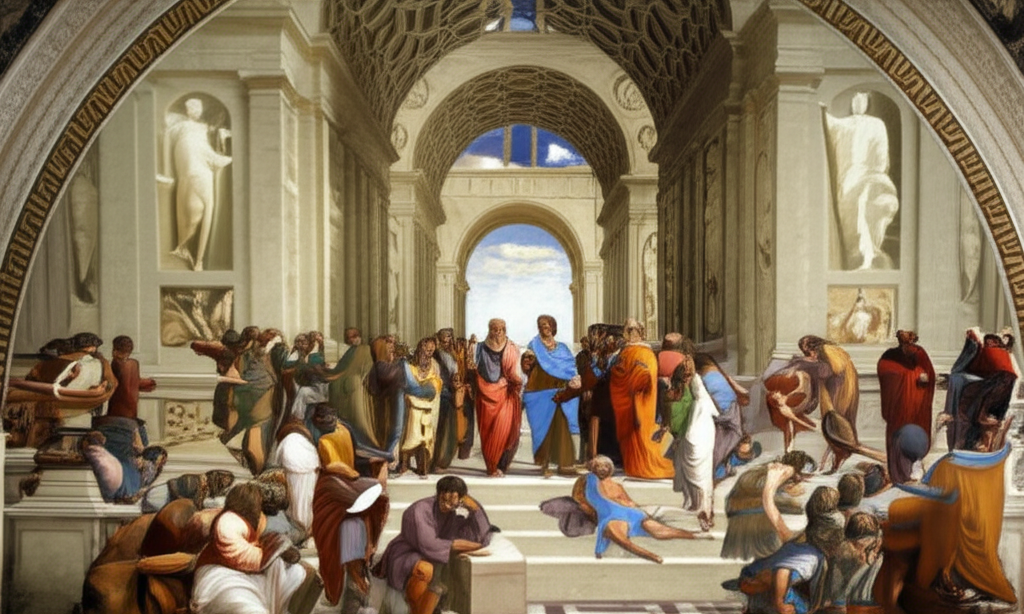 at their feet, representing the natural world and instinct. The background features both a stylized classical building and a wild, untamed landscape, visually contrasting human civilization with raw nature.)
A Comparative Glimpse: Animal vs. Man
To further clarify the distinction, consider the following comparative attributes:
| Attribute | Animal | Man |
|---|---|---|
| Primary Drive | Instinct, survival, reproduction | Reason, purpose, self-actualization, survival |
| Communication | Signals, calls, body language (concrete) | Symbolic language, abstract concepts, written history, philosophy |
| Thought Process | Associative, sensory-based, reactive | Abstract, logical, analytical, self-reflective, hypothetical |
| Relationship to Nature | Adapts to nature, part of ecosystem | Transforms nature, creates artificial environments, studies nature |
| Morality/Ethics | Instinctual empathy, social behaviors | Conscious moral choice, ethical systems, justice, guilt, duty |
| Culture | Learned behaviors, simple traditions | Complex cultures, art, religion, science, institutions |
| Self-Awareness | Situational awareness, basic self-recognition | Deep self-consciousness, existential reflection, awareness of mortality |
The Enduring Challenge and the Future of the Distinction
Despite these clear philosophical delineations, the distinction remains a dynamic field of inquiry. Advances in ethology and neuroscience continually reveal surprising complexities in animal cognition, challenging simplistic views. Yet, as we delve deeper into what makes us human, the unique capacity for self-transcendence, for imagining worlds beyond our immediate experience, and for grappling with the very meaning of our existence, continues to stand as a testament to the profound distinction of man. It is a distinction not of superiority, perhaps, but of a different mode of being within the vast tapestry of nature.
This ongoing philosophical dialogue, rooted in the Great Books, invites us to perpetually re-evaluate our place in the cosmos and the responsibilities that come with our unique faculties.
YouTube Suggestions:
-
📹 Related Video: ARISTOTLE ON: The Nicomachean Ethics
Video by: The School of Life
💡 Want different videos? Search YouTube for: ""Aristotle Man Rational Animal Philosophy Explained""
-
📹 Related Video: ARISTOTLE ON: The Nicomachean Ethics
Video by: The School of Life
💡 Want different videos? Search YouTube for: ""Kant Ethics Duty Morality Animals Human Distinction""