

The Profound Chasm: Distinguishing Angel from Human
The realms of metaphysics and theology have long grappled with the intricate tapestry of existence, seeking to define and categorize the various forms of being. Among the most compelling distinctions is that drawn between the angel and man (humanity). While both are often considered intelligent, spiritual creatures, their fundamental natures, modes of operation, and relationships to the divine are profoundly different. This article explores these core differences, drawing upon the rich philosophical and theological traditions found within the Great Books of the Western World, to illuminate why these two categories of being occupy distinct, albeit sometimes parallel, paths in the grand scheme of creation.
Defining Our Terms: Angel and Man
To understand the distinction, we must first establish a clear definition for each.
The Angelic Nature: Pure Intellect and Immateriality
In classical theology and philosophy, particularly as articulated by thinkers like Thomas Aquinas (drawing heavily on Aristotle), an angel is understood as a purely spiritual, intellectual substance, entirely devoid of a material body. They are often described as:
- Immaterial: Without physical form, composition of matter and form is absent.
- Pure Intellect: Their knowledge is intuitive and immediate, not acquired through senses or discursive reasoning. They grasp truths directly.
- Immutable: Their nature is fixed; they do not change or grow in the same way humans do. Their choices are made instantaneously and irrevocably.
- Individual Species: Each angel is often considered a species unto itself, unique and distinct from every other angel.
The Human Nature: A Composite of Body and Soul
Conversely, man is defined as a composite being, a unique union of a material body and an immaterial, rational soul. This composite nature is central to human experience and distinctiveness:
- Material and Spiritual: We are embodied spirits, our intellect and will intimately connected to our physical existence.
- Discursive Reason: Our knowledge begins with sensory experience, moving from particulars to universals, building understanding step by step.
- Mutable and Developing: Humans undergo significant development, both physically and intellectually, throughout their lives. Our choices, though free, are often subject to change and re-evaluation.
- Species with Individuals: Humanity is a single species comprising countless individual persons, all sharing the same essential nature.
Ontological Differences: Being and Knowing
The fundamental distinction between angel and man lies in their very mode of being (ontology) and their way of knowing the world.
Table: Key Ontological and Epistemological Distinctions
| Feature | Angel | Man |
|---|---|---|
| Nature of Being | Purely spiritual, immaterial | Composite of body and rational soul |
| Mode of Knowing | Intuitive, immediate, direct insight | Discursive, acquired through senses & reason |
| Will & Choice | Instantaneous, immutable, perfect | Deliberative, mutable, fallible |
| Relation to Time | Aeviternal (outside temporal flow) | Temporal, bound by past, present, future |
| Location | Not spatially bounded, but can act in space | Spatially located, moves through space |
| Perfection | Created in a state of initial perfection | Created with potential for development |
The Role of the Senses
For man, the senses are the gateway to knowledge. We perceive the world through sight, sound, touch, taste, and smell, and from these sensory inputs, our intellect abstracts universal concepts. The angel, having no body, possesses no senses. Their knowledge is infused directly by God or through their own intellectual apprehension of reality, unmediated by physical experience. This means an angel understands the essence of a thing directly, whereas man must laboriously deduce it.
Purpose and Place in the Cosmic Hierarchy
This distinction is not merely academic; it speaks to the distinct purposes and roles assigned to angel and man within the broader theological framework.
Hierarchy of Being
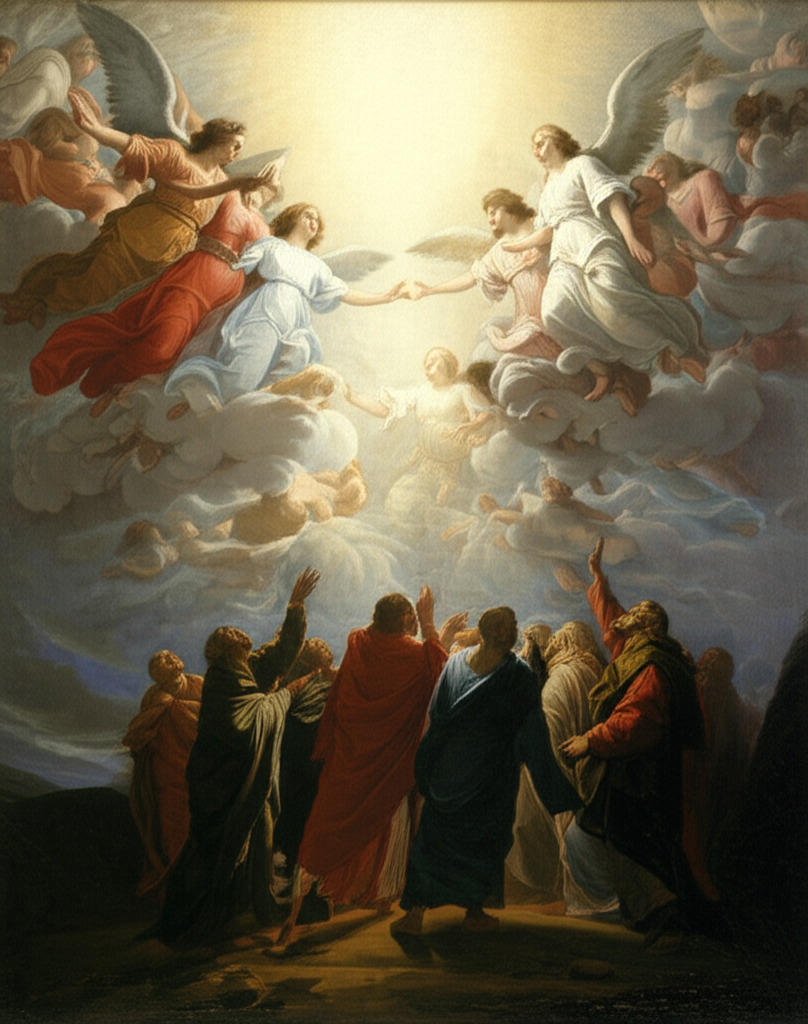
Medieval theology often posited a grand hierarchy of being, with God at the summit, followed by the various choirs of angels, and then man, animals, plants, and inanimate matter. Angels serve primarily as messengers and ministers of God, executing divine will and contemplating divine truth directly. Their existence is one of pure adoration and service in the spiritual realm.
Man, though lower in this spiritual hierarchy than the angel in terms of pure intellect and immateriality, holds a unique and crucial position. Our composite nature allows us to bridge the gap between the material and spiritual worlds. We are called to govern the material creation, to know God through the created order, and to achieve salvation through faith, reason, and free will.
The Challenge of Free Will
Both angel and man possess free will, a cornerstone of their moral agency. However, its exercise differs significantly. An angel's choice, being a direct act of pure intellect and will, is made with perfect clarity and full understanding of its implications, making it immutable. Once an angel chooses for or against God, that choice is fixed for eternity.
Man's choices, influenced by passions, sensory input, and imperfect knowledge, are often made with less clarity and can be repented of and changed. This capacity for repentance and growth is unique to humanity and is a central theme in Christian theology. Our journey towards perfection is a gradual, often arduous, process of moral and intellectual development.
📹 Related Video: What is Philosophy?
Video by: The School of Life
💡 Want different videos? Search YouTube for: ""Aquinas Angels vs Humans" or "Medieval Philosophy on Human Nature""
Implications for Human Understanding
Understanding the profound distinction between angel and man offers valuable insights into the human condition itself. It highlights:
- Our Unique Dignity: Man is not merely a lesser angel, but a distinct creation with a unique dignity stemming from our composite nature and our capacity to know and love God through the material world.
- The Value of Embodiment: Our physical bodies are not prisons to be escaped, but integral parts of our being, through which we experience, learn, and interact with creation.
- The Journey of Knowledge: Our discursive reasoning, though slower than angelic intuition, is a powerful tool for discovery and understanding, allowing for growth and revelation over time.
- The Grace of Imperfection: Our capacity for error and repentance underscores God's mercy and the ongoing journey of human moral development.
In conclusion, the definition of angel and man reveals two fundamentally different types of intelligent, spiritual beings. The angel, a pure, immaterial intellect, operates with intuitive knowledge and immutable will. Man, a composite of body and soul, learns through the senses and discursive reason, embarking on a temporal journey of growth, choice, and potential for redemption. This distinction, deeply rooted in philosophical and theological tradition, not only clarifies the hierarchy of creation but also profoundly illuminates the unique nature and purpose of humanity.