

The Profound Chasm: Defining the Distinction Between Angel and Human
The realms of metaphysics and theology have long grappled with the intricate tapestry of existence, seeking to understand the various forms of being that populate the cosmos. Among the most compelling comparisons drawn throughout Western thought, particularly within the traditions chronicled in the Great Books of the Western World, is the fundamental distinction between Angel and Man (human). While both are often conceived as intelligent, volitional beings, their very definition as substances sets them apart, carving out unique places in the hierarchy of creation and offering profound insights into the nature of reality, knowledge, and purpose.
At its core, the difference lies in their composition: the Angel is pure spirit, an incorporeal intellect, while Man is a composite being, a union of spirit (soul) and matter (body). This foundational difference branches into myriad implications concerning their mode of existence, acquisition of knowledge, freedom, and ultimate destiny.
The Nature of Angels: Pure Intellect, Immaterial Essence
To understand the Angel, we must first grasp its radical immateriality. Philosophers and theologians, most notably Thomas Aquinas in his Summa Theologica, characterize angels as wholly spiritual substances, devoid of a physical body.
-
Definition and Composition:
- Pure Spirit: Angels are intellects and wills without any material component. They are subsistent forms, meaning their essence is their existence as pure intelligences.
- Incorporeal: They do not occupy space in the way physical objects do, nor do they possess physical senses or organs.
- Indivisible: Being immaterial, an angel cannot be divided into parts.
- Immutable (in essence): Once created, their fundamental nature does not change. Their choices, particularly their initial free choice regarding God, are eternal and irrevocable.
-
Mode of Knowledge and Action:
- Intuitive Knowledge: Angels do not learn through sensory experience or discursive reasoning like humans. Their knowledge is immediate and intuitive, directly apprehending truths without the need for abstraction from particulars.
- Direct Illumination: They receive knowledge directly from God or from higher angels, understanding concepts wholly and simultaneously.
- Volition: Their will is perfect and direct, acting immediately upon their intellective apprehension. An angelic choice, therefore, carries immense weight, as it is made with full, unclouded understanding.
-
Purpose and Place:
- Messengers and Ministers: The very word "angel" (from the Greek angelos) means "messenger." They serve as intermediaries between God and the material world, executing divine commands.
- Contemplation: Their primary purpose is often understood as the direct contemplation and worship of God, a beatific vision unmediated by physical limitations.
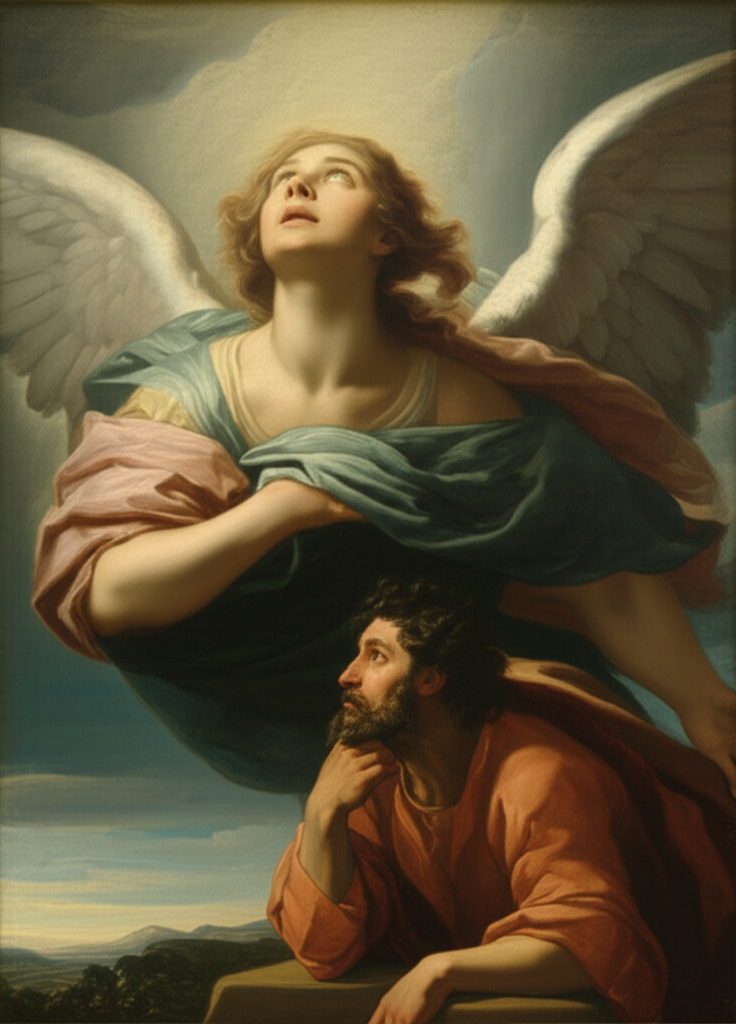
The Nature of Man: A Composite of Spirit and Matter
In stark contrast, Man occupies a unique position as a bridge between the purely spiritual and the purely material. The human definition is inextricably linked to this duality – a rational animal, a body-soul composite.
-
Definition and Composition:
- Body and Soul: Humans are a substantial union of a material body and an immaterial, rational soul. The soul is the form of the body, giving it life and specific human characteristics.
- Material and Spiritual: We are subject to the laws of physics and biology, yet possess an intellect and will that transcend mere animal instinct.
- Divisible (body): The body is extended and divisible, subject to change, decay, and mortality. The soul, while spiritual, is intrinsically linked to this material existence.
-
Mode of Knowledge and Action:
- Sensory and Discursive Knowledge: Human knowledge begins with sensory experience. We abstract universal concepts from particular instances, reason from premises to conclusions, and build understanding incrementally.
- Imagination and Memory: These faculties, tied to our physical brain, are crucial for our learning and processing of information.
- Volition and Moral Development: Our will operates through our intellect, but is also influenced by passions and sensory appetites. Human freedom involves a continuous process of moral choice, learning, and growth, often through struggle and imperfection.
-
Purpose and Place:
- Stewards of Creation: Humans are often seen as having dominion over the natural world, tasked with its care and development.
- Journey of Becoming: Unlike angels, whose nature is fixed, humans are on a journey of becoming, striving towards perfection, knowledge of God, and moral excellence through their lived experience.
- Social and Relational: Our embodied nature necessitates social interaction, community, and procreation, forming complex societies and cultures.
Key Distinctions: A Comparative Overview
The following table highlights the fundamental differences in definition and attributes between Angel and Man, crucial for understanding their respective roles and natures within theology and philosophy:
| Feature | Angel | Man (Human) |
|---|---|---|
| Composition | Pure Spirit (Incorporeal) | Body and Soul (Corporeal & Spiritual Composite) |
| Knowledge | Intuitive, Direct, Immediate | Sensory, Discursive, Abstractive, Incremental |
| Will/Choice | Perfect, Irrevocable (after initial choice) | Imperfect, Revocable, Subject to Growth/Struggle |
| Materiality | None | Essential (Body) |
| Mortality | Immortal (Spiritually and Essentially) | Mortal (Body), Immortal (Soul) |
| Locomotion | Not bound by physical space/time | Physical movement within space/time |
| Reproduction | None | Through Procreation |
| Change/Growth | Fixed nature after creation | Continuous development, learning, moral growth |
| Relationship to | Direct Contemplation of God | Contemplation through Senses and Reason, Faith |
| World |
Philosophical and Theological Implications
Understanding these distinctions is not merely an academic exercise; it carries profound implications for our understanding of ourselves and the cosmos.
- Hierarchy of Being: This differentiation helps establish a hierarchical order of creation, from the purely material to the purely spiritual, with humanity occupying a unique intermediate position.
- The Problem of Evil: The nature of angelic sin (a single, perfect, irrevocable act of defiance) differs significantly from human sin, which often involves weakness, ignorance, and the capacity for repentance and redemption.
- The Dignity of Man: Despite the angelic superiority in intellect and spiritual purity, human beings possess a unique dignity stemming from their composite nature, their capacity for overcoming adversity, and their potential to bridge the material and spiritual worlds through their journey of becoming.
- The Incarnation: The Christian doctrine of the Incarnation—God becoming Man—underscores the profound significance of human nature, suggesting a unique potential for union with the divine that is not similarly ascribed to angels.
The careful examination of the definition of Angel versus Man, as explored through centuries of theology and philosophy within the Great Books, reveals not just differences in attributes, but fundamentally distinct modes of existence, each with its own inherent dignity, purpose, and profound implications for our understanding of reality.
YouTube: "Aquinas Angels vs Humans Philosophy"
YouTube: "Plato Aristotle Human Soul Body Distinction"
📹 Related Video: What is Philosophy?
Video by: The School of Life
💡 Want different videos? Search YouTube for: "The Distinction Between Angel and Human (Man) philosophy"