

The Enduring Quest: Distinguishing Opinion from Truth
In the vast landscape of human thought, few distinctions are as fundamental yet frequently conflated as that between opinion and truth. While opinion is a subjective belief, often swayed by emotion or limited perspective, truth stands as an objective reality, verifiable and universal. Understanding this profound difference is not merely an academic exercise; it is essential for the pursuit of genuine knowledge and the navigation of a complex world. As we delve into the rich tapestry of the Great Books of the Western World, we find this distinction at the very heart of philosophical inquiry, guiding our ascent from mere supposition to enlightened understanding.
The Shifting Sands of Opinion
An opinion is a personal belief or judgment that, while sincerely held, may not be based on verifiable facts or rigorous proof. It is subjective, often reflecting an individual's feelings, experiences, or interpretations. In the Platonic tradition, opinion (or doxa) is contrasted sharply with true knowledge (episteme).
Consider Plato's famous Allegory of the Cave from The Republic. The prisoners, chained since birth, perceive only shadows cast on a wall as reality. These shadows are their opinions – their limited, distorted perceptions of the world. They believe the shadows are real because they have no other frame of reference. Their beliefs are deeply held, but fundamentally flawed, lacking correspondence with the true objects casting the shadows.
Key Characteristics of Opinion:
- Subjective: Based on individual perception, feeling, or interpretation.
- Fallible: Prone to error, bias, and incomplete information.
- Variable: Can change over time or differ greatly between individuals.
- Lacks Justification: Often held without rigorous evidence or reasoned argument.
- Rooted in Experience: Shaped by personal history and cultural context.
The Unyielding Rock of Truth
In contrast, truth refers to a statement or belief that corresponds to reality, is objectively verifiable, and holds universally, independent of personal feelings or beliefs. For something to be true, it must reflect the way things are.
Plato, again, offers a profound framework with his Theory of Forms. For Plato, true reality exists in a realm of perfect, eternal, and unchanging Forms. The truths about justice, beauty, or goodness are not mere opinions but reflections of these perfect Forms. Our world of sensory experience is merely an imperfect copy. While modern philosophy has diversified its understanding of truth, the core idea of truth as something objective, distinct from individual perception, remains central. Aristotle, while diverging from Plato's Forms, also sought truth through empirical observation and logical deduction, emphasizing the correspondence between thought and reality.
Key Characteristics of Truth:
- Objective: Exists independently of individual minds or beliefs.
- Verifiable: Can be demonstrated, proven, or evidenced.
- Universal: Holds true across different individuals and contexts.
- Consistent: Does not contradict itself or other established truths.
- Corresponds to Reality: Accurately describes the state of affairs in the world.
Opinion vs. Truth: A Comparative Overview
To crystallize the distinction, let's examine their fundamental differences:
| Feature | Opinion | Truth |
|---|---|---|
| Nature | Subjective, personal belief | Objective, universal reality |
| Basis | Feeling, limited experience, interpretation | Evidence, reason, verifiable facts |
| Stability | Variable, prone to change, often fleeting | Constant, immutable (in a philosophical sense) |
| Proof | Often lacks rigorous justification | Requires demonstration, justification |
| Impact | Can be mistaken, lead to error or illusion | Leads to understanding, genuine knowledge |
| Platonic Term | Doxa | Episteme |
From Shadows to Light: The Ascent to Knowledge
The journey from opinion to knowledge is arguably the central theme of Western philosophy. Knowledge is often defined as justified true belief. This means that for something to be known, three conditions must generally be met:
- Belief: You must believe the proposition to be true.
- Truth: The proposition must actually be true.
- Justification: You must have good reasons or evidence for believing it to be true.
Without truth, a belief, however strongly held, cannot be knowledge. Without justification, even a true belief might be mere lucky guessing, not genuine understanding. The philosopher's task, as exemplified throughout the Great Books, is to rigorously examine beliefs, seeking the justification that transforms mere opinion into robust knowledge.
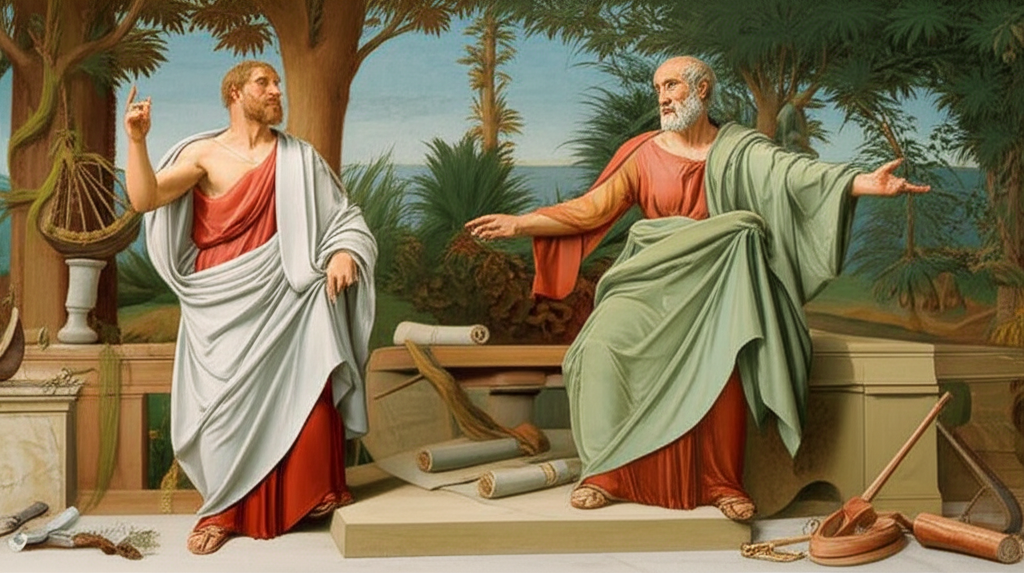
The Socratic Path: Dialectic as a Tool for Truth
How do we bridge the gap between our fallible opinions and objective truth? One of the most powerful tools bequeathed to us by the ancients is dialectic. Originating with Socrates and masterfully demonstrated in Plato's dialogues, dialectic is a method of philosophical inquiry that involves reasoned argumentation and critical discussion.
The Socratic method, a form of dialectic, proceeds by asking a series of questions to expose contradictions in an interlocutor's beliefs, thereby leading them to abandon their unexamined opinions and pursue a more coherent, justifiable understanding. It's not about winning an argument, but about collaboratively reaching a deeper truth. Through this rigorous intellectual exchange, assumptions are challenged, definitions are refined, and the logical consistency of propositions is tested. The Great Books are replete with examples of dialectic in action, from the passionate debates in Plato's Symposium to the systematic reasoning of Aristotle's Organon, demonstrating its power to refine our understanding and move us closer to knowledge.
Why This Distinction Matters: Navigating a World of Information
In an age saturated with information, the ability to distinguish between opinion and truth is more critical than ever. Without this discernment:
- Misinformation thrives: Unsubstantiated opinions can be mistaken for facts, leading to widespread confusion and error.
- Decision-making suffers: Personal and societal choices based on flawed opinions rather than truth can have detrimental consequences.
- Critical thinking erodes: The capacity to evaluate evidence and construct sound arguments diminishes when the pursuit of truth is abandoned for the comfort of unexamined beliefs.
- The pursuit of wisdom stalls: True wisdom is not merely accumulating opinions but understanding reality as it truly is, a journey that begins with the pursuit of truth.
The enduring legacy of the Great Books reminds us that this distinction is not an abstract academic exercise, but a vital component of a well-lived, thoughtful life.
Conclusion
The difference between opinion and truth is a foundational pillar of philosophical thought. While our opinions are personal, subjective, and often flawed, truth represents an objective reality that we strive to apprehend through reason, evidence, and rigorous inquiry. The journey from the shadows of opinion to the light of truth is the very essence of the pursuit of knowledge, a path illuminated by the practice of dialectic and the timeless wisdom found within the Great Books of the Western World. It is a journey that demands intellectual humility, relentless questioning, and an unwavering commitment to understanding the world as it truly is, rather than as we merely wish it to be.
📹 Related Video: PLATO ON: The Allegory of the Cave
Video by: The School of Life
💡 Want different videos? Search YouTube for: "Plato's Allegory of the Cave explained"
📹 Related Video: What is Philosophy?
Video by: The School of Life
💡 Want different videos? Search YouTube for: "What is Knowledge? Justified True Belief"