

The Enduring Quest: Distinguishing Between Opinion and Truth
The distinction between opinion and truth is one of philosophy's oldest and most persistent challenges, a bedrock upon which much of Western thought is built. In an age saturated with information, understanding this difference is more crucial than ever. Simply put, an opinion is a belief or judgment based on personal experience, feeling, or interpretation, often subjective and open to debate. Truth, on the other hand, refers to a statement or idea that corresponds to reality, is objectively verifiable, and holds universally. The journey from fleeting opinion to enduring truth is often paved with rigorous inquiry, critical thought, and the pursuit of knowledge through methods like the dialectic.
The Elusive Nature of Truth
What exactly constitutes truth? For millennia, philosophers from Plato to Kant have grappled with this question. In the tradition of the Great Books of the Western World, truth is often presented as something objective and universal, existing independently of human perception or belief. Plato, for instance, posited a realm of perfect Forms, where true reality resides, accessible not through sensory experience but through intellect and reason. For him, the world we perceive is merely a shadow of this ultimate truth.
Truth, in this classical sense, demands more than mere assertion. It requires:
- Correspondence: It must align with how things actually are in the world.
- Coherence: It must fit logically with other established truths.
- Verifiability: In principle, it should be possible to demonstrate its accuracy, even if empirically challenging.
The pursuit of truth is therefore an endeavor to transcend individual viewpoints and grasp a reality that holds true for all, regardless of their personal inclinations.
The Subjective Realm of Opinion
Opinion stands in stark contrast to this grand conception of truth. An opinion is inherently personal, a viewpoint shaped by individual experiences, biases, emotions, and limited information. It is the realm of "I think," "I feel," or "In my view." While opinions are fundamental to human interaction and identity, they carry several defining characteristics:
- Subjectivity: They are tied to the individual holder.
- Variability: Opinions can differ widely among people and even change within an individual over time.
- Lack of Universal Claim: An opinion does not necessarily claim to be universally binding or objectively correct for everyone.
- Basis in Belief: Often rooted in personal conviction rather than empirical evidence or logical proof.
Consider everyday discussions: "Coffee is better than tea" is an opinion. "The Earth revolves around the Sun" is a truth. The former is a matter of taste; the latter, a verifiable fact. The challenge arises when opinions are presented or mistaken for truths, particularly in complex social or political discourse.
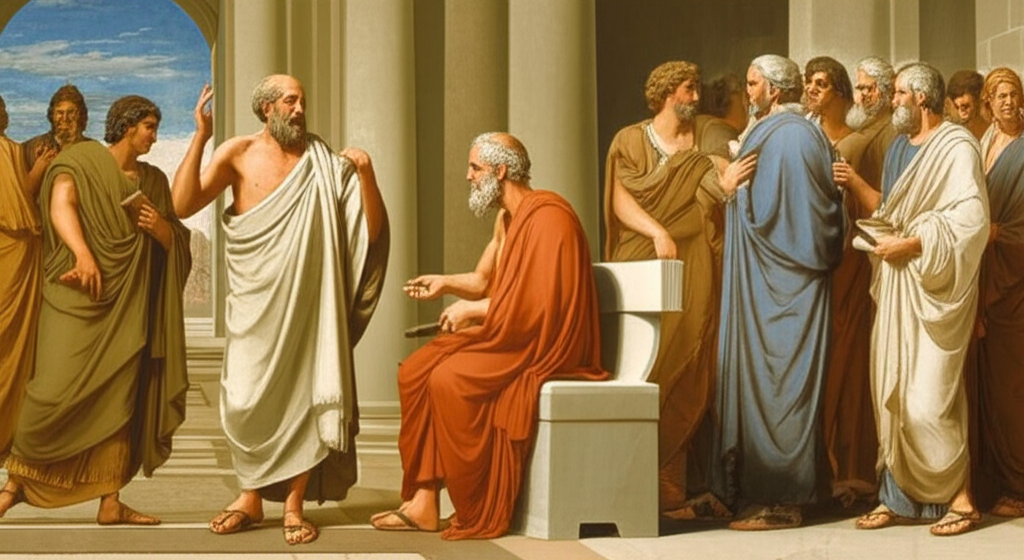
Bridging the Gap: Knowledge and the Dialectic
How do we elevate our understanding from the shifting sands of opinion to the firm ground of truth? This is where the concepts of knowledge and the dialectic become indispensable tools, deeply rooted in the philosophical heritage of the Great Books.
Knowledge is often defined as justified true belief. It's not enough to merely believe something (opinion), nor is it enough for that belief to happen to be true. For a belief to qualify as knowledge, it must also be supported by adequate reasons, evidence, or logical arguments – it must be justified. This justification is what distinguishes knowledge from mere lucky guesswork or unfounded opinion.
The dialectic is the method, famously employed by Socrates and Plato, for moving towards knowledge and truth. It involves a rigorous, back-and-forth exchange of ideas, questions, and arguments, designed to expose contradictions, refine definitions, and critically examine assumptions. Through this process, unfounded opinions are challenged, and ideas are tested against reason and evidence, gradually leading participants closer to a more coherent and justified understanding.
This table illustrates the key distinctions:
| Feature | Opinion | Knowledge | Truth |
|---|---|---|---|
| Nature | Subjective belief or judgment | Justified true belief | Objective reality or fact |
| Basis | Personal feeling, experience, interpretation | Evidence, reason, justification | Correspondence to reality |
| Universality | Variable, individual, not universally binding | Potentially universal if justification holds | Universal, independent of belief |
| Verification | Difficult to verify objectively | Can be demonstrated or proven | Verifiable, demonstrable |
| Method of Attainment | Personal reflection, common sense | Inquiry, research, logic, dialectic | Discovery, understanding, rational insight |
Why Does This Distinction Matter?
The ability to differentiate between opinion and truth is not merely an academic exercise; it is fundamental to rational thought, ethical decision-making, and the functioning of a healthy society. When opinions are presented as truths without proper justification, it can lead to misinformation, dogmatism, and an inability to engage in productive discourse. Conversely, the pursuit of truth, even when challenging, fosters intellectual humility, critical thinking, and a deeper understanding of ourselves and the world. It encourages us to question, to seek evidence, and to engage in the dialectic process, moving beyond superficial agreement to a more profound grasp of reality.
In essence, the philosophical journey, as illuminated by the Great Books, is an ongoing invitation to transcend the limitations of individual opinion and strive for the universal clarity of truth, guided by the light of knowledge and the rigorous path of the dialectic.
YouTube Suggestions:
- "Plato's Allegory of the Cave explained"
- "What is Truth? Philosophy Basics"
📹 Related Video: What is Philosophy?
Video by: The School of Life
💡 Want different videos? Search YouTube for: "The Difference Between Opinion and Truth philosophy"