

Navigating the Labyrinth of Belief: The Enduring Difference Between Opinion and Truth
The modern world, awash in information and instant commentary, often blurs the lines between what we feel to be true and what is objectively true. Yet, the distinction between opinion and truth remains one of the most fundamental and critical pursuits in philosophy, shaping our understanding of reality, guiding our actions, and fostering genuine knowledge. This article explores this vital difference, drawing upon the wisdom of foundational thinkers, and highlights why discerning one from the other is more crucial now than ever.
The Slippery Slope: What is Opinion?
An opinion is a belief or judgment that is not necessarily based on fact or knowledge. It is often subjective, influenced by personal feelings, experiences, cultural background, and even biases. In the tradition of the Great Books, Plato grappled extensively with opinion, or doxa, as he called it. For Plato, opinion resided in the realm of appearances, the ever-changing shadows on the cave wall, as depicted in his famous Allegory. It's the realm of common sense, popular belief, and unexamined assumptions.
- Characteristics of Opinion:
- Subjective: Varies from person to person.
- Emotional: Often tied to feelings or personal preference.
- Lacks Rigorous Justification: May not be supported by verifiable evidence or logical reasoning.
- Changeable: Can shift easily based on new experiences or influences.
- Can be Widely Held: Popularity does not equate to veracity.
Consider our taste in art, our preferred political candidate, or our gut feeling about a situation. These are prime examples of opinions. While valuable for personal expression and social discourse, they do not inherently reflect an objective reality.
The Bedrock of Reality: What is Truth?
In stark contrast, truth refers to a statement or belief that corresponds to reality or fact. It is objective, verifiable, and holds independently of individual perception or feeling. Philosophers throughout history, from Aristotle to the Enlightenment thinkers, have sought to define and discover truth through various means, emphasizing reason, empirical observation, and logical deduction. Truth aims to describe how things are, not just how we wish them to be.
- Characteristics of Truth:
- Objective: Exists independently of individual belief.
- Verifiable: Can be tested, proven, or demonstrated through evidence and reason.
- Consistent: Does not contradict itself or other established truths.
- Universal (ideally): Should hold true for everyone, everywhere, under the same conditions.
- Requires Justification: Supported by sound reasoning, evidence, or logical coherence.
The laws of physics, historical events confirmed by multiple sources, or mathematical theorems are examples of truths. They stand apart from personal preference and demand a different standard of acceptance.
Bridging the Divide: From Opinion to Knowledge
The journey from fleeting opinion to stable knowledge is a central theme in philosophy. Knowledge, distinct from mere belief, is often defined as justified true belief. This means that for something to be considered knowledge, it must not only be true, and you must believe it, but you must also have good reasons or evidence to support that belief. It's the process of taking an opinion, scrutinizing it, testing it against reality, and providing robust justification that elevates it to the status of knowledge.
The Socratic Path: The Power of Dialectic
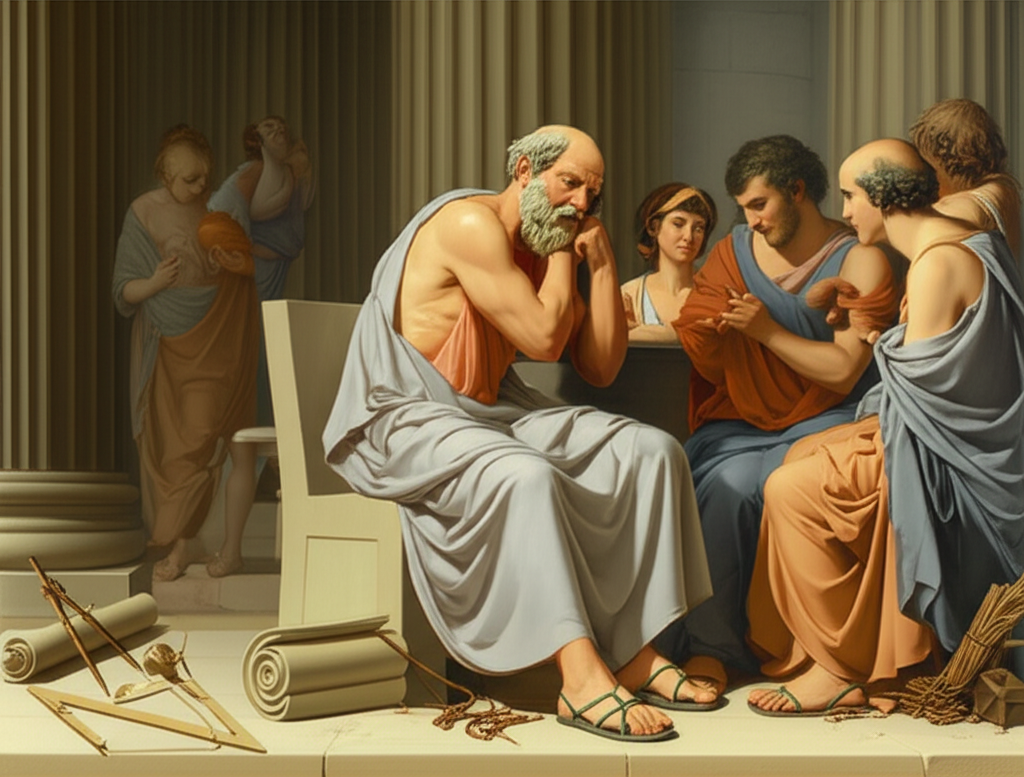
How do we move from the shadows of opinion towards the light of truth and knowledge? One of the most powerful tools bequeathed to us by the Great Books tradition is the dialectic. Originating with Socrates, the dialectic is a method of philosophical argument that involves a rigorous exchange of ideas, questions, and answers to expose assumptions, clarify concepts, and ultimately arrive at a more profound understanding.
Through the dialectical method, opinions are challenged, inconsistencies are revealed, and beliefs are tested against reason and evidence. It's not about winning an argument, but about collaboratively refining understanding and pushing towards a more accurate depiction of reality. This process, central to Plato's dialogues, is a relentless pursuit of clarity and coherence, dismantling false beliefs to pave the way for genuine insight.
Why the Distinction Matters: Consequences for Self and Society
Conflating opinion with truth has profound consequences, both for individuals and for society.
| Feature | Opinion | Truth |
|---|---|---|
| Foundation | Personal feeling, belief, experience | Evidence, reason, objective reality |
| Nature | Subjective, relative, changeable | Objective, universal, stable |
| Verification | Often none beyond personal conviction | Testable, demonstrable, justifiable |
| Goal | Expression of self | Correspondence to reality |
| Impact on Action | Can lead to arbitrary or biased choices | Guides rational, effective, ethical action |
When we treat our opinions as undeniable truths, we close ourselves off to new information, critical self-reflection, and genuine dialogue. It fosters dogmatism, tribalism, and an inability to adapt or learn. In public discourse, this blurring can undermine democracy, make rational problem-solving impossible, and lead to the spread of misinformation.
Conversely, embracing the distinction empowers us. It encourages intellectual humility, fosters critical thinking, and opens the door to continuous learning. It allows us to engage with others not just to assert our views, but to collectively seek a deeper, more accurate understanding of the world. The pursuit of truth, even when elusive, is a noble and necessary endeavor for a flourishing life and a just society.
The Ongoing Quest
The difference between opinion and truth is not merely an academic exercise; it is a vital skill for navigating the complexities of existence. By understanding this distinction and employing methods like the dialectic, we equip ourselves to move beyond mere belief towards substantiated knowledge, fostering clarity in thought and purpose in action. The journey is continuous, demanding constant vigilance, open-mindedness, and a steadfast commitment to reason.
📹 Related Video: PLATO ON: The Allegory of the Cave
Video by: The School of Life
💡 Want different videos? Search YouTube for: ""Plato Allegory of the Cave explained" or "Socratic Method explained""