

The Enduring Quest: Distinguishing Opinion from Truth
In the vast landscape of philosophical inquiry, few distinctions are as pivotal, yet frequently blurred, as that between opinion and truth. While an opinion represents a subjective belief, often personal and lacking rigorous justification, truth aspires to an objective reality, verifiable and independent of individual perspective. This article delves into this crucial philosophical divide, exploring how we, as thinkers, strive to move beyond mere belief to a more profound understanding of reality, guided by reason and the pursuit of knowledge.
The Shifting Sands of Opinion: Subjectivity and Belief
Opinion is the realm of doxa, as the ancient Greeks, particularly Plato, described it. It is our personal take, our individual interpretation, often influenced by emotion, upbringing, cultural context, and limited information. An opinion, by its very nature, is subjective and open to change. It can be passionately held, widely shared, or deeply personal, but its validity does not depend on universal agreement or objective proof.
Consider the famous Allegory of the Cave from Plato's Republic, a cornerstone text in the Great Books of the Western World. The prisoners, chained and facing shadows on a wall, mistake these fleeting images for reality. These shadows are akin to opinions – perceived realities that are, in fact, merely reflections or interpretations, far removed from the true forms that cast them. We often cling to our opinions with conviction, precisely because they feel real to us, much like the prisoners believed the shadows were the sum total of existence.
- Characteristics of Opinion:
- Subjective: Dependent on individual perception and belief.
- Variable: Can change from person to person, or over time for a single individual.
- Lacks Justification: Often based on intuition, emotion, or limited experience rather than evidence or logic.
- Non-Universal: Not necessarily accepted by all, and not required to be.
The Steadfast Horizon of Truth: Objectivity and Reality
In stark contrast to the fluidity of opinion, truth stands as an ideal of objectivity and reality. Truth refers to statements or propositions that correspond to the way things actually are, independent of anyone's belief or perception. It is universal, enduring, and, ideally, verifiable. For philosophers, the pursuit of truth is not merely about accumulating facts but about understanding the fundamental nature of existence, ethics, and knowledge itself.
The quest for truth has driven thinkers from Aristotle, who meticulously categorized and analyzed the natural world, to Descartes, who sought indubitable foundations for knowledge through radical doubt. These intellectual giants, whose works fill the pages of the Great Books, understood that discerning truth requires rigorous method, logical consistency, and a relentless questioning of assumptions.
- Characteristics of Truth:
- Objective: Exists independently of individual minds or beliefs.
- Universal: Valid for everyone, everywhere (if truly a truth).
- Verifiable: Can be supported by evidence, reason, or empirical observation.
- Immutable: Does not change based on personal preference or societal consensus.
Opinion vs. Truth: A Comparative Glance
| Feature | Opinion | Truth |
|---|---|---|
| Nature | Subjective belief | Objective reality |
| Foundation | Personal feeling, limited experience | Evidence, reason, verifiable facts |
| Validity | Varies by individual/context | Universal and constant |
| Proof | Often none required | Requires justification and evidence |
| Goal | Expression of a viewpoint | Correspondence to reality |
Bridging the Gap: From Opinion to Knowledge
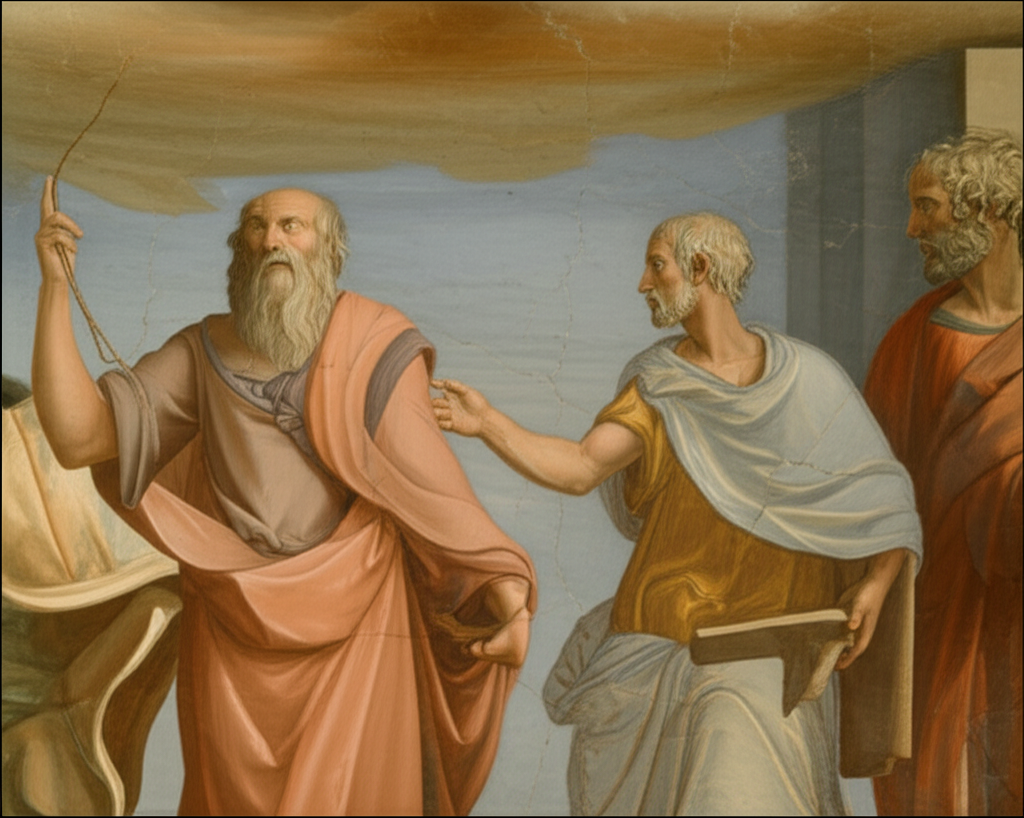
The journey from opinion to truth is often mediated by knowledge. According to Plato, true knowledge (episteme) is not merely true belief, but justified true belief. This means that for something to be considered knowledge, it must not only be true, but we must also have good reasons—justifications—for believing it to be true.
This justification comes through critical thinking, logical reasoning, empirical observation, and philosophical inquiry. It is the process of examining our beliefs, testing them against evidence, and refining them through rigorous thought. This intellectual ascent is what distinguishes the philosopher from the mere purveyor of opinions. It's the struggle to move beyond the shadows towards the light, to understand the Forms themselves rather than just their reflections.
The Role of Dialectic in Uncovering Truth
One of the most powerful tools in this ascent from opinion to knowledge and ultimately to truth is the dialectic. Originating with Socrates and famously employed by Plato in his dialogues, the dialectic is a method of philosophical inquiry that involves reasoned argument and counter-argument. It is a collaborative exchange of ideas, where participants critically examine their own assumptions and those of others, seeking to expose inconsistencies, clarify concepts, and arrive at a more profound understanding.
Through the dialectic, opinions are challenged, inconsistencies are revealed, and concepts are refined. It's a dynamic process of questioning and answering, thesis and antithesis, leading towards a synthesis that is closer to truth. This method, so central to the Great Books of the Western World, exemplifies the hard work required to move beyond superficial agreement or comfortable belief to a more robust and justified understanding.
- Stages of Dialectical Inquiry:
- Presentation of a Thesis: An initial statement or opinion is put forth.
- Antithesis/Questioning: The thesis is rigorously questioned, challenged, and examined for inconsistencies or weaknesses.
- Refinement/Synthesis: Through reasoned debate, the initial thesis is refined or replaced by a more robust understanding, moving closer to truth.
- Iteration: The new understanding becomes a new thesis, and the process continues, deepening knowledge.
The Enduring Quest
The distinction between opinion and truth is not merely an academic exercise; it is fundamental to how we navigate the world, make decisions, and construct our societies. Embracing this distinction means cultivating intellectual humility, a willingness to question our own beliefs, and a commitment to seeking justification for what we claim to know. The philosophical journey, as illuminated by the profound works in the Great Books of the Western World, is an ongoing testament to humanity's tireless quest to move beyond the fleeting shadows of opinion towards the enduring light of truth.
📹 Related Video: PLATO ON: The Allegory of the Cave
Video by: The School of Life
💡 Want different videos? Search YouTube for: "Plato's Allegory of the Cave explained"
📹 Related Video: What is Philosophy?
Video by: The School of Life
💡 Want different videos? Search YouTube for: "What is Truth? A Philosophical Introduction"