

The Enduring Power of the Dialectic Method in Philosophical Inquiry
The dialectic method stands as a cornerstone of philosophical inquiry, a rigorous process of reasoned argumentation that has, for millennia, propelled our understanding of the world and ourselves. It is a dynamic approach to philosophy that moves beyond simple assertion, fostering critical reasoning by pitting opposing ideas against each other to forge a more profound and comprehensive knowledge. This article explores the essence of the dialectic, its historical trajectory, and its indispensable role in the pursuit of truth.
Unpacking the Dialectic: A Journey Through Contradiction
At its heart, the dialectic method is a conversational or argumentative process between two or more people holding different points of view about a subject but wishing to establish the truth through reasoned arguments. It's not about winning an argument, but about refining ideas and reaching a higher level of understanding. This process typically involves:
- Thesis: An initial proposition or idea is presented.
- Antithesis: A counter-proposition or opposing idea emerges, often highlighting limitations or contradictions in the thesis.
- Synthesis: Through critical discussion and reasoning, a new, more refined understanding or proposition is formed, which integrates elements of both the thesis and antithesis, resolving their apparent conflict. This synthesis then often becomes a new thesis, perpetuating the cycle towards deeper knowledge.
This isn't merely a linear progression but a spiral, constantly challenging existing assumptions to build more robust intellectual frameworks.
The Historical Tapestry of Dialectical Thought
The roots of the dialectic plunge deep into ancient Greek philosophy.
Socratic Method: The Art of Questioning
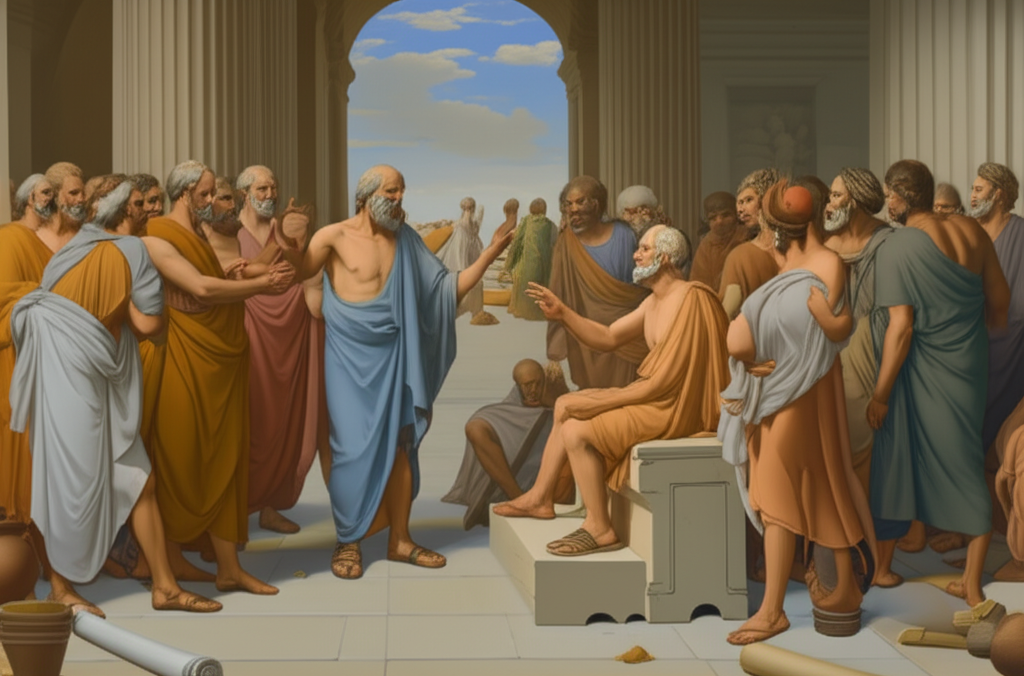
Perhaps the most famous early proponent was Socrates, whose method, often synonymous with the dialectic, involved relentless questioning. He would engage individuals in conversation, probing their beliefs and definitions, exposing inconsistencies, and gently guiding them toward a more precise understanding. This was not a lecture but a shared journey of intellectual discovery, aimed at refining initial assumptions and moving closer to genuine knowledge. Plato, through his dialogues, masterfully captured this process, showcasing how ideas are forged and tested in the crucible of intellectual exchange.
Hegelian Dialectic: The Evolution of Ideas
Centuries later, German philosopher G.W.F. Hegel reinterpreted the dialectic not just as a method of argument, but as the very engine of historical and intellectual development. For Hegel, reality itself unfolds dialectically, with ideas and historical movements progressing through a similar thesis-antithesis-synthesis structure. This grand vision posited that all of history, culture, and thought are engaged in a constant dialectic struggle, moving towards a higher state of self-awareness and absolute knowledge.
The Indispensable Role of Reasoning in Dialectical Inquiry
The dialectic method is utterly reliant on sound reasoning. It demands:
- Logical Coherence: Arguments must be internally consistent and follow logical principles.
- Critical Analysis: The ability to dissect arguments, identify flaws, and distinguish between valid and invalid inferences.
- Intellectual Humility: A willingness to have one's own ideas challenged and, if necessary, revised or abandoned in light of stronger evidence or superior arguments.
Without these elements, the dialectic devolves into mere debate or sophistry, failing to achieve its goal of advancing knowledge. It is through this rigorous application of reasoning that superficial opinions are stripped away, revealing deeper truths.
Why the Dialectic Method Continues to Matter
In an age inundated with information and often polarized discourse, the dialectic method offers a vital antidote. It teaches us:
- To Think Critically: Rather than passively accepting information, it encourages us to question, analyze, and synthesize.
- To Engage Constructively: It provides a framework for productive disagreement, transforming conflict into a catalyst for understanding.
- To Pursue Deeper Knowledge: It acknowledges that truth is often complex and multifaceted, requiring continuous exploration and refinement.
📹 Related Video: SOCRATES ON: The Unexamined Life
Video by: The School of Life
💡 Want different videos? Search YouTube for: ""Socratic method explained," "Hegel's dialectic simplified""
The dialectic is not just a historical curiosity; it is a living, breathing methodology for anyone seeking to grapple with complex ideas, whether in philosophy, science, politics, or everyday life. By embracing this method, we participate in a timeless intellectual tradition that seeks to illuminate the path to genuine knowledge through the courageous engagement of diverse perspectives. It reminds us that the journey of understanding is often best undertaken through thoughtful conversation, challenging assumptions, and ceaseless reasoning.