

The Unfolding of Truth: Embracing the Dialectic Method of Philosophical Inquiry
The dialectic method stands as a cornerstone of philosophy, a timeless process of rigorous reasoning that has shaped human knowledge for millennia. At its heart, it is an art of intellectual discourse, a systematic approach to uncovering truth through the examination and resolution of contradictions. Far from being a mere academic exercise, the dialectic is a dynamic engine for critical thought, pushing us beyond superficial understanding to a more profound and nuanced grasp of reality. This article will delve into the essence of the dialectic, tracing its historical lineage and illustrating its indispensable role in the pursuit of philosophical insight.
What is the Dialectic Method? A Journey Through Contradiction
The term "dialectic" derives from the Greek dialegesthai, meaning "to converse" or "to discourse." Fundamentally, it describes a method of philosophical argument that involves some sort of contradictory process between opposing sides. This isn't merely about winning an argument; it's about a collaborative or even confrontational journey towards deeper understanding.
In philosophical inquiry, the dialectic serves several crucial functions:
- To clarify concepts: By testing definitions and ideas against counter-examples and opposing viewpoints.
- To resolve contradictions: Identifying inconsistencies within arguments or beliefs and working towards a more coherent synthesis.
- To advance knowledge: Moving beyond initial assumptions to more sophisticated and robust conclusions.
It is a commitment to the idea that truth often emerges not from singular pronouncements, but from the crucible of critical engagement.
A Historical Tapestry: From Ancient Greece to Modern Thought
The dialectic has a rich and varied history, evolving significantly through the hands of some of history's greatest thinkers, many of whom are immortalized in the Great Books of the Western World.
The Socratic Method: The Birth of Philosophical Inquiry
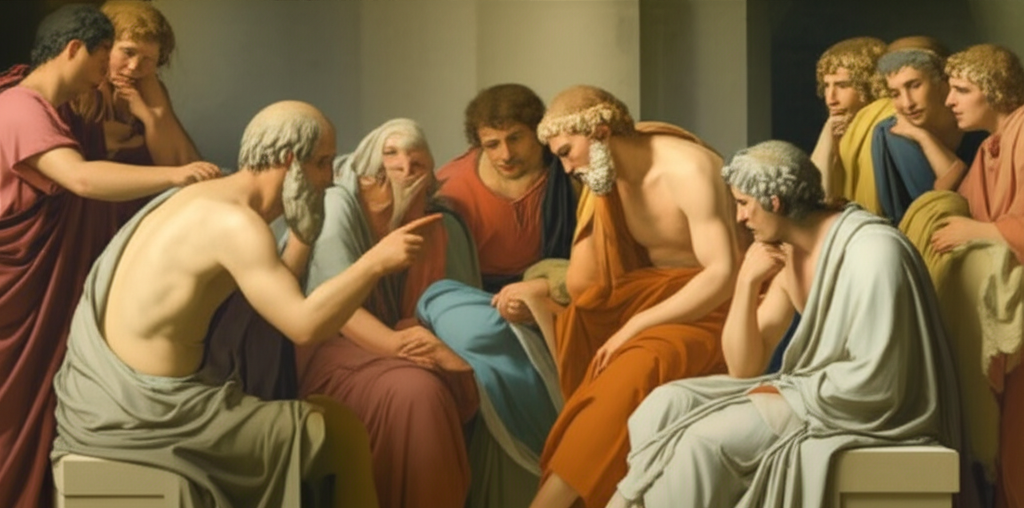
Our journey begins with Socrates, who, as depicted in Plato's dialogues, employed a method of persistent questioning (the elenchus) to expose contradictions in his interlocutors' beliefs. He would engage individuals in conversation, asking a series of questions that gradually revealed the inadequacy or inconsistency of their initial definitions or claims. This wasn't about humiliation but about intellectual purification, clearing away false knowledge to make way for genuine understanding. The Socratic dialectic is a powerful demonstration of how reasoning through dialogue can dismantle ignorance.
Plato's Ascent to the Forms
Plato, Socrates' most famous student, elevated the dialectic into a method for ascending to the apprehension of the Forms – the eternal, perfect archetypes that constitute true reality. For Plato, the dialectic was the highest intellectual discipline, enabling the philosopher to move beyond sensory perceptions and mere opinions (doxa) to grasp immutable truths (episteme). His method involved both the "collection" of diverse phenomena under a single idea and the "division" of general ideas into their specific kinds, ultimately leading to a coherent understanding of the metaphysical structure of reality.
Aristotle's Logic and Argumentation
While often contrasted with Plato, Aristotle also contributed significantly to the dialectical tradition through his development of formal logic. His work on syllogisms, premises, and conclusions provided a structured framework for reasoning and argumentation. For Aristotle, dialectic was concerned with probable opinions, serving as a valuable tool for examining premises that are generally accepted, even if not demonstrably true, to reach conclusions. It was a crucial part of his method for exploring ethical and political questions where absolute certainty might be elusive.
Kant's Antinomies: The Limits of Pure Reason
Centuries later, Immanuel Kant explored the inherent contradictions of pure reason in his Critique of Pure Reason. He identified "antinomies," pairs of contradictory statements about the universe (e.g., that the world has a beginning in time and space, and that it does not) that could both be proven by reasoning. Kant's work highlighted the limitations of applying pure reason beyond the realm of possible experience, revealing a new dimension of dialectical tension within human cognition itself.
Hegel's Dynamic Synthesis: Thesis, Antithesis, Synthesis
Perhaps the most famous articulation of the dialectic comes from Georg Wilhelm Friedrich Hegel. For Hegel, the dialectic was not just a method of argument but the very process by which reality, history, and consciousness unfold. His model of thesis, antithesis, and synthesis posits that an initial idea (thesis) generates its opposite (antithesis), and the conflict between them leads to a higher, more comprehensive understanding (synthesis). This synthesis then becomes a new thesis, perpetuating an ongoing, dynamic evolution towards absolute knowledge and freedom. Hegel's dialectic is a grand narrative of the progress of Reason itself.
The Mechanics of Dialectical Reasoning: A Practical Approach
Regardless of its specific philosophical context, the dialectic typically involves a series of steps:
- Presentation of a Thesis: An initial idea, proposition, or argument is put forth.
- Introduction of an Antithesis/Counter-Argument: This thesis is challenged by an opposing viewpoint, a critique, or the identification of internal contradictions.
- Critical Examination and Debate: Both the thesis and antithesis are rigorously scrutinized. This often involves:
- Questioning assumptions: Uncovering the unstated premises behind each position.
- Seeking evidence: Examining the support for each claim.
- Identifying implications: Exploring the logical consequences of each position.
- Emergence of a Synthesis: Through the process of debate and critical analysis, a new understanding emerges. This synthesis is not merely a compromise but a more refined, comprehensive, and robust idea that incorporates the valid insights of both the thesis and antithesis while resolving their conflicts.
- Iteration: The synthesis itself can then become a new thesis, subject to further dialectical engagement, leading to an ongoing process of intellectual refinement and the expansion of knowledge.
Why Dialectic is Crucial for Philosophical Knowledge
The enduring relevance of the dialectic method lies in its power to forge resilient knowledge. It is a process that:
- Refines Arguments: By subjecting ideas to rigorous critique, weaknesses are identified and addressed, leading to stronger, more defensible positions.
- Uncovers Hidden Assumptions: The act of challenging a thesis often reveals the unspoken beliefs upon which it rests, bringing them to light for examination.
- Fosters Deeper Understanding: Moving beyond superficial agreement or disagreement, the dialectic compels us to grapple with complexity and nuance.
- Builds Robust Knowledge: Truth discovered through dialectical engagement is often more resilient, having withstood the test of opposing viewpoints and critical scrutiny.
- Cultivates Intellectual Humility: The iterative nature of the dialectic reminds us that our current understanding is always provisional, open to further refinement.
Applying the Dialectic in Modern Thought
The principles of the dialectic extend far beyond ancient Greek forums or Hegelian metaphysics. In contemporary academic discourse, scientific debate, legal arguments, and even everyday problem-solving, the spirit of the dialectic persists. It underpins critical thinking, encouraging us to consider multiple perspectives, anticipate counter-arguments, and strive for comprehensive solutions. Any serious pursuit of knowledge benefits from this dynamic interplay of ideas.
Conclusion
The dialectic method is more than a historical curiosity; it is a vital, living tradition in philosophy and intellectual life. From the probing questions of Socrates to the grand historical sweep of Hegel, it has provided humanity with a powerful tool for systematic reasoning and the profound expansion of knowledge. By embracing the tension of opposing ideas and committing to rigorous intellectual engagement, we continue to unfold the layers of truth, one dialectical exchange at a time. It reminds us that the journey of philosophical inquiry is often a dialogue, not a monologue.
📹 Related Video: SOCRATES ON: The Unexamined Life
Video by: The School of Life
💡 Want different videos? Search YouTube for: ""Socratic method explained philosophy""
📹 Related Video: PLATO ON: The Allegory of the Cave
Video by: The School of Life
💡 Want different videos? Search YouTube for: ""Hegel dialectic explained animation""