

The Dialectic Method: A Path to Deeper Philosophical Inquiry
The pursuit of Knowledge is, at its heart, a journey of questioning, challenging, and refining our understanding. Among the most potent tools forged in the crucible of Philosophy for this very purpose is the Dialectic Method. Far from being a mere academic exercise, the dialectic represents a dynamic and rigorous approach to Reasoning, a conversational dance between opposing ideas that aims not at victory, but at truth. It is a method that demands intellectual humility, a willingness to scrutinize one's own assumptions, and the courage to follow an argument wherever it may lead, ultimately guiding us toward a more profound and comprehensive grasp of reality.
The Ancient Roots: Socratic Interrogation and Platonic Ascent
The origins of the dialectic are deeply embedded in the intellectual landscape of ancient Greece, particularly in the works of Socrates and Plato, figures whose legacies are foundational to the Great Books of the Western World.
Socrates and the Elenchus: The Art of Questioning
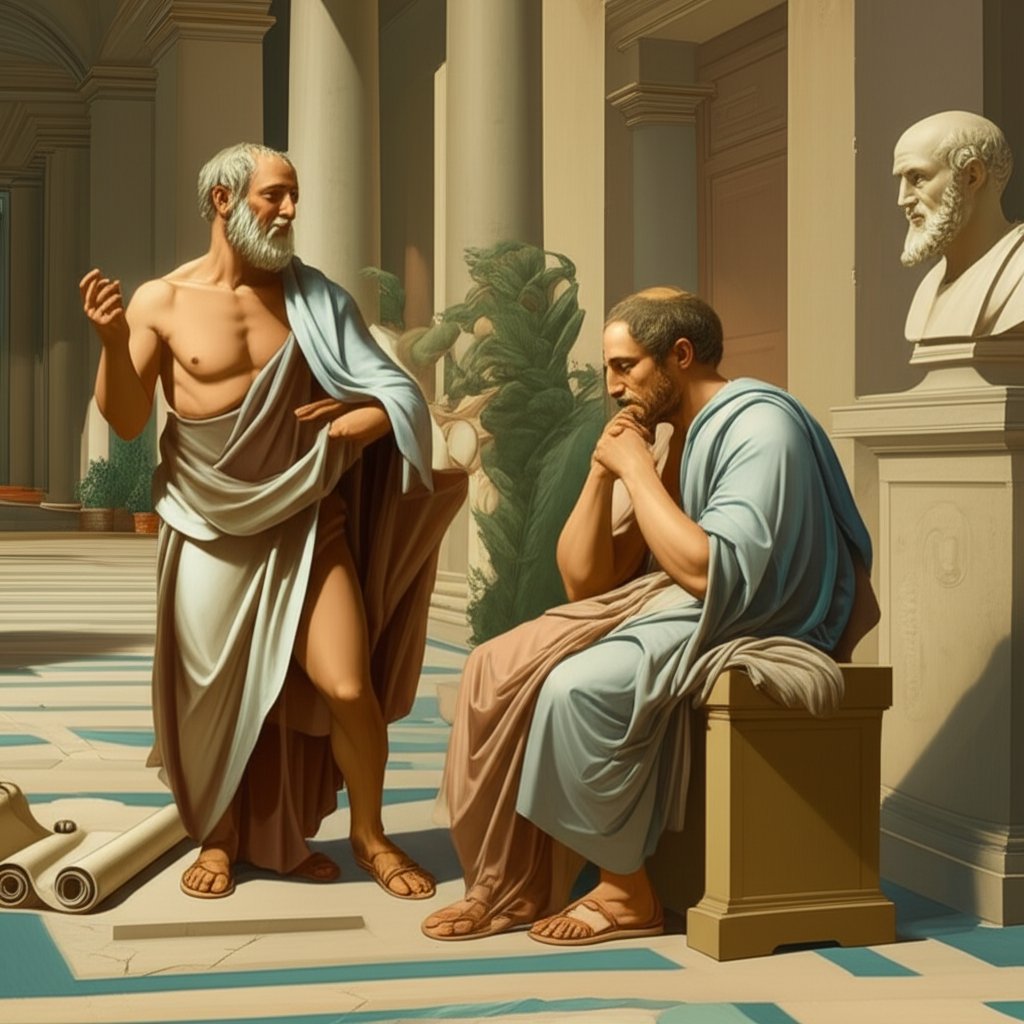
For Socrates, as depicted by Plato, the dialectic was not a formal system but a living, breathing conversation. His method, often referred to as the elenchus, involved a relentless series of questions posed to an interlocutor. Socrates would typically begin with a seemingly simple question about a concept like justice, virtue, or piety. As the interlocutor offered definitions, Socrates would reveal contradictions, ambiguities, or inadequacies in their initial understanding through further questioning.
The Socratic method was less about imparting specific Knowledge and more about exposing ignorance, clearing away false beliefs, and prompting genuine self-examination. It was a rigorous process of intellectual purification, where Reasoning became a tool to dismantle preconceived notions and prepare the mind for true insight.
Plato's Dialectic: Moving from Particulars to Universals
Plato, Socrates' most famous student, formalized the dialectic into a method for ascending from the world of sensory experience to the realm of eternal Forms. For Plato, the dialectic was the highest form of intellectual activity, enabling the philosopher to move beyond mere opinions (doxa) to genuine Knowledge (episteme).
The Platonic dialectic involved:
- Analysis: Breaking down complex ideas into their fundamental components.
- Synthesis: Reconstructing these components into a coherent and more complete understanding.
- Hypothesis Testing: Proposing a definition or idea, then rigorously testing it against objections and alternative perspectives.
This process was crucial for Plato's theory of Forms, allowing the mind to grasp the universal essences that underlie the transient particulars of our world.
The Hegelian Synthesis: History as Dialectical Progression
Centuries later, the Dialectic found a powerful reinterpretation in the work of Georg Wilhelm Friedrich Hegel. For Hegel, the dialectic was not merely a method of philosophical inquiry but the very motor of history and the progression of human consciousness.
Thesis, Antithesis, Synthesis: The Engine of Change
Hegel's dialectic is famously summarized by the triad of thesis, antithesis, and synthesis:
- Thesis: An initial idea, concept, or state of affairs.
- Antithesis: The inherent contradiction or opposition that arises from the thesis, often revealing its limitations or incompleteness.
- Synthesis: A new, higher-level concept that resolves the conflict between the thesis and antithesis, incorporating elements of both while transcending their individual limitations. This synthesis then becomes a new thesis, perpetuating the cycle of intellectual and historical development.
Table 1: Evolution of Dialectical Thought
| Philosopher | Key Focus | Methodological Emphasis | Outcome/Goal |
|---|---|---|---|
| Socrates | Moral concepts, self-knowledge | Elenchus (questioning, exposing contradictions) | Clearing away false beliefs, prompting self-examination |
| Plato | Forms, ultimate reality | Ascent from particulars to universals, rigorous debate | Attainment of true Knowledge (episteme), understanding Forms |
| Hegel | History, Spirit, consciousness | Thesis-Antithesis-Synthesis, conceptual development | Progress of Reasoning and Knowledge through conflict and resolution |
Hegel's dialectic underscores that Philosophy itself is not static, but a dynamic, evolving process driven by the inherent tensions within ideas and historical epochs.
The Mechanics of Dialectical Reasoning
At its core, the Dialectic is a structured approach to Reasoning that encourages critical engagement with ideas. It is a conversation, whether internal or external, that aims to arrive at a more robust and nuanced understanding.
A Process of Refinement
The dialectical process can be broken down into several key stages:
- Presentation of a Thesis: An initial statement, argument, or belief is put forward.
- Introduction of an Antithesis: A counter-argument, objection, or alternative perspective is presented, challenging the initial thesis. This opposition highlights potential flaws, inconsistencies, or unconsidered aspects of the thesis.
- Critical Examination and Debate: Both the thesis and antithesis are rigorously scrutinized. This involves:
- Clarification: Defining terms precisely.
- Justification: Demanding reasons and evidence for claims.
- Identification of Assumptions: Uncovering underlying beliefs.
- Exploration of Implications: Following arguments to their logical conclusions.
- Synthesis and Resolution: Through the process of debate, a new understanding emerges. This synthesis is not merely a compromise but a novel perspective that incorporates the valid insights of both the thesis and antithesis, resolving their apparent conflict at a higher level of comprehension. This new synthesis then becomes a stronger, more refined thesis, ready for further dialectical scrutiny.
Why the Dialectic Endures: Cultivating Deeper Understanding
The enduring power of the Dialectic lies in its capacity to cultivate profound intellectual virtues and produce robust Knowledge.
Benefits for Philosophical Inquiry
- Promotes Critical Thinking: It forces participants to question assumptions, analyze arguments, and identify logical fallacies.
- Fosters Intellectual Humility: By exposing the limitations of initial beliefs, it encourages an openness to revision and growth.
- Builds Robust Arguments: Ideas that survive dialectical scrutiny are inherently stronger and more defensible.
- Generates New Insights: The interplay of opposing views often sparks novel connections and understandings that might not emerge from isolated thought.
- Deepens Knowledge: Through iterative refinement, our grasp of complex concepts becomes richer and more comprehensive.
Beyond Philosophy: Applications in Everyday Discourse
The principles of dialectical Reasoning are not confined to academic Philosophy. They are implicitly at play in:
- Legal Systems: The adversarial process of prosecution and defense.
- Scientific Debates: The peer review process and the testing of hypotheses against counter-evidence.
- Political Discourse: The clash of ideologies and proposals leading to policy formation.
- Personal Growth: The internal dialogue we engage in when making decisions or re-evaluating our beliefs.
The dialectic reminds us that truth is often found not in simple pronouncements, but in the arduous, yet rewarding, journey of intellectual engagement and mutual challenge.
Challenges and Criticisms of the Dialectic
While powerful, the dialectic is not without its challenges. Critics have pointed out:
- Risk of Sophistry: Without genuine commitment to truth, the method can devolve into mere rhetorical gamesmanship, where the goal is to win an argument rather than to discover Knowledge.
- Elusive Synthesis: The "synthesis" is not always clear or achievable, potentially leading to endless debate without resolution.
- Dependence on Participants: The effectiveness of the method relies heavily on the intellectual honesty and Reasoning abilities of those involved.
Concluding Thoughts: An Ever-Unfolding Conversation
From the bustling agora of ancient Athens to the intricate conceptual landscapes of modern thought, the Dialectic Method stands as a testament to humanity's relentless quest for Knowledge. It is a profound recognition that truth is often unveiled not in isolation, but through vigorous engagement, critical Reasoning, and the courageous confrontation of opposing ideas. As "Henry Montgomery" often muses, Philosophy is less about finding definitive answers and more about asking ever-better questions. The dialectic, in its essence, is the art of asking those questions, of pushing the boundaries of our understanding, and of continually refining our grasp of reality through an unending, enriching conversation.
Further Exploration
📹 Related Video: SOCRATES ON: The Unexamined Life
Video by: The School of Life
💡 Want different videos? Search YouTube for: ""Socratic Method explained" or "Hegel's Dialectic simplified""
📹 Related Video: PLATO ON: The Allegory of the Cave
Video by: The School of Life
💡 Want different videos? Search YouTube for: ""Plato's Dialectic and the Forms" or "Critical Thinking Philosophical Methods""