

The Enduring Art of Philosophical Inquiry: Unpacking the Dialectic Method
The dialectic method stands as a cornerstone of philosophical investigation, a dynamic process of critical reasoning that seeks to refine knowledge through the rigorous exchange of ideas. From ancient Greek discourse to modern intellectual challenges, this method provides a powerful framework for uncovering deeper truths by examining opposing viewpoints and resolving contradictions. It is not merely a historical curiosity but a living tradition, essential for robust intellectual advancement.
Introduction: The Engine of Philosophical Progress
For millennia, humanity has grappled with fundamental questions of existence, ethics, and reality. How do we arrive at understanding? How do we differentiate genuine knowledge from mere opinion? The answer, often found within the pages of the Great Books of the Western World, points to a robust and time-tested approach: the dialectic method. Far from a mere debate, the dialectic is a structured intellectual journey, a systematic process designed to sharpen our reasoning and elevate our comprehension. It is the very engine of philosophical progress, pushing us beyond surface-level assumptions to profound insights.
What is the Dialectic Method?
At its core, the dialectic method is a form of argumentative discourse between two or more people holding different points of view about a subject, who wish to establish the truth of the matter through reasoned arguments. It's not about winning an argument, but about advancing collective understanding and refining knowledge.
The process typically involves the following stages:
- Questioning and Scrutiny: It begins with a proposition or a belief, often one taken for granted or widely accepted. This initial idea serves as the thesis.
- Counter-argumentation: This proposition is then subjected to critical examination, often through the introduction of opposing ideas, counter-examples, or potential contradictions. This opposing viewpoint is the antithesis.
- Resolution and Synthesis: Through rigorous reasoning and the identification of flaws or inconsistencies in both the thesis and antithesis, a new, more refined understanding or knowledge emerges. This synthesis integrates the strengths of the prior arguments while overcoming their weaknesses, leading to a more comprehensive truth.
This process is iterative, a continuous cycle of thesis, antithesis, and synthesis, propelling the inquirer towards a more comprehensive and robust grasp of reality.
Historical Roots: From Socrates to Hegel
The lineage of the dialectic is as old as philosophy itself, with each epoch refining its application and understanding. The Great Books of the Western World provide ample evidence of its evolution.
Socratic Dialectic: The Art of Elenchus
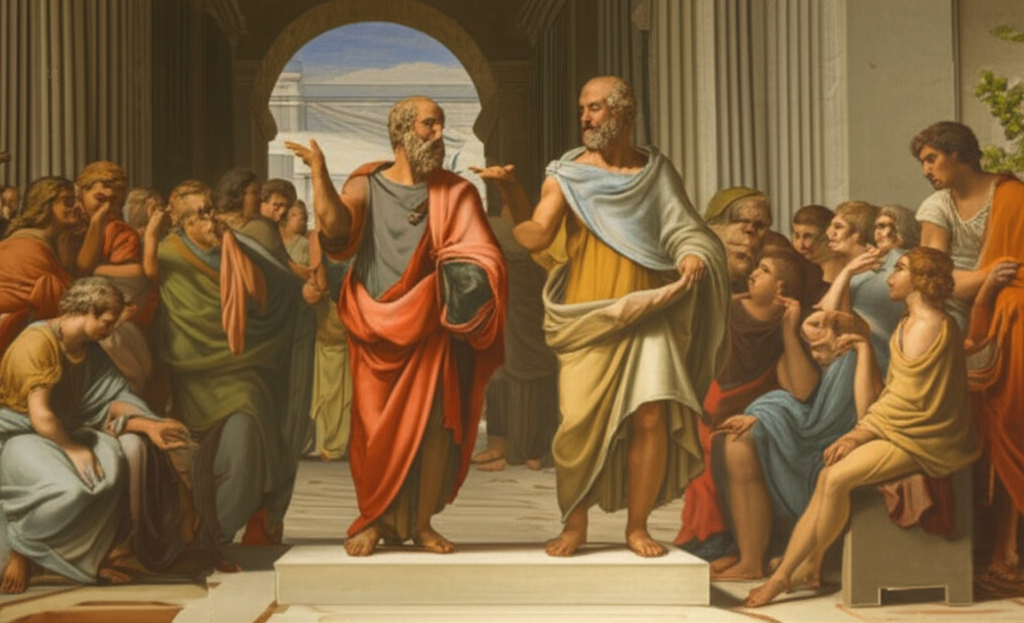
Often considered the father of Western philosophy, Socrates, as depicted by Plato, employed the dialectic through relentless questioning known as the elenchus. He would engage individuals in conversation, exposing contradictions in their beliefs and leading them, often to their surprise, to realize the limits of their own knowledge. His method was not to provide answers but to clear away false assumptions, paving the way for genuine inquiry. A classic example is Socrates' questioning of Euthyphro about the nature of piety, revealing the inadequacy of Euthyphro's initial definitions.
Platonic Dialectic: Ascent to the Forms
Plato, building on his mentor's methods, envisioned the dialectic as the highest form of intellectual pursuit, the path to apprehending the eternal Forms. For Plato, the dialectic involved both division (breaking down concepts into their constituent parts) and collection (synthesizing disparate ideas) to ascend from the world of appearances to the realm of pure knowledge. It was the philosopher's tool for escaping the shadows of the cave and grasping ultimate reality.
Aristotelian Dialectic: Logic and Probable Premises
Aristotle, while differing from Plato in many respects, also recognized the importance of dialectic. In his Topics, he treated dialectic as a method for arguing from probable premises, distinct from demonstrative science which argues from certain ones. It was a crucial tool for training in reasoning and for exploring questions where absolute certainty was elusive, yet rational inquiry was essential. For Aristotle, dialectic was a pathway to opinion and belief, rather than absolute truth, but still vital for intellectual exercise.
Hegelian Dialectic: Thesis, Antithesis, Synthesis
Centuries later, G.W.F. Hegel profoundly reinterpreted the dialectic as a fundamental process of historical and conceptual development. For Hegel, reality itself unfolds dialectically: a thesis (an initial idea or state) generates an antithesis (its inherent contradiction or opposition), and their conflict is resolved in a synthesis (a higher, more comprehensive stage) that incorporates aspects of both. This synthesis then becomes a new thesis, continuing the cycle of progress in knowledge and consciousness. His work, also a cornerstone of the Great Books, demonstrates the dialectic as an engine of historical evolution and the development of Spirit.
The Power of Dialectical Reasoning
The enduring appeal of the dialectic lies in its capacity to foster profound intellectual growth and refine our reasoning. It compels us to:
- Challenge Assumptions: Rather than passively accepting information, we are encouraged to scrutinize, question, and seek underlying principles.
- Develop Critical Thinking: It hones our ability to identify logical fallacies, evaluate arguments, and construct coherent counter-arguments.
- Achieve Deeper Knowledge: By systematically exploring opposing viewpoints, we gain a more nuanced and robust understanding, moving beyond superficial agreement or disagreement.
- Foster Intellectual Humility: The process often reveals the limits of our own knowledge, encouraging a continuous pursuit of wisdom and a recognition of complexity.
Applying the Dialectic in Modern Philosophy
Even in contemporary philosophy, the dialectic remains a vital tool. From ethical debates on emerging technologies to discussions on political theory and the nature of consciousness, the method of engaging with diverse perspectives, identifying tensions, and striving for a more comprehensive understanding continues to drive philosophical progress. It reminds us that knowledge is not a static endpoint but an ongoing, dynamic process of refinement through rigorous reasoning.
Conclusion: The Heartbeat of Intellectual Advancement
The dialectic method is more than a historical curiosity; it is a living tradition, a testament to humanity's persistent quest for truth. As we navigate the complexities of the modern world, the disciplined art of dialectic offers an indispensable framework for clear reasoning, profound knowledge, and robust philosophical inquiry. It is, in essence, the very heartbeat of intellectual advancement, inviting each of us to participate in the grand conversation that defines our shared human experience.
YouTube Video Suggestions:
-
📹 Related Video: PLATO ON: The Allegory of the Cave
Video by: The School of Life
💡 Want different videos? Search YouTube for: ""Socrates Dialectic Method Explained" or "Plato's Dialectic: Journey to the Forms""
-
📹 Related Video: KANT ON: What is Enlightenment?
Video by: The School of Life
💡 Want different videos? Search YouTube for: ""Hegelian Dialectic explained simply" or "Introduction to Philosophical Reasoning: The Dialectic""