

The Dialectic Method of Philosophical Inquiry: A Path to Deeper Knowledge
The dialectic method stands as a towering pillar in the edifice of Western Philosophy, offering a rigorous and dynamic approach to uncovering truth and refining Knowledge. At its heart, it is a process of intellectual engagement, a structured dialogue or Reasoning that probes ideas, identifies contradictions, and ultimately leads to a more comprehensive understanding. Far from mere argument, the dialectic is a collaborative, albeit challenging, journey towards intellectual clarity and the advancement of human thought.
The Unfolding of Truth Through Dialogue
For centuries, the most profound thinkers have employed the dialectic to dissect complex ideas, to challenge assumptions, and to forge new pathways of thought. It is a method that recognizes the inherent limitations of individual perspectives and seeks to transcend them through critical engagement. By systematically examining opposing viewpoints, we are compelled to scrutinize our own beliefs, to strengthen our Reasoning, and to move beyond superficial understanding towards a more robust and nuanced Knowledge.
The Socratic Spark: Ancient Roots of Dialectic
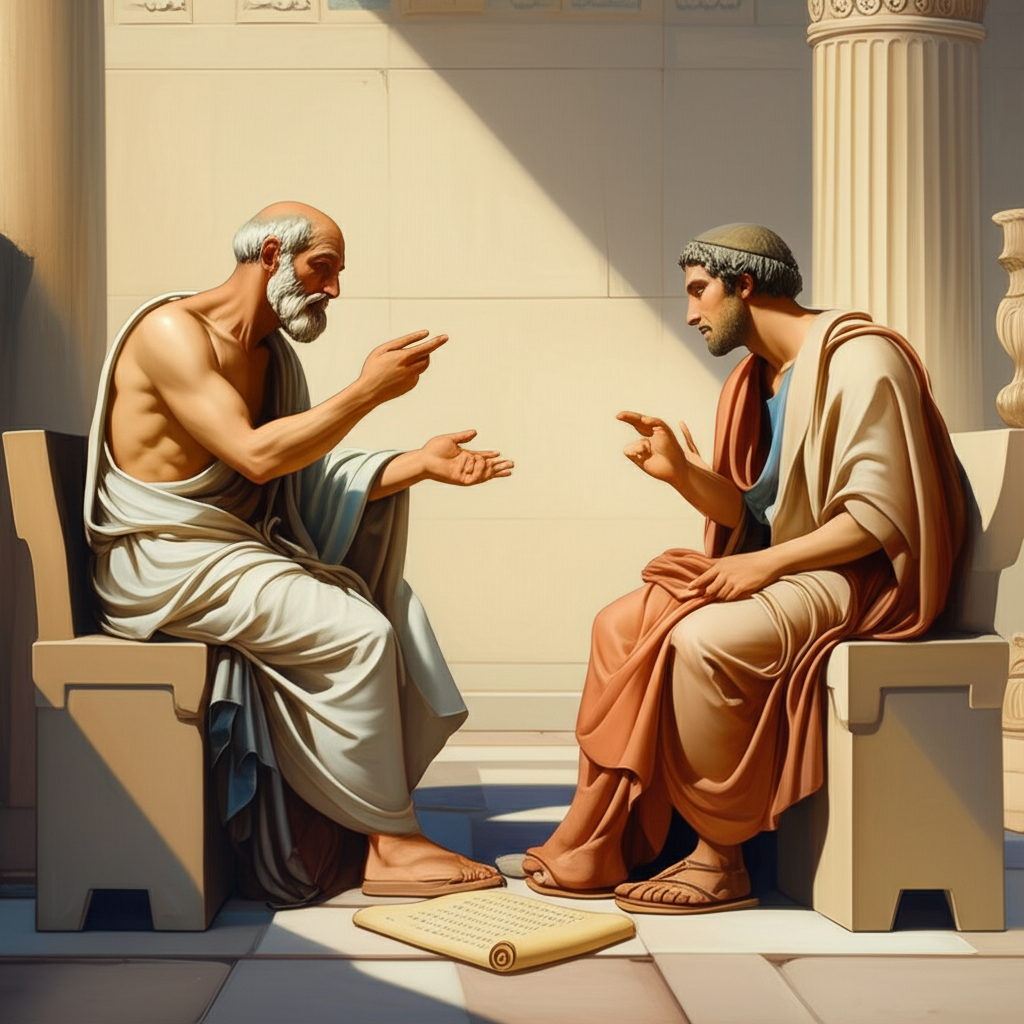
The origins of the dialectic method are most famously rooted in the ancient Greek tradition, particularly through the figure of Socrates, as immortalized in Plato's dialogues—cornerstones of the Great Books of the Western World. Socrates, rather than lecturing, engaged his interlocutors in a relentless series of questions, designed to expose contradictions in their beliefs and to lead them, step by step, towards a clearer apprehension of concepts like justice, virtue, or beauty.
This Socratic method exemplifies the initial phase of dialectical Reasoning:
- Initial Proposition: An assertion or definition is put forth.
- Critical Examination: Through questioning, inconsistencies or flaws in the proposition are revealed.
- Revision and Refinement: The original idea is modified or discarded, prompting a deeper search for truth.
This iterative process, driven by persistent inquiry and logical Reasoning, was not about winning an argument, but about the collaborative pursuit of Knowledge. It taught that true understanding often emerges from the crucible of intellectual challenge.
From Argument to Understanding: The Mechanism of Dialectic
While the Socratic method laid the groundwork, the dialectic evolved, notably through the contributions of thinkers like Georg Wilhelm Friedrich Hegel. Hegel's dialectic presented a more formalized process, often described as a progression through thesis, antithesis, and synthesis.
Let us consider the fundamental stages of this powerful method:
- Thesis: This is an initial proposition, an idea, or a statement of belief. It represents a starting point for inquiry, often a conventional or widely accepted notion.
- Antithesis: This is the opposing argument, the counter-proposition, or the critical challenge to the thesis. It highlights the limitations, contradictions, or partiality of the initial idea. The tension between thesis and antithesis is crucial, as it provides the intellectual friction necessary for progress.
- Synthesis: This is the resolution of the conflict between the thesis and antithesis. It is not merely a compromise, but a new, higher-level understanding that incorporates the valid aspects of both previous positions while transcending their individual limitations. This synthesis then often becomes a new thesis, initiating a further cycle of dialectical inquiry, pushing the boundaries of Knowledge ever forward.
This structured Reasoning ensures that ideas are not merely accepted but are rigorously tested and refined against their opposites, leading to a more robust and comprehensive understanding.
Why Dialectic Endures: Cultivating Philosophical Knowledge
The enduring power of the dialectic method lies in its capacity to cultivate profound philosophical Knowledge. It is a tool that:
- Uncovers Hidden Assumptions: By forcing us to defend our beliefs, the dialectic exposes the often-unexamined premises upon which our arguments rest.
- Fosters Intellectual Humility: The process teaches that truth is often complex and that our initial understanding is rarely complete, encouraging an open mind and a willingness to revise our views.
- Refines Critical Reasoning: Engaging in dialectical discourse sharpens our analytical skills, our ability to construct coherent arguments, and to identify logical fallacies.
- Advances Collective Knowledge: By integrating diverse perspectives and resolving contradictions, the dialectic contributes to a richer, more comprehensive body of shared understanding within any field of inquiry.
Beyond the Academy: Dialectic in Modern Reasoning
While deeply embedded in Philosophy, the principles of the dialectic extend far beyond the academic halls. Its influence can be observed in various forms of modern Reasoning:
- Scientific Method: The process of hypothesis (thesis), experimentation and peer review (antithesis), leading to revised theories (synthesis) mirrors the dialectical progression.
- Legal Systems: The adversarial nature of courtrooms, with prosecution and defense presenting opposing arguments to reach a verdict, is fundamentally dialectical.
- Political Discourse: Healthy democratic debate, where different ideologies clash to forge policy, draws upon the very essence of the dialectic.
- Personal Growth: Even in individual reflection, challenging one's own biases and assumptions through internal dialogue employs a form of dialectical Reasoning.
Conclusion: The Perpetual Quest for Knowledge
The dialectic method is more than just a historical curiosity; it is a vital, living tradition in the pursuit of Knowledge. From the Socratic dialogues of ancient Greece to the grand philosophical systems of Hegel, it has consistently provided a robust framework for critical Reasoning and the systematic exploration of complex ideas. To engage with the dialectic is to commit oneself to a continuous journey of intellectual growth, a perpetual quest for deeper understanding that remains as relevant today as it was millennia ago. It reminds us that truth is often found not in singular pronouncements, but in the dynamic interplay of ideas, in the courageous willingness to challenge, to question, and to synthesize.
📹 Related Video: SOCRATES ON: The Unexamined Life
Video by: The School of Life
💡 Want different videos? Search YouTube for: ""Socratic Method Explained" and "Hegel Dialectic Explained""