

The Enduring Ascent: Navigating Truth Through the Dialectic Method of Philosophical Inquiry
The dialectic method stands as a cornerstone of philosophical inquiry, a rigorous process of reasoning that meticulously sifts through ideas to uncover deeper knowledge. Far from a mere debate, it is a structured journey of intellectual exploration, where opposing viewpoints are engaged not to win an argument, but to refine understanding and move closer to truth. This article will delve into the historical roots, core mechanics, and profound significance of the dialectic, asserting its indispensable role in the pursuit of philosophy.
Unpacking the Dialectic: A Journey Towards Deeper Understanding
The dialectic is, at its heart, a method of intellectual discourse and inquiry that seeks to resolve contradictions and arrive at a more comprehensive truth. It is a process of engaging with ideas, often through dialogue, by presenting a thesis, challenging it with an antithesis, and ultimately synthesizing these opposing views into a new, more advanced understanding. This iterative process of questioning, critiquing, and refining is fundamental to the very fabric of philosophy, driving the evolution of thought and the expansion of knowledge. From the ancient Greek agora to the halls of modern academia, the dialectic remains an essential tool for robust reasoning.
The Historical Tapestry of Dialectical Thought
The origins of the dialectic are deeply embedded in the foundational texts of Western civilization, particularly within the Great Books of the Western World. Its evolution reflects humanity's persistent quest for clarity and truth.
Socrates and the Elenctic Method
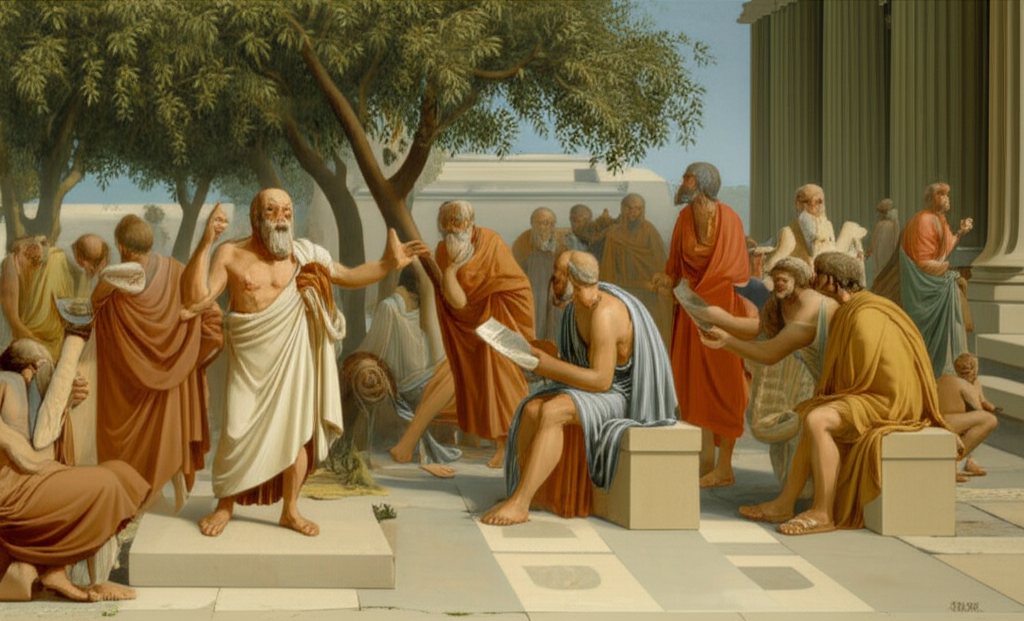
Perhaps the most iconic figure associated with the early dialectic is Socrates. His "elenchus" or Socratic method, as immortalized in Plato's dialogues, involved a relentless process of questioning. Socrates would engage interlocutors, often those who claimed expertise, by probing their definitions and assumptions. Through a series of incisive questions, he would expose contradictions in their beliefs, leading them to acknowledge their own ignorance. This wasn't about humiliation, but about clearing away false knowledge to prepare the ground for genuine inquiry. The Socratic method is a powerful demonstration of how confronting one's own intellectual limits can be the first step towards true wisdom.
Plato's Dialectic: Ascent to the Forms
Plato, a student of Socrates, further developed the dialectic, seeing it as the highest form of reasoning, essential for the philosopher's ascent to the understanding of the Forms. For Plato, dialectic was the intellectual method by which one could move beyond the sensory world of appearances to grasp the eternal, unchanging truths. His dialogues, such as The Republic and Phaedo, are not merely literary works but living examples of this process, where characters engage in rigorous back-and-forth arguments to explore complex philosophical concepts like justice, beauty, and the nature of reality.
Aristotle's Contributions to Logical Inquiry
While Aristotle systematized logic with his syllogisms, his approach to inquiry still bore the marks of the dialectic. He often began his investigations by reviewing the endoxa – the commonly held beliefs or opinions of the wise – before subjecting them to critical examination and logical reasoning. His method, though more structured, still involved a critical engagement with existing knowledge to arrive at more precise definitions and conclusions.
The Core Mechanics: Thesis, Antithesis, Synthesis
The most recognized formulation of the dialectic involves a three-stage progression:
- Thesis: An initial proposition or statement of an idea. This is the starting point, often a widely accepted belief or a new hypothesis.
- Antithesis: A counter-proposition that directly contradicts or challenges the thesis. This stage involves critical examination, identifying inherent flaws, limitations, or opposing perspectives within the initial idea.
- Synthesis: A new proposition that reconciles the tension between the thesis and antithesis, incorporating the valid aspects of both while overcoming their limitations. This synthesis then often becomes a new thesis, restarting the dialectic at a higher level of understanding.
This iterative process ensures that philosophical inquiry is dynamic and progressive, constantly refining knowledge through rigorous reasoning.
The Purpose and Power of Dialectical Inquiry
The consistent application of the dialectic serves several vital purposes in philosophy and beyond:
- Refinement of Concepts: It forces clarity in definitions and precision in arguments, stripping away ambiguity.
- Unveiling Assumptions: By challenging propositions, it brings to light underlying assumptions that might otherwise remain unexamined.
- Expansion of Perspective: Engaging with opposing viewpoints broadens one's understanding, fostering intellectual empathy and a more holistic grasp of complex issues.
- Progressive Knowledge Acquisition: The synthesis stage doesn't just resolve a conflict; it creates new knowledge that is more robust and comprehensive than its predecessors.
- Cultivation of Critical Reasoning: Regular engagement with the dialectic sharpens one's ability to analyze, critique, and construct coherent arguments, an invaluable skill in all facets of life.
Notable Dialectical Approaches Across History
The dialectic has manifested in various forms throughout the history of philosophy, adapted by different thinkers to suit their specific inquiries.
| Philosopher/Era | Key Dialectical Approach | Focus | Contribution to Knowledge |
|---|---|---|---|
| Socrates | Elenctic Method (Questioning to expose contradictions) | Moral concepts, definitions, self-knowledge | Uncovering ignorance, foundational for ethical philosophy |
| Plato | Dialogues (Ascent to the Forms) | Metaphysics, justice, ideal state, eternal truths | Theory of Forms, the ideal Republic, the nature of reality |
| Kant | Antinomies of Pure Reason | Limits of human reasoning, paradoxes of metaphysics | Critiques of dogmatic metaphysics, groundwork for critical philosophy |
| Hegel | Absolute Idealism (Thesis-Antithesis-Synthesis) | History, spirit, logic, the development of consciousness | Dialectical Idealism, understanding history as a rational unfolding of spirit |
| Marx | Historical Materialism | Social and economic structures, class struggle, historical change | Materialist conception of history, critique of capitalism, theory of revolution |
The Enduring Relevance of Dialectic in Contemporary Thought
Even in our highly specialized modern world, the dialectic remains an indispensable tool for intellectual progress. Whether in scientific debate, legal arguments, political discourse, or personal reflection, the ability to critically engage with ideas, identify opposing viewpoints, and synthesize them into a more nuanced understanding is paramount. It fosters intellectual humility, encourages open-mindedness, and strengthens our capacity for robust reasoning. The journey of philosophy itself, as illuminated by the Great Books, is a testament to the enduring power of this method to push the boundaries of human knowledge.
YouTube: "Socrates Dialectic Method Explained"
YouTube: "Hegel's Dialectic: Thesis, Antithesis, Synthesis"
📹 Related Video: SOCRATES ON: The Unexamined Life
Video by: The School of Life
💡 Want different videos? Search YouTube for: "The Dialectic Method of Philosophical Inquiry philosophy"