

Unveiling Truth: The Dialectic Method of Philosophical Inquiry
The dialectic method stands as a cornerstone of philosophy, offering a rigorous approach to reasoning that systematically explores ideas to uncover deeper knowledge. From its Socratic origins to its Hegelian manifestations, it involves a dynamic interplay of viewpoints, challenging assumptions and refining understanding through critical discourse. This article delves into its core principles, historical evolution, and enduring relevance in the pursuit of truth.
The Enduring Power of Philosophical Dialogue
For millennia, humanity has grappled with fundamental questions about existence, morality, and the nature of reality. How do we move beyond mere opinion to genuine knowledge? How do we test the validity of our beliefs? The answer, as many of the Great Books of the Western World attest, often lies in the dialectic method – a process of reasoned argumentation and critical discourse that propels philosophical inquiry forward.
At its heart, the dialectic is not merely a debate; it is a collaborative (or self-reflective) journey towards truth, where conflicting ideas are brought into conversation to reveal inconsistencies, refine concepts, and ultimately forge a more robust understanding. It's the engine of intellectual progress, pushing us to transcend simplistic answers and embrace complexity.
Historical Roots: From Socratic Questioning to Hegelian Synthesis
The dialectic method has a rich and varied history, evolving significantly across different philosophical epochs.
Socrates and the Art of Elenchus
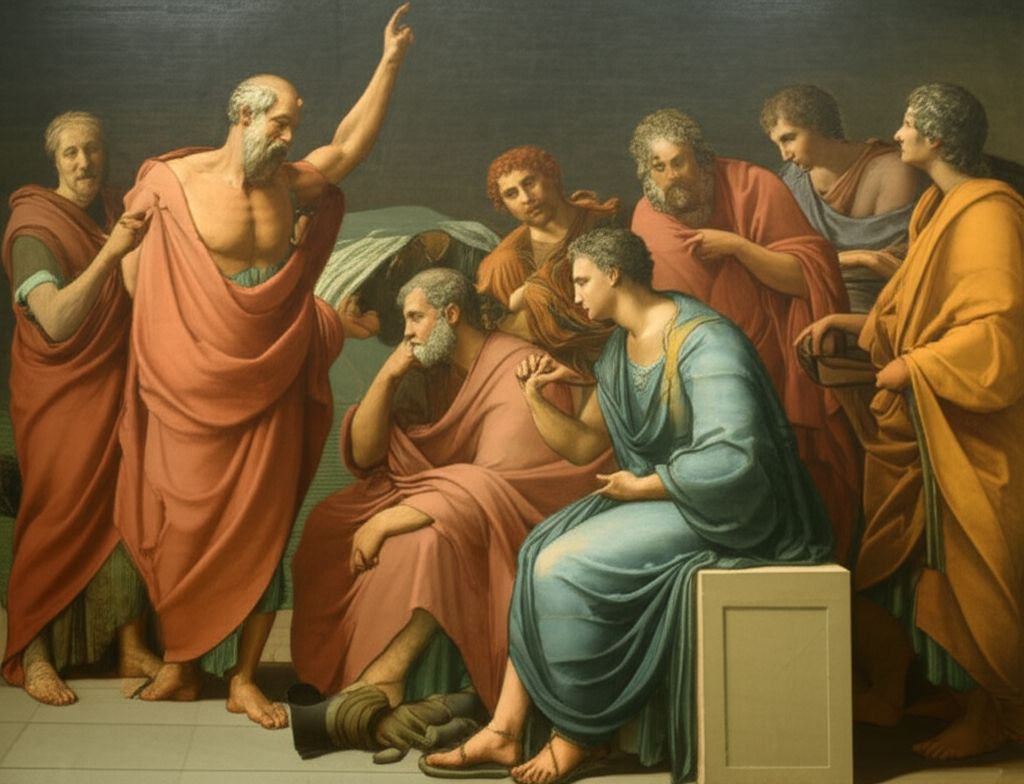
Perhaps the most famous proponent of the dialectic was Socrates, as immortalized in Plato's dialogues. His method, often called elenchus, involved a relentless series of questions posed to an interlocutor. Socrates would challenge definitions, expose contradictions in beliefs, and demonstrate the limits of supposed knowledge. This wasn't about winning an argument but about purging false convictions and preparing the mind for genuine insight. The goal was to move from ignorance to a recognition of one's ignorance, a crucial first step towards wisdom.
- Key Features of Socratic Dialectic:
- Questioning: Posing fundamental questions about concepts like justice, virtue, or beauty.
- Refutation: Demonstrating inconsistencies in the interlocutor's answers.
- Aporia: Reaching a state of perplexity or impasse, revealing the limits of current understanding.
- Maieutic: "Midwifery" – helping others "give birth" to their own ideas, rather than simply imparting knowledge.
Hegel and the Triadic Movement
Centuries later, Georg Wilhelm Friedrich Hegel transformed the dialectic into a grand system explaining the development of history, ideas, and reality itself. For Hegel, the dialectic was a three-stage process:
- Thesis: An initial idea or proposition.
- Antithesis: A counter-proposition that contradicts or negates the thesis.
- Synthesis: A new, higher-level understanding that resolves the conflict between the thesis and antithesis, incorporating elements of both. This synthesis then becomes a new thesis, continuing the process.
This Hegelian dialectic emphasizes that progress is not linear but arises from conflict and resolution, constantly moving towards a more comprehensive and rational understanding of the world. It’s a dynamic process of reasoning that sees ideas evolve and develop through internal contradictions.
The Mechanics of Dialectical Reasoning
Regardless of its specific form, the dialectic method hinges on several core principles that facilitate robust reasoning and the acquisition of knowledge:
| Element | Description | Role in Inquiry |
|---|---|---|
| Proposition (Thesis) | An initial statement, belief, or concept presented for consideration. | Provides a starting point for discussion and analysis. |
| Counter-Proposition (Antithesis) | An opposing argument, critique, or alternative viewpoint that challenges the initial proposition. | Forces critical examination, exposes potential flaws, and introduces complexity. |
| Critical Evaluation | The rigorous analysis of both the proposition and counter-proposition, seeking logical consistency. | Identifies contradictions, strengths, and weaknesses of each argument. |
| Refinement & Synthesis | The process of revising, integrating, or creating a new understanding that transcends the initial conflict. | Moves beyond simple opposition to a more nuanced, comprehensive, and accurate form of knowledge. |
| Iterative Process | The understanding that the synthesis itself can become a new thesis, continuing the cycle of inquiry. | Ensures ongoing intellectual growth and the continuous pursuit of deeper truths. |
This iterative process of challenge and resolution is what makes the dialectic such a powerful tool in philosophy. It doesn't allow ideas to remain unchallenged; instead, it subjects them to the crucible of rigorous intellectual scrutiny.
Why the Dialectic is Indispensable to Philosophy
The dialectic method is not just a historical curiosity; it is fundamentally intertwined with the very nature of philosophy itself.
- Cultivating Critical Thinking: It trains the mind to question assumptions, identify fallacies, and construct coherent arguments. This is foundational to all sound reasoning.
- Deepening Understanding: By forcing us to consider opposing viewpoints, it prevents intellectual stagnation and encourages a more holistic grasp of complex issues. We don't just learn what to think, but how to think.
- Achieving Robust Knowledge: When an idea withstands dialectical scrutiny, its validity is significantly strengthened. The knowledge gained through this process is more resilient and less prone to easy refutation.
- Promoting Intellectual Humility: Encountering the limitations of one's own beliefs through dialectical exchange fosters humility, reminding us that truth is often more elusive and multifaceted than we initially assume.
- Driving Intellectual Progress: As seen in the Great Books of the Western World, philosophical progress often occurs when new ideas challenge established ones, leading to syntheses that advance human thought.
Embracing Dialectical Reasoning in the Modern World
Even outside formal philosophical discourse, the principles of the dialectic remain incredibly valuable. In an age of information overload and echo chambers, the ability to engage in reasoned, open-minded dialogue is more crucial than ever.
Whether we are evaluating political arguments, making ethical decisions, or simply trying to understand differing perspectives in our daily lives, applying a dialectical approach encourages us to:
- Clearly articulate our own positions.
- Actively seek out and understand counter-arguments.
- Identify underlying assumptions and potential biases.
- Strive for a more nuanced and comprehensive understanding, rather than simply asserting a belief.
By consciously engaging in this process of thesis, antithesis, and synthesis, we can elevate our discussions, improve our decision-making, and collectively move towards a more enlightened understanding of the world. It’s a timeless method for pursuing genuine knowledge.
Conclusion: The Unending Quest for Truth
The dialectic method, in its various forms, remains a vital tool in the philosophical toolkit. From the bustling agora of ancient Athens to the quiet contemplation of modern scholars, it has consistently provided a pathway for rigorous reasoning and the systematic pursuit of knowledge. It reminds us that truth is rarely simple, often emerging from the careful examination and reconciliation of conflicting ideas. As we continue our human journey of inquiry, the dialectic will undoubtedly remain an indispensable guide, urging us ever onward in our quest for deeper understanding.
📹 Related Video: SOCRATES ON: The Unexamined Life
Video by: The School of Life
💡 Want different videos? Search YouTube for: "Socrates Dialectic Method Explained"
📹 Related Video: PLATO ON: The Allegory of the Cave
Video by: The School of Life
💡 Want different videos? Search YouTube for: "Hegel Dialectic Thesis Antithesis Synthesis"