

The Desire for Infinity: A Philosophical Inquiry into Man's Boundless Yearning
Summary:
From the deepest recesses of the soul, man harbors an insatiable desire for something beyond the finite – a yearning for infinity. This article explores this profound human characteristic, tracing its philosophical roots through the Great Books of the Western World and examining how this inherent longing shapes our pursuits in knowledge, beauty, and the spiritual. We delve into the implications of a creature bound by time and space yet perpetually drawn towards the boundless, suggesting that this very tension defines much of our human experience and philosophical endeavor.
Introduction: The Echo of the Boundless
There is a peculiar restlessness woven into the fabric of human existence. No matter the achievements, the satisfactions, or the comforts attained, a certain emptiness often persists, a whisper suggesting that something more lies just beyond our grasp. This is not merely discontent; it is, I believe, a fundamental desire for infinity, an inherent pull towards the boundless that distinguishes man from all other creatures. It is this profound yearning that has fueled our greatest philosophical inquiries, our most sublime artistic creations, and our most fervent spiritual quests.
The Human Condition: A Glimpse of the Infinite
Man is a creature of limits. Our lives are finite, our knowledge imperfect, our perceptions constrained by the senses. Yet, within this bounded existence, we possess the capacity to conceive of the unbounded. We can imagine endless space, eternal time, perfect forms, and ultimate truths. This capacity, this unique mental faculty, hints at a profound connection between our inner world and the outer cosmos, or perhaps, a reflection of a deeper reality.
The Restless Soul:
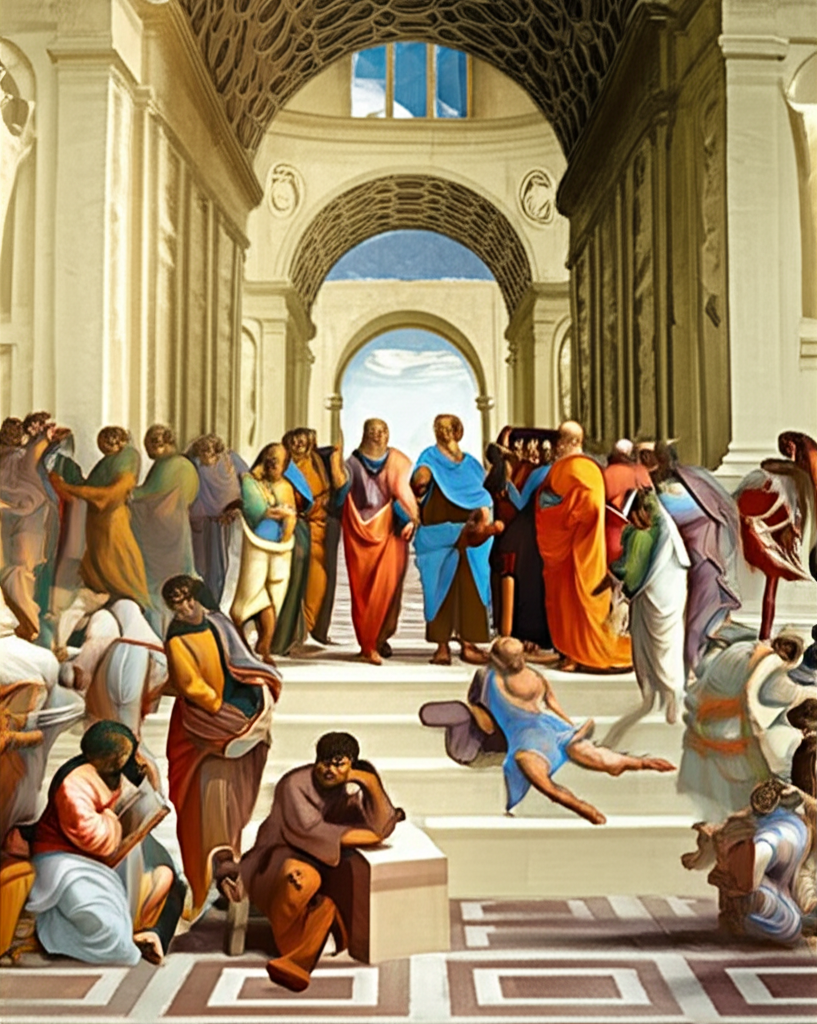
The ancient philosophers often spoke of the soul as the seat of our higher faculties, the part of us that seeks the divine, the true, and the beautiful. For figures like Plato, the soul remembers a realm of perfect Forms, a realm of pure infinity that our earthly experience can only dimly reflect. This remembrance ignites a longing, a desire to transcend the ephemeral and reconnect with the eternal. It is this restless soul, perpetually seeking completion, that drives our quest for meaning beyond the mundane.
Philosophical Roots of Infinite Desire in the Great Books
The annals of Western thought are replete with explorations of this infinite desire. The Great Books of the Western World offer a rich tapestry of perspectives on this fundamental human drive:
| Philosopher/Tradition | Concept/Contribution to "Desire for Infinity" |
|---|---|
| Plato | The soul's ascent to the Forms; the Good as the ultimate, infinite object of knowledge and desire. Our earthly loves are but shadows of a perfect, infinite Love. |
| Aristotle | The Prime Mover as the uncaused cause, pure actuality, and the ultimate object of intellectual contemplation, drawing all things towards itself through desire. |
| Augustine | "Our heart is restless until it rests in Thee." A direct articulation of the soul's infinite desire for God, an infinite being, as its only true fulfillment. |
| Aquinas | The human intellect's natural desire to know the first cause, which can only be fully satisfied by the vision of God, an infinite intellect. |
| Kant | The moral law within us, demanding an infinite progression towards perfect virtue (the summum bonum), implying the immortality of the soul and the existence of God to achieve this infinite ideal. |
These thinkers, across millennia, consistently point to an inherent orientation of man towards something beyond the finite, whether it be perfect Forms, an ultimate cause, or a divine being. The desire for infinity is not merely a philosophical construct but a deeply felt experience, articulated and analyzed by history's greatest minds.
Manifestations of Man's Infinite Aspiration
This deep-seated desire for infinity manifests in countless ways throughout human endeavor:
- Scientific Inquiry: The relentless pursuit of knowledge, seeking to understand the universe's boundless complexity, its origins, and its ultimate laws. Every answer often opens doors to more questions, hinting at an endless frontier of understanding.
- Artistic Creation: The drive to create beauty that transcends time and space, to capture the ineffable, to express emotions and ideas that resonate universally and eternally.
- Spiritual and Religious Life: The quest for communion with the divine, for salvation, for enlightenment, for an eternal existence, reflecting the most direct expression of the soul's yearning for the absolute and infinite.
- Love and Relationships: The search for an unconditional, enduring love that promises a connection beyond the limitations of individual lives, a glimpse of infinite affection and belonging.
- Moral and Ethical Striving: The pursuit of justice, truth, and goodness, often against all odds, driven by an ideal of perfection that seems infinitely distant yet infinitely desirable.
In each of these domains, man stretches beyond his immediate circumstances, driven by an inner compass pointing towards the boundless.
The Paradox of Desire and Infinity
The fundamental paradox lies in our finite nature grasping at infinity. We are beings of time, yet we yearn for eternity. We are embodied, yet we dream of transcendence. This tension is not a flaw in the human design but perhaps its very essence. It is the friction between our limitations and our aspirations that sparks creativity, fuels inquiry, and gives depth to our spiritual journeys.
The desire for infinity is not a promise of its attainment in this life, but rather a compelling force that shapes our values, our goals, and our understanding of what it means to be human. It reminds us that man is not content with mere survival or transient pleasure; there is an inherent nobility in our ceaseless reach for the stars, a testament to the profound capacity of the human soul.
Conclusion: Embracing the Infinite Journey
To acknowledge the desire for infinity is to embrace a fundamental aspect of the human condition. It is to recognize that our deepest longings are not for finite possessions or fleeting moments, but for something that truly satisfies the boundless dimensions of our soul. Whether this ultimate satisfaction lies in a transcendent realm, an eternal truth, or an ongoing process of becoming, the desire itself is a powerful indicator of man's unique place in the cosmos—a finite being with an infinite heart. It is a journey, not a destination, a perpetual striving that defines our very essence.
YouTube Video Suggestions:
-
📹 Related Video: PLATO ON: The Allegory of the Cave
Video by: The School of Life
💡 Want different videos? Search YouTube for: "Plato's Theory of Forms explained for beginners"
2. ## 📹 Related Video: PLATO ON: The Allegory of the Cave
Video by: The School of Life
💡 Want different videos? Search YouTube for: "St. Augustine's Confessions: The Restless Heart"