

The Architecture of Being: Unpacking Quality and Form in Philosophical Inquiry
We begin with the profound challenge of defining Quality and Form—two concepts that lie at the very heart of Metaphysics. Far from being mere abstract notions, they are the very scaffolding upon which our understanding of reality, excellence, and purpose is built. This exploration delves into the classical philosophical traditions, particularly those found in the Great Books of the Western World, to illuminate how these foundational ideas shape our perception of existence itself, guiding us through the intricate dance between the ideal and the actual.
The Elusive Nature of Quality: More Than Just "Good"
What truly makes something good? What constitutes excellence, or indeed, its opposite? The notion of Quality is one we intuitively grasp in our daily lives, yet its philosophical definition proves remarkably elusive. Is the Quality of a piece of music subjective, residing solely in the listener's appreciation, or does it possess an inherent excellence, a formal perfection that transcends individual taste?
From the earliest inquiries, philosophers grappled with this very question. For many, Quality is not merely an attribute but a measure of how well something fulfills its purpose, how closely it approximates an ideal. It speaks to the essence of a thing, its very being, and its potential for perfection. To understand Quality, then, we must first confront the nature of Form.
The Blueprint of Being: Plato's Forms
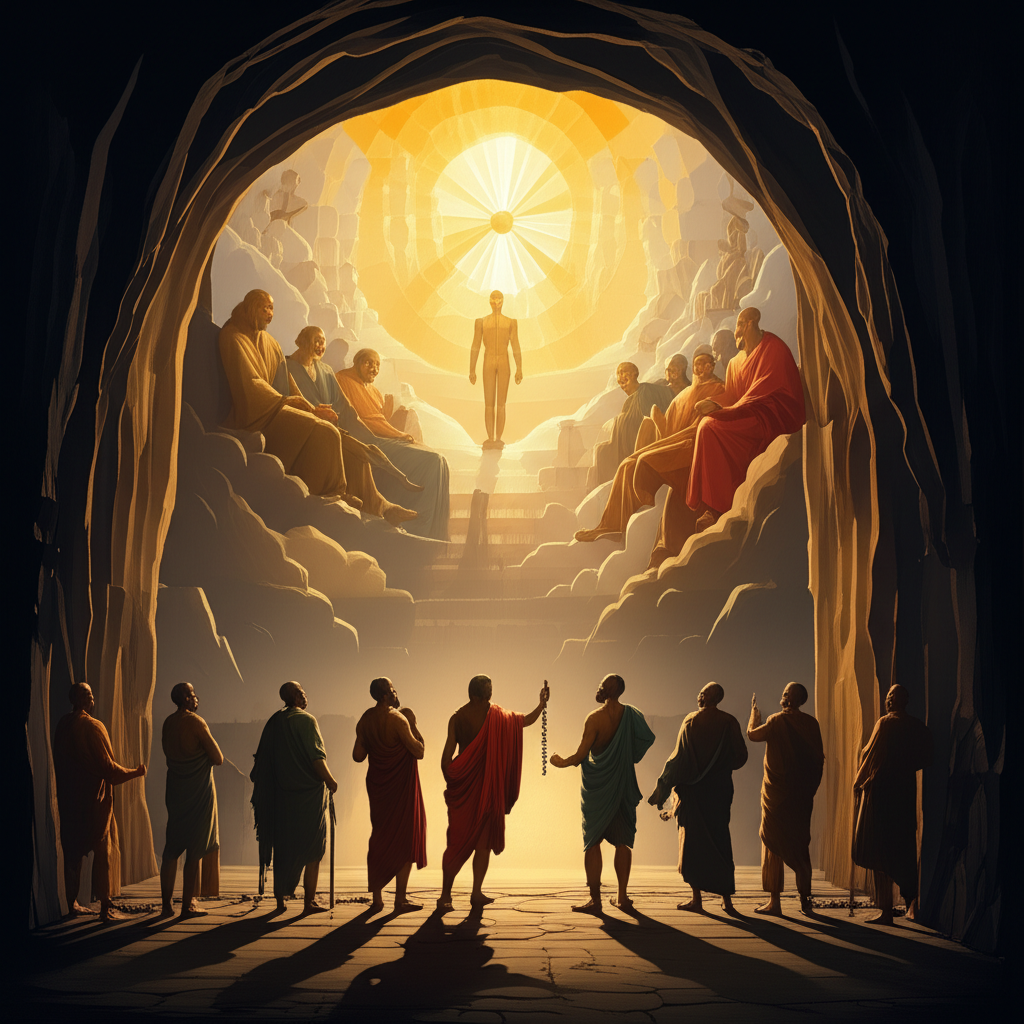
Perhaps no philosopher has more profoundly shaped our understanding of Form than Plato. In his Metaphysics, particularly in dialogues like Phaedo, Republic, and Parmenides, Plato introduces the theory of Forms (or Ideas) as eternal, unchanging, and perfect archetypes that exist independently of the physical world. For Plato, the world we perceive through our senses is merely a shadow, an imperfect copy of these true, intelligible Forms.
Consider a beautiful horse. Its beauty, its Quality, is not merely an opinion, but a participation in the Form of Beauty itself. The horse is beautiful because it partakes, however imperfectly, in the ideal, perfect Form of Beauty that resides in a transcendent realm. Similarly, the Form of Horseness is what makes a horse a horse, giving it its essential nature and distinguishing it from a cow or a tree. These Forms provide the ultimate definition for all things, serving as the standards against which all particulars are measured, and from which they derive their Quality.
Aristotle's Embodied Form and the Pursuit of Quality
While deeply influenced by Plato, Aristotle offered a different, yet equally profound, perspective on Form. For Aristotle, as explored in his Metaphysics and Physics, Form is not separate from matter but is immanent within it. It is the organizing principle, the essence, the "what-it-is" that makes a particular substance what it is. A sculptor shapes clay, but it is the Form of the statue—its specific shape, structure, and intended purpose—that defines it, not merely the clay itself.
Aristotle's concept of Form is intrinsically linked to his idea of teleology, or purpose. The Form of an acorn is to become an oak tree; its Quality is measured by how well it actualizes this potential. For Aristotle, Quality is the fulfillment of a thing's inherent Form or essence. A good knife has the Quality of sharpness and durability because these attributes enable it to fulfill its Form as a cutting tool. The definition of a thing, therefore, involves understanding its Form and its ultimate end.
To illustrate the subtle but significant differences:
| Aspect | Plato's Form (Idea) | Aristotle's Form (Eidos) |
|---|---|---|
| Location | Transcendent, separate realm (World of Forms) | Immanent, inherent in particular objects |
| Nature | Perfect, eternal, unchanging archetype | Essential nature, structure, function of a thing |
| Relationship to Matter | Independent of matter; matter "participates" in Forms | Inseparable from matter; gives matter its specific being |
| Knowledge Acquisition | Attained through intellect, recollection | Attained through empirical observation and rational analysis |
| Role in Quality | Standard of perfection; things have Quality by partaking | Fulfillment of potential; Quality is the actualization of Form |
The Indissoluble Link: Quality as a Reflection of Form
Whether transcendent or immanent, the philosophical exploration of Quality cannot be disentangled from the concept of Form. Form provides the structure, the essence, the very blueprint of existence. Quality, in turn, describes how perfectly that Form is instantiated or realized. A well-made chair embodies the Form of a chair effectively, serving its purpose with durability and aesthetic appeal—its Quality is high. A poorly made chair fails to fully realize its Form, resulting in low Quality.
This connection extends beyond physical objects to abstract concepts. The Quality of a philosophical argument, for instance, might be judged by its logical Form, its coherence, and its ability to accurately represent truth. In all these cases, the definition of Quality relies fundamentally on an understanding of the underlying Form.
Beyond Ancient Greece: Enduring Questions in Metaphysics
The foundational discussions of Plato and Aristotle laid the groundwork for millennia of philosophical inquiry into Metaphysics, Quality, and Form. Later thinkers, from medieval scholastics like Thomas Aquinas (who synthesized Aristotelian Form with Christian theology) to modern empiricists and idealists, continued to wrestle with these concepts.
- Rationalists like Descartes and Spinoza sought universal, rational Forms that underpin reality.
- Empiricists like Locke and Hume questioned the existence of inherent Forms, emphasizing sensory experience as the source of our ideas about Quality.
- Aesthetics, a branch of philosophy dedicated to beauty and art, directly engages with the Quality of artistic Forms.
The debate continues to this day, evolving with new scientific discoveries and philosophical paradigms. Yet, the initial questions posed by the Great Books of the Western World remain strikingly relevant: What is the true nature of things? What makes something excellent? How do we define the essence that gives rise to both being and worth?
Conclusion: An Ongoing Dialogue
The definition of Quality and Form is not a static pronouncement but an ongoing philosophical journey. From Plato's transcendent ideals to Aristotle's immanent essences, these concepts provide the very language through which we attempt to understand the universe and our place within it. They compel us to look beyond the superficial, to seek the underlying structures and purposes that give meaning and value to existence. In contemplating Quality and Form, we engage in the timeless pursuit of Metaphysics—the quest to comprehend the fundamental architecture of being itself.
YouTube Video Suggestions:
-
📹 Related Video: PLATO ON: The Allegory of the Cave
Video by: The School of Life
💡 Want different videos? Search YouTube for: "Plato's Theory of Forms explained animated"
2. ## 📹 Related Video: ARISTOTLE ON: The Nicomachean Ethics
Video by: The School of Life
💡 Want different videos? Search YouTube for: "Aristotle Metaphysics Form and Matter"