

Unpacking the Essence: The Philosophical Definition of Quality and Form
Have you ever paused to consider what truly makes something what it is? We use terms like "quality" and "form" constantly, often without a second thought. Yet, these seemingly simple words unlock some of the most profound and enduring questions in philosophy, particularly within the realm of metaphysics. This article delves into how the great thinkers of the Western tradition wrestled with defining these fundamental concepts, revealing that they are not mere descriptors but the very bedrock of our understanding of reality. From Plato's ethereal Forms to Aristotle's immanent essences, we'll explore how the quest to define quality is inextricably linked to the nature of form.
The Elusive Nature of Definition Itself
Before we plunge into the specifics of quality and form, let's acknowledge the inherent challenge: defining definition itself. To define is to set limits, to describe the essential characteristics that distinguish one thing from all others. But how do we define the abstract, the universal, the very principles that underpin our world? This is where philosophy truly begins, pushing beyond superficial observations to grasp the underlying structures of being. The Great Books of the Western World are replete with attempts to do just this, offering diverse lenses through which to view the cosmos.
Form: The Blueprint of Being in Metaphysics
The concept of "Form" is arguably one of the most pivotal in Western metaphysics. It speaks to the underlying structure, the essence, the "whatness" of a thing.
Plato's Realm of Perfect Forms
For Plato, as explored extensively in works like The Republic and Phaedo, Forms are not merely mental constructs but objective, eternal, and perfect archetypes existing in a realm beyond our sensory experience.
- Transcendent: They exist independently of the physical world.
- Immutable: They do not change; they are perfect and everlasting.
- Intelligible: They can only be grasped by the intellect, not the senses.
- Paradigm for Particulars: Individual objects in our world are imperfect copies or participants in these perfect Forms. A beautiful flower is beautiful because it participates in the Form of Beauty.
Example: The Form of "Horseness" is the perfect, ideal horse, of which all physical horses are imperfect manifestations. This Form gives every horse its definition and, crucially, its qualities as a horse. Without the Form, there would be no underlying structure to give a horse its equine attributes.
Aristotle's Immanent Forms
Aristotle, a student of Plato, offered a powerful counterpoint. While acknowledging the importance of Form, he rejected the notion of a separate realm. For Aristotle, as detailed in his Metaphysics and Physics, Form is not transcendent but immanent – it exists within the particular object, inseparable from its matter.
- Hylomorphism: Aristotle's doctrine that every physical substance is a compound of matter (hyle) and form (morphe).
- Essence: Form is the essence, the "what it is to be" a thing. It's what makes a bronze statue a statue, not just a lump of bronze.
- Purpose (Telos): Form also dictates the potentiality and purpose of a thing. The Form of an acorn contains the potentiality to become an oak tree.
Consider: For Aristotle, the Form of "horseness" isn't in a separate realm; it's what makes this specific creature a horse, animating its matter and giving it its distinctive characteristics. It provides the definition and the qualities directly within the object itself.
Quality: Attributes, Excellence, and Perception
If Form provides the whatness, then "Quality" describes the howness – the attributes, characteristics, or properties of that what. But quality is a multifaceted concept.
Attributes and Predicates
In a basic sense, qualities are the features we predicate of a subject. A table might have the qualities of being "wooden," "brown," "smooth," and "four-legged." These attributes help us to define the table more fully. Aristotle categorized qualities as one of his ten categories of being, describing them as inherent properties that can vary in degree.
Quality as Excellence or Value
Beyond mere attributes, "quality" often carries a normative connotation, implying a standard of excellence or value. When we speak of a "quality product," we mean one that is well-made, durable, and performs its function effectively. This aspect of quality often points back to an ideal or a perfect Form. A "quality horse" might be one that perfectly embodies the ideal characteristics of its breed.
The Subjectivity vs. Objectivity of Quality
This leads to a crucial philosophical debate: Is quality an objective feature of reality, or is it a subjective perception?
- Objective Quality: If quality is rooted in Form, then it has an objective basis. The Form of "goodness" or "beauty" would imply objective qualities.
- Subjective Quality: Empiricists like John Locke, in An Essay Concerning Human Understanding, distinguished between primary qualities (inherent in the object, like shape and motion) and secondary qualities (produced in the perceiver, like color and taste). This distinction complicates the idea of objective quality, suggesting that some qualities are mind-dependent.
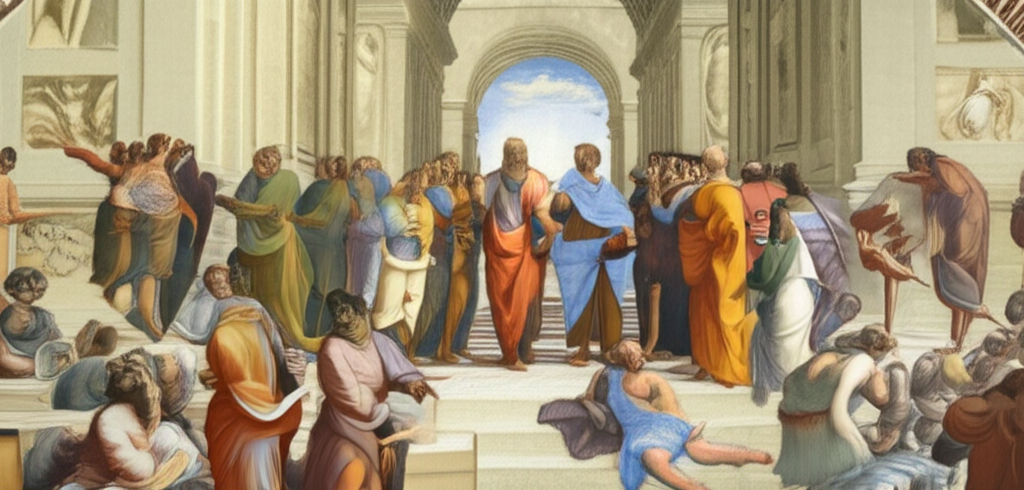
The Interplay: How Form Defines Quality
The true philosophical insight emerges when we see Form and Quality not as separate entities, but as deeply intertwined.
-
Form as the Ground of Quality: In both Platonic and Aristotelian metaphysics, Form is the fundamental principle that determines and grounds the qualities of a thing. A thing possesses its specific qualities because it has a particular Form.
- Plato: An object is "red" because it participates in the Form of Redness; it is "just" because it participates in the Form of Justice. The Form provides the blueprint for the quality.
- Aristotle: An object has the quality of being "hard" or "heavy" because its matter is organized by a Form that necessitates these properties. The Form is the organized structure that gives rise to the qualities.
-
Quality as the Manifestation of Form: Conversely, the qualities we observe are the empirical manifestations of an underlying Form. By analyzing the qualities of a thing, we attempt to understand its underlying Form or essence. This is a crucial step in scientific and philosophical inquiry.
A Table of Perspectives: Form and Quality
| Philosopher | View of Form | Relation to Quality | Key Text (Great Books) |
|---|---|---|---|
| Plato | Transcendent, eternal, perfect archetypes in a separate realm. | Forms are the source and standard for all qualities in the physical world. Particulars possess qualities by participating in Forms. | The Republic, Phaedo |
| Aristotle | Immanent essence within particular objects, inseparable from matter. | Form is the essence that gives rise to the inherent qualities of an object. Qualities are expressions of the object's Form. | Metaphysics, Physics |
| Locke | (Not primarily a theory of Form, but relevant to Quality) | Distinguished Primary (objective) and Secondary (subjective) Qualities, complicating the objective nature of qualities. | An Essay Concerning Human Understanding |
Conclusion: An Enduring Philosophical Quest
The definition of quality and form remains a cornerstone of metaphysics. From the lofty ideals of Plato to the grounded empiricism of Aristotle, the Great Books of the Western World illuminate a persistent human drive to understand the fundamental nature of reality. Whether you see Form as a blueprint in the heavens or an essence within the very fabric of existence, it is clear that our understanding of what something is (its Form) dictates what attributes it has (its Qualities). This philosophical journey is not merely an academic exercise; it's an invitation to look beyond the surface, to question the obvious, and to seek the deeper structures that give meaning and order to our world.
**## 📹 Related Video: PLATO ON: The Allegory of the Cave
Video by: The School of Life
💡 Want different videos? Search YouTube for: ""Plato's Theory of Forms Explained""**
**## 📹 Related Video: ARISTOTLE ON: The Nicomachean Ethics
Video by: The School of Life
💡 Want different videos? Search YouTube for: ""Aristotle Metaphysics Form and Matter""**