

The Enduring Quest for a Just War: A Philosophical Inquiry into its Definition
The very phrase "just war" presents a profound philosophical tension. How can something so inherently destructive and violent as war ever be considered "just"? Yet, for millennia, humanity has grappled with this paradox, attempting to lay down principles and Laws that might delineate the permissible from the reprehensible in armed conflict. From the ancient world to the modern era, philosophers, theologians, and legal scholars have sought a rigorous Definition of what constitutes a just war, not as an endorsement of violence, but as a framework for moral restraint and the pursuit of Justice even amidst the chaos of battle. This enduring inquiry, deeply rooted in the traditions preserved within the Great Books of the Western World, remains central to our understanding of War and Peace.
Historical Roots: From Classical Thought to Scholastic Doctrine
The seeds of just war theory were sown long before the Christian era. Roman thinkers like Cicero, for instance, articulated rudimentary conditions for righteous warfare, often emphasizing the necessity of a formal declaration and the pursuit of redress for wrongs. However, it was within the Christian tradition that the theory truly began to coalesce, driven by the tension between pacifist ideals and the realities of governance and defense.
The foundational contributions often trace back to St. Augustine of Hippo (354-430 AD). Confronted with the sack of Rome and the need for Christian rulers to defend their people, Augustine argued that war, while tragic, could be a necessary evil undertaken out of love and a desire for Peace. For Augustine, a just war must be defensive, waged to restore peace, and authorized by a legitimate authority. Crucially, it must be motivated by Justice, not by a lust for power or vengeance.
Centuries later, St. Thomas Aquinas (1225-1274 AD), drawing heavily on Augustine and integrating Aristotelian philosophy, systematized the criteria for a just war in his Summa Theologica. Aquinas's framework provided a clear Definition with three essential conditions for jus ad bellum (justice in going to war):
- Legitimate Authority: War must be waged by a sovereign, not by private individuals.
- Just Cause: There must be a grave wrong that cannot be otherwise remedied, such as self-defense or the recovery of what was unjustly taken.
- Right Intention: The warring party must intend to promote good or avoid evil, not to inflict harm for its own sake, or to gain power or wealth.
These three pillars formed the bedrock upon which subsequent legal and philosophical discourse on just war would be built, shaping the very Definition of legitimate recourse to arms.
The Age of Reason and the Emergence of International Law
The Renaissance and the Age of Reason witnessed a further refinement of just war theory, particularly with the rise of nation-states and the nascent field of international Law. Figures like Hugo Grotius (1583-1645 AD), often considered the father of international law, expanded upon the scholastic tradition. In his seminal work, On the Law of War and Peace, Grotius sought to establish a secular basis for international legal norms, independent of purely theological arguments. He elaborated not only on the conditions for going to war (jus ad bellum) but also on the conduct within war (jus in bello).
The Grotian tradition emphasized the importance of rational principles and the rights of states, attempting to bring order and ethical considerations to interstate conflict. This period solidified the understanding that a comprehensive Definition of a just war must encompass both the decision to initiate hostilities and the manner in which those hostilities are carried out.
The Two Pillars: Jus ad Bellum and Jus in Bello
Modern just war theory, reflecting centuries of philosophical and legal development, is typically divided into two distinct but interconnected sets of criteria, providing a comprehensive Definition of Justice in War and Peace.
1. Jus ad Bellum (Justice in Going to War)
These are the conditions that must be met before war can be legitimately waged. They address the moral permissibility of resorting to armed conflict.
- Just Cause: The fundamental reason for going to war must be morally justifiable. This typically includes self-defense against aggression, defense of others, or in extreme cases, to prevent massive human rights violations (humanitarian intervention). It explicitly excludes wars of conquest, revenge, or economic gain.
- Legitimate Authority: Only a legitimate political authority (e.g., a sovereign state, as recognized by international Law) has the right to declare and wage war. This prevents private individuals or rogue groups from initiating large-scale violence.
- Right Intention: The ultimate aim of the war must be to achieve a just Peace or to restore Justice, not motivated by malice, vengeance, or territorial expansion. The intention must be to correct the wrong that constituted the just cause.
- Last Resort: War must be considered only after all peaceful alternatives and diplomatic efforts have been exhausted and failed. It is the final, gravest option.
- Proportionality (ad bellum): The good to be achieved by going to war must outweigh the anticipated harm and costs of the war itself. The suffering and destruction expected from the conflict must not be disproportionate to the injustice it seeks to rectify.
- Reasonable Prospect of Success: There must be a reasonable chance that the war will achieve its just aims. Waging a war that is futile or will only lead to greater suffering without achieving Justice is deemed unjust.
2. Jus in Bello (Justice in Conducting War)
These are the conditions that must be met during the conduct of war, regardless of whether the war itself was initiated justly. They govern the ethical behavior of combatants.
- Discrimination (Non-Combatant Immunity): Military forces must distinguish between combatants and non-combatants. Intentional targeting of civilians, civilian infrastructure (unless it directly supports the war effort and its destruction is proportionate), or those who are no longer participating in hostilities (e.g., wounded soldiers, prisoners of war) is strictly forbidden.
- Proportionality (in bello): The force used in military operations must be proportionate to the military objective. Even against legitimate military targets, excessive force that causes disproportionate collateral damage to civilians or civilian property is considered unjust. The harm inflicted must be necessary and not excessive relative to the military advantage gained.
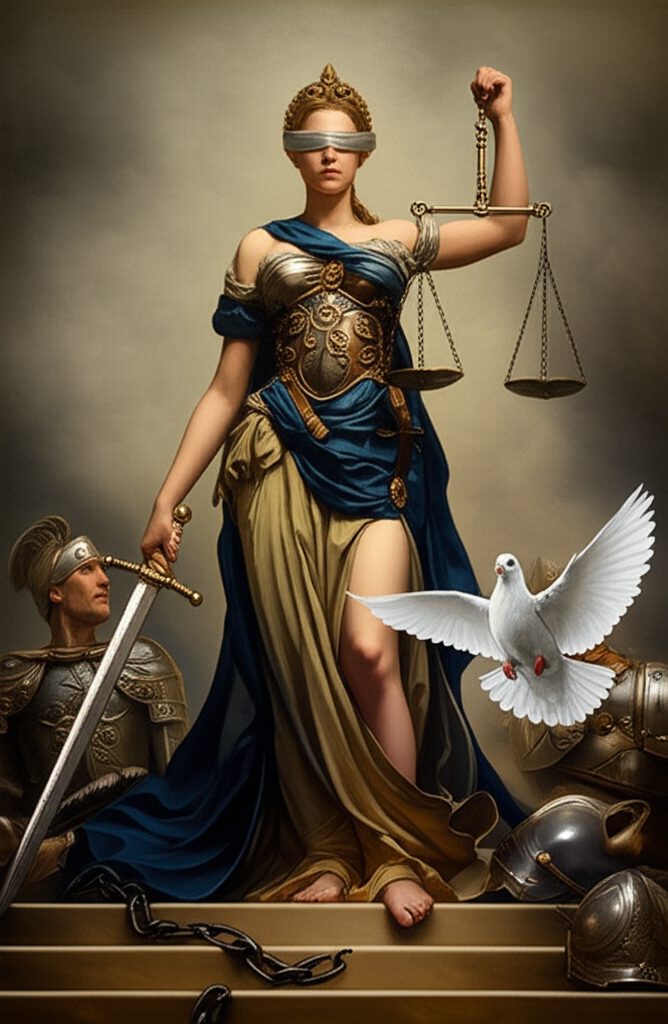
Modern Challenges and Enduring Relevance
The Definition of a just war, though refined over centuries, faces continuous challenges in the modern era. The advent of nuclear weapons, the rise of non-state actors in asymmetric warfare, the complexities of humanitarian intervention, and the pervasive influence of propaganda all test the boundaries of these established principles. Questions arise: Can a "preventive" war ever be just? How do we apply proportionality in an age of precision weaponry and widespread civilian displacement? What constitutes a "legitimate authority" when states fail or when international consensus is elusive?
Despite these complexities, the framework of just war theory, rooted in the Great Books and the persistent human quest for Justice, remains indispensable. It provides a moral compass for leaders, soldiers, and citizens alike, guiding discussions on when and how force may be used, and serving as a critical lens through which to evaluate the ethics of War and Peace. It is a perpetual reminder that even in the darkest corners of human conflict, the imperative of Law and Justice must never be abandoned.
Conclusion
The Definition of a just war is not a simple formula, but a dynamic and evolving philosophical and legal endeavor. From the early insights of Augustine and Aquinas to the sophisticated international Law articulated by Grotius, the core principles have sought to mitigate the horrors of war by subjecting it to moral scrutiny. While conflict may be an inescapable facet of human existence, the relentless pursuit of a just war framework provides a vital moral and ethical standard, striving to ensure that the use of force, when tragically necessary, remains tethered to the ultimate aim of Justice and the restoration of a lasting Peace.
YouTube Video Suggestions:
-
📹 Related Video: PLATO ON: The Allegory of the Cave
Video by: The School of Life
💡 Want different videos? Search YouTube for: ""Just War Theory Explained" or "Michael Walzer Just and Unjust Wars Summary""
2. ## 📹 Related Video: ARISTOTLE ON: The Nicomachean Ethics
Video by: The School of Life
💡 Want different videos? Search YouTube for: ""Augustine Aquinas Just War Philosophy" or "The Ethics of War Crash Course Philosophy""