

The Enduring Quest: Defining a Just War
The concept of a "Just War" is not merely an academic exercise; it is a profound ethical framework that seeks to impose moral and legal constraints on the most destructive of human endeavors. At its core, the Definition of a Just War, as explored through centuries of philosophical discourse, provides criteria by which to judge whether resort to armed conflict is morally permissible (jus ad bellum) and, once initiated, how it ought to be conducted (jus in bello). This ancient yet ever-relevant theory grapples with the inherent tension between the desire for Peace and the grim reality of War, striving to infuse Justice into a realm often perceived as devoid of it, ultimately shaping the very foundations of international Law.
The Weight of Conflict and the Call for Justice
From the earliest city-states to the complexities of modern global politics, humanity has wrestled with the justification of violence. Is there ever a morally defensible reason to wage war? And if so, what limits must be observed? These are the questions that animate Just War theory, a tradition deeply embedded in the philosophical and theological heritage of the Western world. It is a testament to our enduring aspiration for order and Justice, even amidst the chaos of conflict, that thinkers have consistently sought to articulate principles governing the use of force.
I. The Dual Pillars: Jus ad Bellum and Jus in Bello
The framework of Just War theory is traditionally divided into two principal components, each addressing a distinct phase of armed conflict.
A. Jus ad Bellum: Justice in Going to War
This set of criteria pertains to the legitimacy of resorting to war. It establishes the conditions under which a state or entity may ethically and legally initiate armed conflict. Without these conditions being met, the war is deemed unjust from its inception.
- Just Cause: War must be waged for a morally legitimate reason, typically understood as self-defense against aggression, or to rectify a grave public evil (e.g., genocide, massive human rights violations). It is not for conquest or economic gain.
- Legitimate Authority: Only a duly constituted public authority, responsible for the common good, has the right to declare war. This precludes private individuals or rogue factions from initiating conflict.
- Right Intention: The primary goal of the war must be to achieve a just peace, restore order, or correct the injustice that prompted the conflict. Vengeance or wanton destruction are not legitimate intentions.
- Last Resort: All peaceful alternatives—diplomacy, sanctions, negotiations—must have been exhausted or deemed impractical before military force is considered.
- Proportionality (of Ends): The overall good anticipated from waging war must outweigh the harm it is likely to cause. The expected benefits must be commensurate with the likely costs and destruction.
- Reasonable Prospect of Success: There must be a reasonable chance of achieving the just aims of the war. To engage in a war with no hope of success is seen as a futile waste of life.
B. Jus in Bello: Justice in Conducting War
Once a war has legitimately begun, jus in bello dictates the ethical conduct of the combatants during the conflict. These principles ensure that even in the throes of battle, certain moral boundaries are not crossed, upholding the principles of Justice and Law.
- Discrimination (Non-Combatant Immunity): Military force must distinguish between combatants and non-combatants. Direct attacks on civilians, civilian infrastructure (unless directly supporting the war effort and proportional), and prisoners of war are strictly prohibited.
- Proportionality (of Means): The force used in any given military action must be proportional to the military objective being pursued. Excessive force or destruction beyond what is necessary to achieve a legitimate military goal is forbidden.
- Necessity: Only the minimum amount of force necessary to achieve a legitimate military objective should be employed. Unnecessary suffering or destruction is to be avoided.
II. A Philosophical Lineage: Voices from the Great Books
The Definition of a Just War is not a modern invention but a deeply rooted tradition, extensively explored by the intellectual titans compiled in the Great Books of the Western World.
Augustine of Hippo: The Reluctant Warrior for Peace
Writing in the 4th and 5th centuries, Saint Augustine laid crucial groundwork. In City of God, he grappled with the apparent contradiction of Christian pacifism and the need for earthly order. He posited that war could be justified only as a sorrowful necessity, for defensive purposes or to restore Peace and Justice after an injury. For Augustine, the right intention was paramount: war must be waged out of love, not malice, and with the ultimate aim of peace.
Thomas Aquinas: Systematizing the Moral Framework
Centuries later, in his Summa Theologica, Thomas Aquinas (13th century) formalized Augustine's ideas into three explicit conditions for jus ad bellum:
- Legitimate Authority: The sovereign must authorize the war.
- Just Cause: The enemy must deserve to be attacked because of some fault.
- Right Intention: The intention must be to advance good or avoid evil, not for vengeance or greed.
Aquinas's systematic approach provided a robust philosophical and theological foundation for the Just War tradition, deeply influencing subsequent thought on War and Peace.
Hugo Grotius: Towards an International Law of War and Peace
Often considered the father of international Law, Hugo Grotius, in his 17th-century masterpiece On the Law of War and Peace, secularized and expanded upon the Just War doctrine. He sought to establish a universal framework for international relations based on natural law and the Law of nations, independent of specific religious doctrines. Grotius meticulously detailed the rights and obligations of states in both initiating and conducting war, moving the Definition of Just War from purely moral theology to a nascent international legal code.
Immanuel Kant: Perpetual Peace and the Rule of Law
In his essay Perpetual Peace (1795), Immanuel Kant offered a more radical vision. While acknowledging the reality of war, Kant argued for a future where international Law and a federation of republics would render war obsolete. His focus was less on justifying war and more on establishing the conditions for lasting Peace and Justice through a global legal order. Kant's ideas emphasize the importance of international cooperation and the moral imperative of establishing a system where Law, not force, governs relations between states, providing a powerful counterpoint to the justification of war.
III. The Unfinished Definition: Modern Challenges to Justice and Law
Despite its venerable history, the Definition of a Just War remains a subject of intense debate, especially in the face of modern conflicts. The rise of non-state actors, terrorism, humanitarian interventions, and the proliferation of devastating weaponry challenge the traditional categories. How do concepts like legitimate authority apply when states are fighting diffuse networks? What constitutes proportionality in an age of precision strikes and asymmetric warfare? These questions underscore the dynamic nature of the Just War tradition, constantly adapting to new realities while holding fast to its core commitment to Justice and Law in a world perpetually grappling with War and Peace. The ethical complexities demand continuous re-evaluation and careful application of these principles, ensuring that the pursuit of Justice remains central to any decision regarding armed conflict.
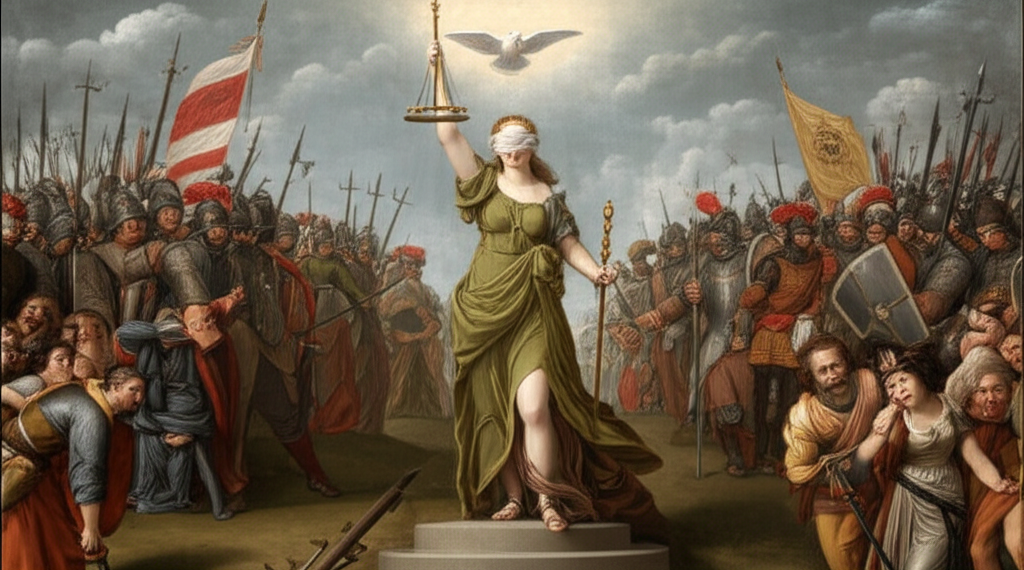
Conclusion: The Perpetual Pursuit of a Just Peace
The Definition of a Just War, forged through centuries of philosophical inquiry and refined by thinkers from Augustine to Kant, offers more than just a set of rules; it provides a moral compass for navigating the perilous landscape of international relations. It is a constant reminder that even in the direst circumstances of conflict, the principles of Justice and Law must not be abandoned. By meticulously examining the conditions for waging War and Peace, we strive not only to mitigate suffering but to uphold the dignity of humanity and to work towards a world where the need for such a framework might, one day, diminish. The pursuit of a Just War is, ultimately, the perpetual pursuit of a just peace.
📹 Related Video: What is Philosophy?
Video by: The School of Life
💡 Want different videos? Search YouTube for: "Just War Theory explained philosophy"
📹 Related Video: KANT ON: What is Enlightenment?
Video by: The School of Life
💡 Want different videos? Search YouTube for: "Augustine and Aquinas on War and Peace"