

The Enduring Framework: Custom, Convention, and the Philosophy of Marriage
Marriage, at its core, is far more than a mere personal union; it is a profound philosophical construct, deeply embedded in the fabric of human society through layers of custom and convention. This article delves into how this foundational institution, the family, has been shaped and understood by Western thought, examining the interplay of societal norms, codified law, and individual and collective duty. From ancient Greece to the Enlightenment, philosophers have grappled with marriage not just as a biological imperative but as a cornerstone of the state, a locus of ethical obligation, and a primary shaper of human experience.
The Genesis of Custom and Convention in Matrimony
The institution of marriage predates formal legal systems, emerging organically from human social structures. Early philosophers, observing the natural inclination towards pairing and procreation, began to articulate the customs that governed these unions and the conventions that elevated them beyond simple cohabitation.
- Aristotle, in his Politics, discusses the household (oikos) as the fundamental unit of the state, preceding the village and the city. He views the union of male and female for the sake of procreation as natural and essential, driven by the desire to leave behind another like oneself. This natural impulse quickly acquired customary forms, dictating roles, responsibilities, and succession.
- Plato, in his Republic, while proposing radical alternatives for the guardian class, still acknowledges the deep-seated nature of marital customs for the general populace, recognizing their role in maintaining social order and population stability. The very idea of challenging these norms highlights their pervasive influence.
These early observations underscore that marriage, even in its most nascent forms, was never solely a private affair. It was always imbued with communal significance, guided by unwritten rules that gradually solidified into widely accepted conventions.
Marriage as a Social Institution: The Imprint of Law
As societies grew more complex, the informal customs and conventions surrounding marriage began to be formalized and enforced through law. This transition marked a crucial shift, elevating marriage from a merely traditional practice to a legally recognized and regulated institution, with profound implications for property, inheritance, and the very structure of the state.
The codification of marriage introduced:
- Defined Rights and Obligations: Law established what was expected of spouses, their rights concerning property, and their responsibilities towards children.
- Social Stability: By regulating who could marry whom, and under what conditions, law aimed to prevent disorder and ensure the orderly transfer of wealth and status.
- Public Recognition: Legal marriage conferred a public status, differentiating it from other forms of cohabitation and providing a framework for societal recognition of the family unit.
Thomas Aquinas, drawing on Aristotelian thought and Christian theology, viewed marriage as a natural institution perfected by a sacrament, emphasizing its indissolubility and its primary ends: procreation and the mutual good of the spouses. Here, law (both natural and divine) provides the overarching structure, guiding the customs and reinforcing the duties inherent in the marital bond.
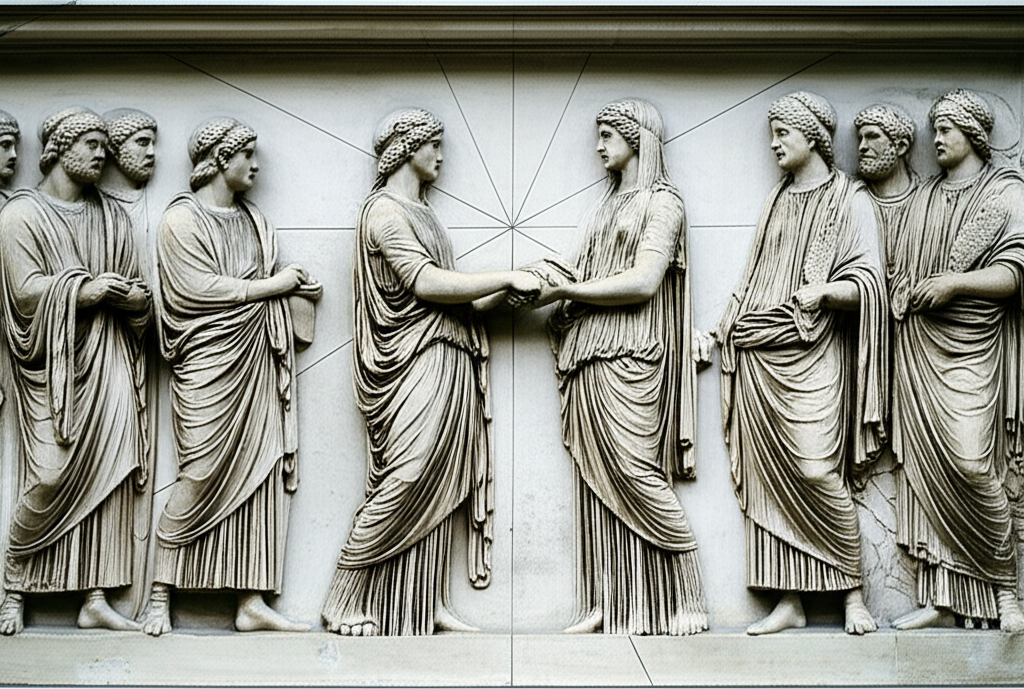
The Philosophical Dimensions of Family Duty
Central to the philosophical understanding of marriage and the family is the concept of duty. Once custom and convention are formalized by law, they impose specific moral and ethical obligations on individuals. These duties extend not only between spouses but also from parents to children, and from the family unit to the broader community.
- Duty to Spouse: This involves loyalty, support, and adherence to vows. Philosophers like Immanuel Kant might frame this in terms of treating the spouse as an end in themselves, never merely as a means, emphasizing the moral imperative of mutual respect and commitment within the marital bond.
- Duty to Children: The procreative aspect of marriage brings with it the profound duty to nurture, educate, and provide for offspring. This is often seen as a fundamental societal obligation, ensuring the continuation and well-being of future generations.
- Duty to Society: The stable family unit, forged through marriage, is traditionally viewed as the primary school of citizenship. It is where individuals first learn social norms, ethical behavior, and their responsibilities towards others, thereby fulfilling a duty to contribute to a stable society. Thinkers like John Locke might implicitly link the stability of the family, and the proper upbringing of children, to the health of the commonwealth and the preservation of property rights.
| Aspect of Marriage | Philosophical Implication | Key Thinker (Great Books) |
|---|---|---|
| Custom | Organic social cohesion | Aristotle |
| Convention | Accepted social norms | Plato |
| Law | Formalized regulation, rights, obligations | Aquinas, Locke |
| Duty | Ethical imperative, moral obligation | Kant, Aristotle |
| Family | Fundamental societal unit | Aristotle, Locke |
Evolving Customs, Enduring Principles
While the specific customs and conventions of marriage have undeniably evolved over centuries – from arranged marriages to unions based on romantic love, and from purely patriarchal structures to more egalitarian partnerships – the underlying philosophical questions persist. How do we balance individual autonomy with societal expectations? What is the duty of the state in regulating private relationships? What constitutes a just and thriving family?
The Great Books of the Western World offer a rich tapestry of perspectives, reminding us that the conversation about marriage, family, law, duty, and the enduring power of custom and convention is not static but a continuous, vital inquiry into the nature of human community and our place within it.
YouTube Video Suggestions:
-
📹 Related Video: ARISTOTLE ON: The Nicomachean Ethics
Video by: The School of Life
💡 Want different videos? Search YouTube for: "Aristotle Politics Family Household"
2. ## 📹 Related Video: ARISTOTLE ON: The Nicomachean Ethics
Video by: The School of Life
💡 Want different videos? Search YouTube for: "Kant Duty Ethics Marriage"