

The Enduring Framework: Custom, Convention, and the Philosophical Family
Marriage, at its core, represents one of humanity's most ancient and persistent institutions. It is a complex tapestry woven from biological imperatives, deeply ingrained social customs, and formalized conventions that ultimately shape the very fabric of the family unit. This article delves into the philosophical underpinnings of marriage, exploring how thinkers throughout Western thought have grappled with its nature, its evolution into law, and the profound duties it entails for individuals and society alike.
The Duality of Marriage: Nature and Nurture
Marriage, viewed through a philosophical lens, is never merely a simple union. It is a profound duality: an institution seemingly rooted in natural human instincts for procreation and companionship, yet simultaneously elevated and constrained by societal constructs. From the earliest human groupings, the pairing of individuals, often for the purpose of raising offspring, became a custom. Over millennia, these customs solidified into conventions, eventually codified into laws that dictate rights, responsibilities, and the very definition of a family.
Philosophers, from the ancient Greeks to the Enlightenment thinkers, have consistently examined this interplay. Is marriage a "natural" state, or is it a purely artificial construct designed for social order? The answer, as often is the case in philosophy, lies in its intricate blend.
Philosophical Perspectives on Custom and Convention
The Great Books of the Western World offer a rich dialogue on the evolution of marriage and the family. Ancient thinkers often viewed the household as the fundamental building block of the state, while later philosophers debated its role in individual liberty and societal progress.
- Aristotle's Politics: Aristotle saw the family (oikos) as the most basic association, preceding the village and the state. He considered the conjugal relationship, along with master-slave and parent-child, as natural components of the household, essential for daily life and the perpetuation of the species. For Aristotle, the custom of marriage was not just about procreation but also about mutual aid and the development of virtue within a shared life.
- Plato's Republic: In stark contrast, Plato, in his ideal state, proposed a radical reimagining of the family for the guardian class. To ensure absolute loyalty to the state, private marriages and child-rearing would be abolished, replaced by communal arrangements. This highlights the philosophical tension: is the custom of the private family a strength or a potential weakness in the grand scheme of the polis?
- John Locke's Two Treatises of Government: Locke explored the "conjugal society" as a voluntary compact, distinct from political society. He emphasized the continuation of the union for the sake of procreation and the nurturing of children until they could fend for themselves. Here, the custom of marriage is framed by natural law and the duty of parents, yet it is also a consensual agreement.
- Jean-Jacques Rousseau's Discourse on the Origin and Basis of Inequality Among Men: Rousseau posited that the first and only natural society is that of the family, where children remain bound to their father only as long as they need him for their preservation. Once this need ceases, the natural bond dissolves, and any continued association becomes a matter of convention.
These diverse perspectives demonstrate that while the custom of marriage is ancient, its philosophical interpretation and societal convention have been subject to constant re-evaluation.
Marriage as Law and Duty
The transition from informal custom to formalized convention is most clearly seen in the establishment of law. Societies across cultures have deemed marriage too significant to be left solely to individual discretion, embedding it within legal frameworks that define its parameters, rights, and obligations.
Key Aspects of Marriage as Law:
- Legal Recognition: Grants status, inheritance rights, and often, legal protection.
- Regulation of Consent: Defines who can marry and under what conditions (e.g., age, consanguinity).
- Dissolution Procedures: Provides a framework for ending a marriage, recognizing its profound societal impact.
- Parental Rights and Responsibilities: Codifies the duties of parents towards their children, often irrespective of the marital status of the parents themselves.
The duty inherent in marriage extends beyond legal obligations. It encompasses moral and ethical responsibilities to one's spouse, children, and the broader community. Philosophers have often debated the nature of these duties: are they primarily for the good of the individual, the family, or the state?
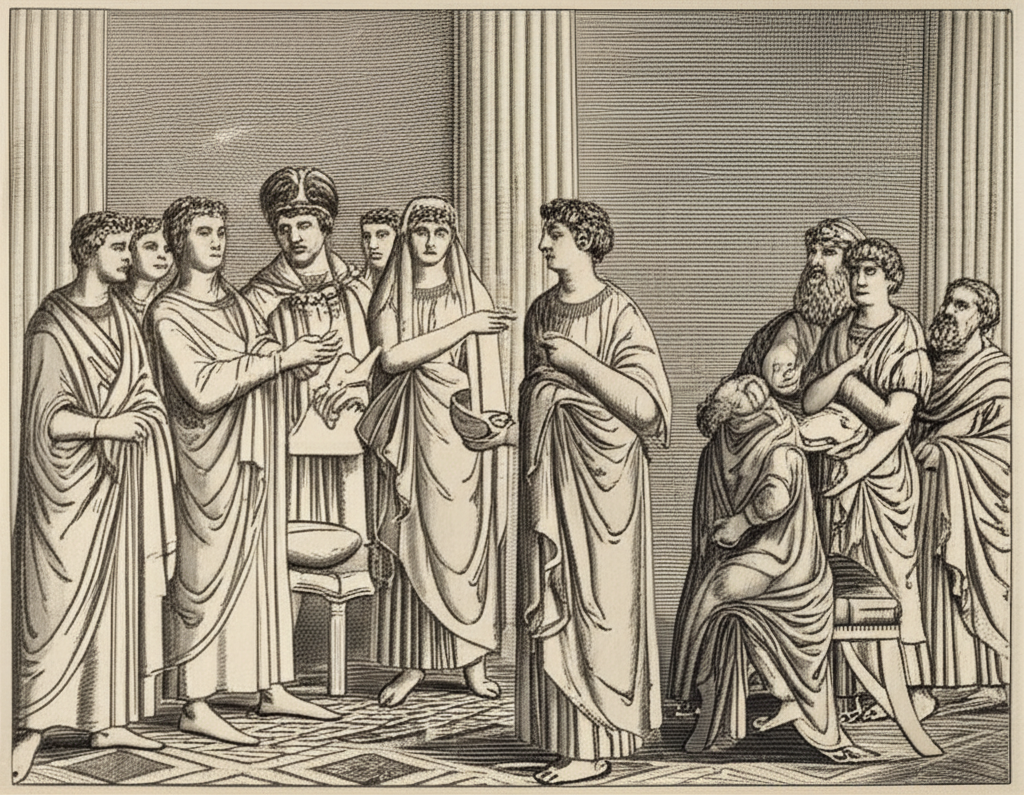
The Family Unit: Foundation and Evolution
The family, universally recognized as the primary unit of socialization, is profoundly shaped by the customs and conventions of marriage. It is within the family that individuals first learn about duty, responsibility, and their place within a larger social structure.
The Evolving Family Structure:
| Era/Philosophical Context | Dominant Family Model | Key Philosophical Debates |
|---|---|---|
| Ancient Greece (Aristotle) | Patriarchal household | Oikos as state's foundation, roles of men/women |
| Medieval (Aquinas) | Nuclear/Extended, Sacramental | Marriage as sacrament, purpose of procreation |
| Enlightenment (Locke) | Nuclear, contractual | Consent, parental duty, individual rights |
| Modern (20th-21st Century) | Diverse forms (nuclear, single-parent, blended, same-sex) | Autonomy vs. tradition, state's role in family definition |
As societies evolve, so too do the customs and conventions surrounding marriage and the family. Modern philosophical discourse often grapples with questions of equality, individual autonomy, and the recognition of diverse family structures, challenging traditional definitions while still acknowledging the enduring human need for connection and belonging.
Conclusion: The Enduring Philosophical Question
The custom and convention of marriage, and by extension the family, remain fertile ground for philosophical inquiry. From the ancient insights of Aristotle on the household's natural associations to Locke's emphasis on consent and duty, the conversation continues. Marriage is not a static institution but a dynamic reflection of our deepest values, our understanding of law, and our collective sense of duty to one another and to future generations. To ponder marriage is to ponder the very essence of human society.
YouTube Video Suggestions:
-
📹 Related Video: What is Philosophy?
Video by: The School of Life
💡 Want different videos? Search YouTube for: ""Great Books of the Western World Marriage Philosophy""
2. ## 📹 Related Video: PLATO ON: The Allegory of the Cave
Video by: The School of Life
💡 Want different videos? Search YouTube for: ""Plato Aristotle Family State Philosophy""