

The Enduring Paradox: Marriage as Custom, Convention, and the Cornerstone of Society
Marriage, in its myriad forms across civilizations and epochs, stands as a profound testament to humanity's intricate dance between inherent inclinations and deliberate societal construction. It is simultaneously a deeply personal bond and a public declaration, a natural association, and a meticulously crafted legal and social institution. This article delves into the philosophical underpinnings of marriage, exploring how it embodies both custom—the long-standing traditions passed through generations—and convention—the agreed-upon rules and structures that formalize its existence, thereby shaping the very essence of the family unit, enforced by law, and imbued with significant duty.
The Inherent and the Imposed: Marriage as Custom and Convention
At its most fundamental, marriage appears to answer a natural human impulse for companionship, procreation, and the raising of offspring. Aristotle, in his Politics, speaks of the household as the primary association, naturally formed for the satisfaction of daily recurrent needs, with the male and female coming together for the purpose of procreation. This elemental pairing, driven by a natural desire to leave behind another being like oneself, forms the biological and emotional bedrock upon which more complex social structures are built.
However, the moment this natural pairing is recognized, regulated, and celebrated by a community, it transcends mere instinct and enters the realm of custom and convention. The rituals, ceremonies, vows, and expectations surrounding marriage are not universal in their specifics, yet their existence is a near-universal human phenomenon. These customs—from the exchange of rings to specific familial blessings—imbue the union with cultural significance, connecting individuals to a lineage and a broader community.
- Custom: Refers to the unwritten rules, traditions, and practices that have evolved over time within a particular society or culture. These are often deeply ingrained and carry significant social weight.
- Convention: Denotes the explicit or implicit agreements, laws, and formal structures that govern behavior and interactions. Conventions provide stability and predictability to social institutions.
Thus, marriage is a profound synthesis: the natural inclination to form a pair becomes codified by custom, which then often solidifies into formal convention, frequently sanctioned by the state or religious institutions.
The Family Unit: A Foundation of Society
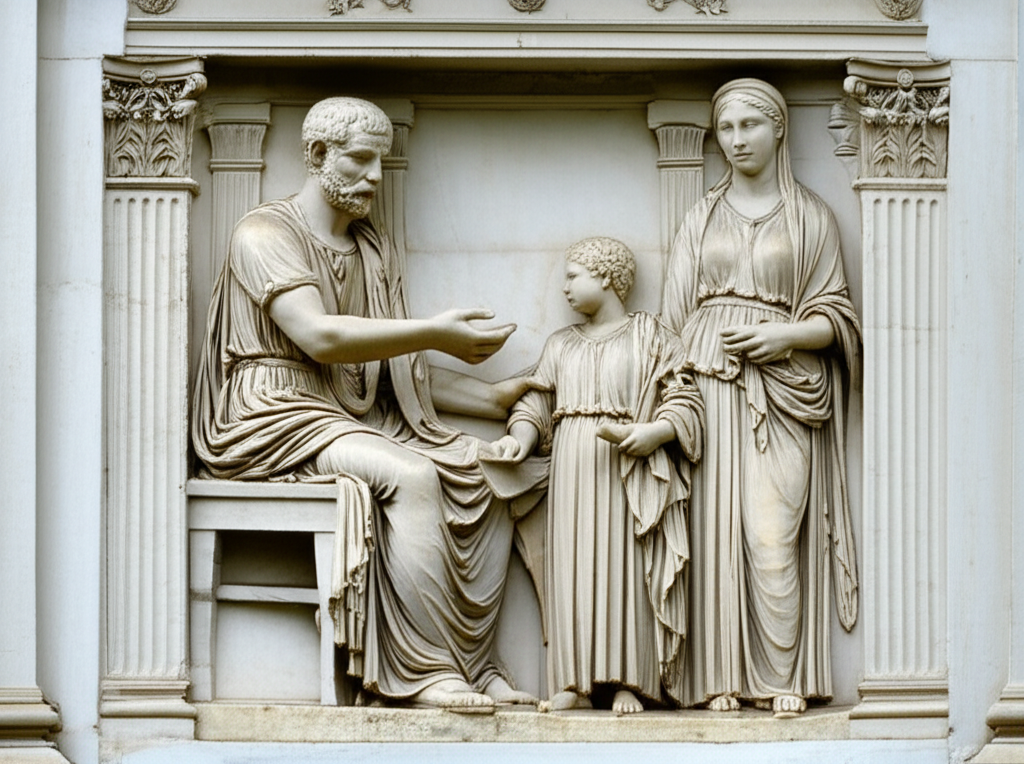
Central to the concept of marriage is the formation of the family. The family, as conceived by many thinkers in the Great Books of the Western World, is not merely a collection of individuals but the foundational unit of society, a microcosm of the state itself. Plato, while envisioning a radical restructuring of family in his ideal Republic for the guardian class, nevertheless recognized the profound influence of early upbringing on a citizen's character. Aristotle, more conservatively, viewed the household as the sphere where individuals first learn the principles of governance, justice, and economic management.
The family serves several critical functions:
- Procreation and Nurturing: Ensuring the continuation of the species and the care of the young.
- Socialization and Education: Transmitting cultural values, moral principles, and practical skills to new generations. Children learn their first lessons in duty and responsibility within the family unit.
- Economic Unit: Historically, families were the primary units of production and consumption, pooling resources and labor.
- Emotional Support: Providing a stable environment for emotional development, companionship, and mutual support.
Law, Duty, and the Marital Bond
The transition from custom to formal convention often involves the intervention of law. Legal frameworks surrounding marriage transform a social understanding into a legally binding contract, bestowing rights and imposing duties upon the spouses and, by extension, upon the family. From ancient Roman patria potestas to modern marriage certificates, the state has played a crucial role in defining who can marry, what constitutes a valid marriage, and the legal consequences of the union's dissolution.
John Locke, in his Two Treatises of Government, discusses conjugal society as a "voluntary compact" between man and woman, primarily for procreation and mutual support, but notes that it carries with it "a mutual support and assistance, and a communion of interests too." This compact, while voluntary, carries specific duties:
- Duty to Spouse: Fidelity, mutual support, companionship.
- Duty to Children: Provision, protection, education, and moral guidance.
- Duty to Society: Contributing to social order through the stable upbringing of citizens.
The law formalizes these duties, providing recourse for their breach and structuring the inheritance of property, parental rights, and other civic responsibilities. Marriage, therefore, becomes a public institution through which society ensures its own perpetuation and stability, making the private union a matter of public concern and legal enforcement.
Evolution of Custom: From Ancient Polis to Modern State
The specific customs and conventions of marriage have, of course, evolved dramatically. In ancient Athens, marriage was primarily a civic duty to produce legitimate heirs for the polis, often arranged without much emphasis on romantic love. Roman manus marriage placed the wife under the legal control of her husband, though later forms offered more autonomy. Medieval Christian thought elevated marriage to a sacrament, emphasizing its spiritual significance and indissolubility.
These shifts illustrate that while the core functions of marriage—procreation, companionship, societal stability—remain constant, the customs and conventions that govern it are fluid, reflecting changes in philosophical thought, religious doctrine, and legal understanding of individual rights and societal needs. Yet, through all these transformations, the fundamental question persists: how do we balance the natural human desire for connection with the societal imperative to create stable, functioning families through established law and shared duty?
Conclusion: The Enduring Philosophical Significance of Marriage
Marriage, as a nexus of custom and convention, remains one of humanity's most enduring and complex institutions. It is a testament to our capacity for both profound personal connection and sophisticated social organization. By examining its philosophical roots in the Great Books, we understand that marriage is not merely a personal choice but a cornerstone of the family unit, a subject of law, and a profound source of duty that shapes individuals, communities, and the very trajectory of civilization. Its continued evolution invites ongoing philosophical reflection on its purpose, its forms, and its indispensable role in the human experience.
📹 Related Video: ARISTOTLE ON: The Nicomachean Ethics
Video by: The School of Life
💡 Want different videos? Search YouTube for: ""Aristotle Politics Family Household""
📹 Related Video: PLATO ON: The Allegory of the Cave
Video by: The School of Life
💡 Want different videos? Search YouTube for: ""Locke on Conjugal Society and Natural Law""