

The Constitution as a Social Contract: A Philosophical Inquiry
The concept of a constitution, often viewed merely as a foundational legal document, takes on a profound philosophical dimension when understood through the lens of the social contract. At its core, the Constitution is not simply a set of rules; it is a dynamic agreement, a living compact between the governed and the governing, and among the citizens themselves. This pillar page delves into how this vital instrument of governance functions as our collective social contract, shaping our shared existence, defining our rights and responsibilities, and reflecting the evolving will of a people.
I. The Genesis of Governance: What is a Constitution?
A constitution, in its most fundamental sense, is the supreme Law of the land. It establishes the framework for government, defines the distribution of power, and often enumerates the rights and liberties of the Citizen. But to truly grasp its essence, we must look beyond its textual form.
A. Written vs. Unwritten Constitutions
While many nations, like the United States, possess a single, codified document known as their Constitution, others, like the United Kingdom, operate under an "unwritten" constitution. This distinction highlights a crucial point: a constitution is more than just parchment and ink.
- Written Constitutions: These are explicit, often rigid documents that provide a clear blueprint for governance. They are typically difficult to amend, signifying their status as foundational agreements.
- Unwritten Constitutions: These evolve over time, comprising a collection of statutes, judicial precedents, treaties, and most importantly, Custom and Convention. These unwritten norms, though not codified, carry immense weight and are essential to the functioning of the state.
Regardless of its form, a constitution represents a society's highest expression of its collective will regarding how it wishes to be governed. It is the agreed-upon structure that prevents arbitrary power and ensures a degree of predictability and justice.
II. The Philosophical Compact: Unpacking the Social Contract
The idea of the social contract is a cornerstone of Western political philosophy, explored extensively by thinkers featured in the Great Books of the Western World. It posits that individuals willingly surrender some of their natural freedoms in exchange for the benefits of an organized society, primarily security and order.
A. Key Thinkers and Their Visions
The concept of the social contract has been articulated in various forms, each with distinct implications for the nature of government and the role of the Citizen:
| Philosopher | Core Idea of Social Contract | State of Nature (Pre-Contract) | Purpose of Government (Post-Contract) |
|---|---|---|---|
| Thomas Hobbes | A surrender of all individual rights to an absolute sovereign. | "War of all against all"; life is "solitary, poor, nasty, brutish, and short." | To provide absolute security and prevent chaos. |
| John Locke | A limited surrender of rights to protect natural rights (life, liberty, property). | Governed by natural law, but lacks enforcement. | To protect natural rights and ensure justice. |
| Jean-Jacques Rousseau | A complete surrender of individual rights to the "general will" of the community. | Noble savage; free and equal, but without moral development. | To ensure freedom and equality through collective self-governance. |
These diverse perspectives underscore that the social contract is not a static concept but a continuous negotiation of individual liberty versus collective security and well-being.
III. Weaving the Threads: The Constitution as Our Social Contract
When we examine the Constitution through the lens of the social contract, its deeper meaning emerges. It is the formalization of this implicit agreement, a written (or unwritten) testament to how a people choose to live together.
A. Codifying Consent and Limiting Power
The act of ratifying a constitution is, in essence, an act of collective consent. It signifies the agreement of the Citizen to abide by certain rules in exchange for the benefits of a stable society. The constitution then serves as a bulwark against the potential for tyranny, ensuring that power remains within defined boundaries.
- Checks and Balances: These constitutional mechanisms (e.g., separation of powers) are explicit safeguards against the concentration of power, reflecting a fundamental distrust of unchecked authority, a lesson learned from the pre-contract state of nature.
- Rights and Freedoms: The inclusion of bills of rights within constitutions directly addresses the Lockean concern for protecting natural liberties, ensuring that the state's power does not infringe upon the individual's inherent dignity.
B. The Interplay of Law, Custom, and Convention
The social contract is not solely a matter of written Law. It is also profoundly shaped by Custom and Convention, the unwritten rules and practices that evolve over time and gain the force of agreement.
- Law as the Explicit Contract: Statutory laws, judicial decisions, and constitutional amendments are the explicit terms of the social contract, binding all citizens.
- Custom and Convention as the Implicit Contract: These are the informal understandings, traditions, and political practices that, though not legally enforceable, are crucial for the smooth functioning of the constitutional system. For example, the peaceful transfer of power, while often enshrined in law, is also deeply rooted in custom and convention. A breakdown in these unwritten norms can destabilize the entire constitutional order, revealing the fragility of the underlying social contract.
C. The Citizen's Enduring Role
The social contract is not a one-time event; it requires ongoing participation and affirmation from the Citizen. Through voting, civic engagement, and even civil disobedience, citizens continually renegotiate and reaffirm the terms of their collective agreement. This active engagement ensures the constitution remains a living document, capable of adapting to new challenges and reflecting changing societal values.
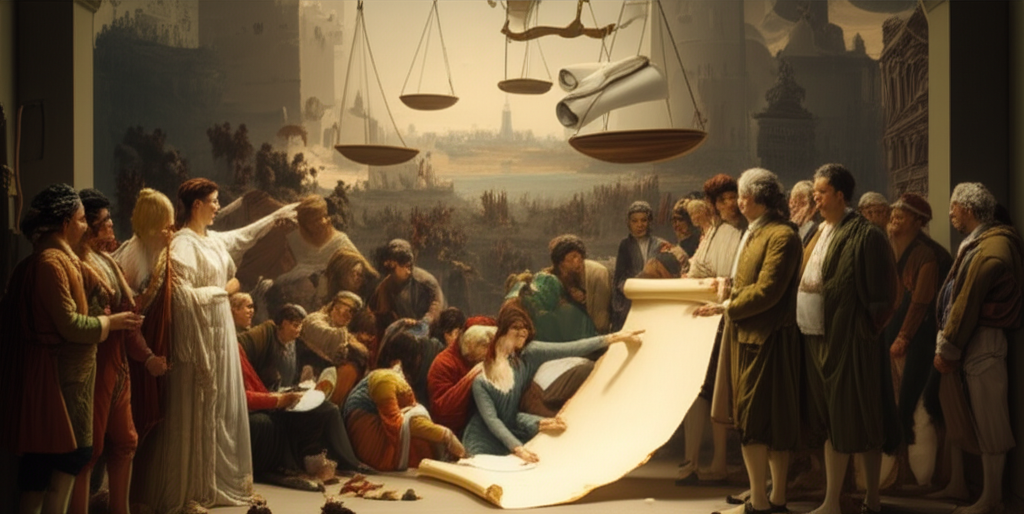
IV. Historical Echoes from the Great Books
The philosophical foundations of the Constitution as a social contract are deeply embedded in the works compiled in the Great Books of the Western World.
- Plato's Republic: Though not directly a social contract theorist, Plato's exploration of ideal governance and the just state provides an early framework for considering how a society ought to be ordered, emphasizing the collective good and the specialized roles within it.
- Aristotle's Politics: Aristotle's analysis of different forms of government and his emphasis on the "polis" (city-state) as the natural home for humans, where they can achieve their full potential, underscores the idea that governance is essential for human flourishing. His focus on constitutional rule, even if not explicitly a "contract," highlights the agreed-upon structures that enable a good life.
- Hobbes, Locke, and Rousseau: As discussed, these thinkers directly articulated the social contract theory, providing the intellectual scaffolding upon which modern constitutional thought was built. Their debates over the state of nature, natural rights, and the nature of sovereignty directly informed the framers of many constitutions.
V. Living Document, Living Agreement: Modern Challenges and the Citizen's Role
In the 21st century, the notion of the Constitution as a social contract faces new pressures. Rapid technological change, global interconnectedness, and evolving societal norms constantly test the limits of our foundational agreements.
The integrity of the social contract depends on:
- Interpretation: How the constitution is interpreted by courts and policymakers continually shapes its meaning and application.
- Amendment: The process of formal amendment allows the contract to be explicitly updated to reflect new societal consensus.
- Civic Education: An informed Citizenry is crucial for understanding the terms of the contract and participating effectively in its ongoing negotiation.
- Upholding Custom and Convention: The unwritten rules of political behavior are just as vital as the written Law for maintaining trust and stability. When these are eroded, the social contract itself can fray.
Understanding the Constitution as a social contract empowers us to see it not as a static relic, but as a dynamic, living agreement that requires constant engagement, interpretation, and renewal by each generation of Citizens. It is the ongoing promise we make to ourselves and to one another about how we will live together in a shared political community.
📹 Related Video: ARISTOTLE ON: The Nicomachean Ethics
Video by: The School of Life
💡 Want different videos? Search YouTube for: ""Social Contract Theory Explained - Hobbes, Locke, Rousseau""
📹 Related Video: PLATO ON: The Allegory of the Cave
Video by: The School of Life
💡 Want different videos? Search YouTube for: ""The US Constitution as a Living Document""