

The Constitution: A Framework for Enduring Justice
The pursuit of a just society has captivated philosophers for millennia, from the ancient Greeks to the Enlightenment thinkers. At the heart of this pursuit, particularly in modern democracies, stands the Constitution – not merely a legal document, but a profound philosophical statement. This article explores how a constitution serves as the foundational framework, a carefully engineered blueprint, designed to establish, maintain, and evolve the principles of Justice within the machinery of Government and the application of Law. It is the bedrock upon which the aspirations for fairness, equity, and order are built, constantly challenging us to interpret and uphold its ideals.
The Philosophical Genesis of Constitutional Justice
To understand the constitution's role in Justice, we must first look to its philosophical roots. Long before written constitutions, thinkers pondered the ideal state and the just ruler. Plato, in his Republic, envisioned a society where Justice was achieved through the harmonious function of its parts, each performing its proper role, guided by wisdom. While his ideal state was perhaps utopian, it laid the groundwork for considering the structure of Government as intrinsically linked to the realization of Justice. Aristotle, in his Politics and Nicomachean Ethics, delved deeper, differentiating between various forms of Justice – distributive, corrective, and reciprocal – and examining how different Government structures could best achieve them for the common good.
A constitution, therefore, is an attempt to institutionalize these ancient ideals. It is a societal covenant, a social contract in the Lockean sense (as explored in John Locke’s Second Treatise of Government), where individuals consent to be governed by certain Laws in exchange for the protection of their rights and the promise of a just order. It seeks to prevent arbitrary rule and ensure that power, once granted, is exercised within defined boundaries for the ultimate benefit of all.
Defining and Delivering Justice Through Law
The Constitution codifies the principles of Justice by establishing the rule of Law. This means that Government itself is subject to Law, and that Law applies equally to all citizens. This fundamental principle is a bulwark against tyranny and a cornerstone of procedural Justice. It dictates how Laws are made, how they are enforced, and how disputes are resolved, ensuring a consistent and predictable application of standards.
However, Justice is not merely procedural. A constitution also aims for substantive Justice by articulating fundamental rights and liberties. These are not granted by the Government but are recognized as inherent, limiting the scope of Government action and protecting individuals from oppression.
Key Constitutional Mechanisms for Justice:
- Separation of Powers: Inspired by Montesquieu's The Spirit of the Laws, this divides
Governmentauthority into distinct branches (legislative, executive, judicial) to prevent the concentration of power and provide checks and balances. This prevents any single entity from unilaterally defining or enforcingJustice. - Independent Judiciary: A court system free from political influence is crucial for impartially interpreting
Lawsand theConstitutionitself, ensuring fair trials and upholding individual rights. - Bill of Rights/Fundamental Rights: Guarantees specific freedoms (speech, religion, assembly) and protections (due process, equal protection under the
Law), ensuring that the pursuit ofJusticerespects individual dignity. - Amendments and Review Processes: Provisions for amending the
Constitutionallow it to adapt to evolving societal understandings ofJustice, while judicial review ensuresLawsremain consistent with constitutional principles. - Accountability Mechanisms: Impeachment, elections, and public scrutiny hold
Governmentofficials responsible for their actions, promoting ethical governance and preventing abuses of power that undermineJustice.
These mechanisms, carefully interwoven, form a complex system designed to steer the Government towards the consistent administration of Justice, even amidst human fallibility and political contention.
The Dynamic Nature of Constitutional Justice
While a Constitution provides a stable framework, Justice itself is not a static concept. Societal norms, moral understandings, and historical experiences constantly shape our interpretation of what Justice demands. This is where the Constitution truly shines as a living document. Its broad principles allow for ongoing interpretation and adaptation, ensuring its relevance across generations.
The ongoing debates surrounding civil rights, environmental Law, and economic equity are all manifestations of society grappling with how constitutional principles apply to new challenges. The Government and its institutions, bound by the Constitution, are continually tasked with reconciling foundational ideals with contemporary realities. This dynamic interplay underscores the idea that Justice is not merely enshrined but must be actively pursued and protected through constant vigilance and thoughtful re-evaluation.
Conclusion: The Enduring Pursuit
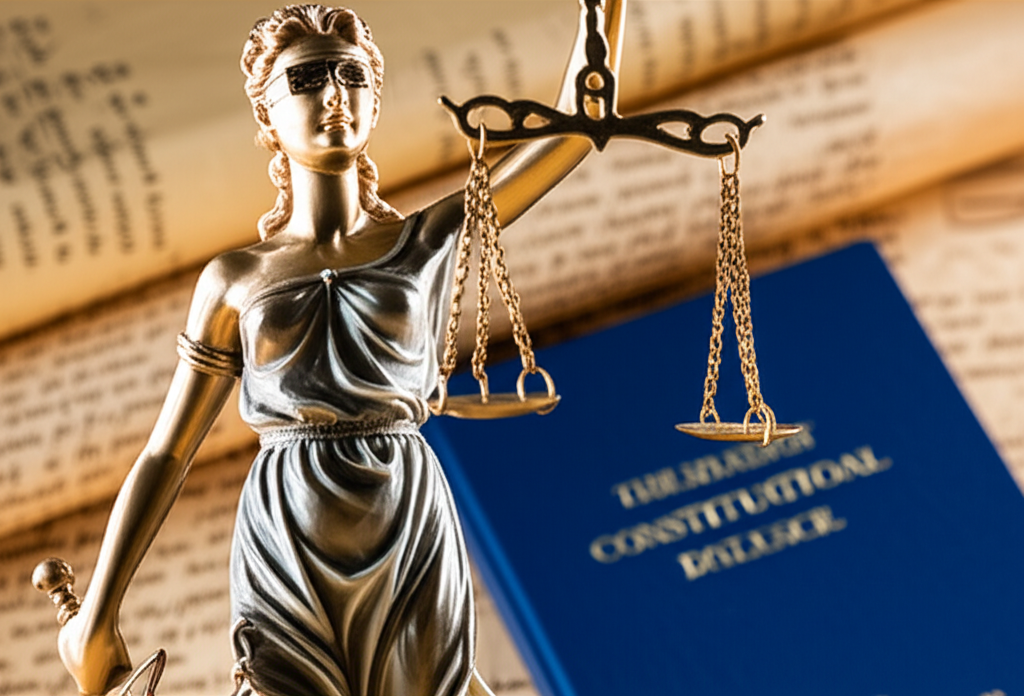
The Constitution is far more than a set of rules; it is a profound philosophical commitment to the ideal of Justice. It provides the essential blueprint for a Government structured to serve its people, to uphold their rights, and to administer Law fairly. Drawing inspiration from the Great Books of the Western World, we see that the enduring quest for Justice has always been tied to the establishment of sound governance. The Constitution is our modern-day embodiment of this quest, a testament to humanity's ongoing effort to build a society where Justice is not just an aspiration but a lived reality, continually shaped and safeguarded by its foundational principles. It calls upon each generation to engage with its meaning, to interpret its demands, and to ensure that its promise of Justice remains vibrant and accessible to all.
YouTube Video Suggestions:
-
📹 Related Video: PLATO ON: The Allegory of the Cave
Video by: The School of Life
💡 Want different videos? Search YouTube for: ""Plato's Republic Justice Philosophy Explained""
2. ## 📹 Related Video: ARISTOTLE ON: The Nicomachean Ethics
Video by: The School of Life
💡 Want different videos? Search YouTube for: ""Constitutional Law Separation of Powers Checks and Balances""