

The Constitution as a Framework for Justice: A Philosophical Inquiry
The U.S. Constitution, often lauded as a foundational document of American democracy, is more than just a set of rules for government; it is, at its heart, a philosophical framework for the pursuit of justice. This article delves into how the Constitution, through its intricate design of law, powers, and rights, attempts to establish and maintain a just society. Drawing upon enduring philosophical concepts that have shaped Western thought, we explore the document's aspirations and the ongoing challenges in realizing its promise of justice for all. It is a testament to the enduring human quest for order, fairness, and the protection of fundamental liberties, constantly evolving through interpretation and societal change.
I. The Philosophical Roots of Constitutional Justice
The crafting of the U.S. Constitution was not merely a pragmatic exercise in nation-building; it was deeply informed by centuries of philosophical discourse, much of which is captured within the Great Books of the Western World. The framers grappled with fundamental questions about human nature, the purpose of government, and the ideal structure for a just society.
From Ancient Ideals to Modern Government
Philosophers like Plato, with his vision of a just state in The Republic, and Aristotle, who meticulously analyzed various forms of government in Politics, laid the groundwork for understanding societal organization. Later, the Enlightenment thinkers—John Locke, Jean-Jacques Rousseau, and Montesquieu, among others—provided the immediate intellectual scaffolding. Their ideas on the social contract, natural rights, and the separation of powers were not abstract theories but blueprints for a government designed to protect individual liberties and prevent tyranny.
- Social Contract Theory: The idea that government derives its legitimacy from the consent of the governed, a voluntary agreement to surrender certain freedoms for the common good and the protection of rights. This concept is fundamental to the Constitution's preamble: "We the People."
- Natural Rights: The belief that individuals possess inherent rights—life, liberty, and property (or the pursuit of happiness)—that no government can legitimately infringe upon. These rights form the bedrock of the Bill of Rights.
- Rule of Law: The principle that all individuals, including those in government, are subject to and accountable under the law. This contrasts sharply with arbitrary rule and is a cornerstone of constitutional justice.
The Constitution, therefore, can be seen as an ambitious attempt to translate these philosophical ideals into a concrete system of law and government, aiming to create a republic where justice is not merely an aspiration but a structural imperative.
II. The Constitution's Architecture of Justice
To ensure justice, the Constitution employs several ingenious structural mechanisms designed to balance power, protect individual rights, and provide avenues for redress.
Separation of Powers and Checks and Balances
Perhaps the most celebrated innovation, borrowed from Montesquieu, is the division of government into three distinct branches: the legislative, executive, and judicial. Each branch is granted specific powers, and crucially, mechanisms to check the powers of the others. This intricate dance of authority is intended to prevent any single branch from becoming too powerful, thereby safeguarding against despotism and promoting a more equitable application of law.
- Legislative Branch (Congress): Responsible for making laws.
- Executive Branch (President): Responsible for enforcing laws.
- Judicial Branch (Courts): Responsible for interpreting laws and ensuring their just application.
This system, while sometimes appearing cumbersome, is a deliberate design choice aimed at fostering deliberation, accountability, and ultimately, justice. It ensures that no single entity can unilaterally dictate the course of the nation or arbitrarily deny citizens their rights.
Rights and Liberties: The Bill of Rights
While the original Constitution established the framework for government, the subsequent addition of the Bill of Rights explicitly enumerates fundamental individual liberties. These first ten amendments serve as a powerful bulwark against potential government overreach, ensuring that certain rights are inalienable and protected by law.
Key Protections for Individual Justice:
- Freedom of Speech and Religion: Essential for a vibrant public discourse and individual conscience.
- Right to Due Process: Guarantees fair legal proceedings and protection from arbitrary government action.
- Protection Against Unreasonable Search and Seizure: Safeguards personal privacy and security.
- Right to a Fair Trial: Ensures impartial justice in the face of accusation.
These provisions are not mere suggestions; they are legally binding principles that define the very essence of justice within the American constitutional order. They empower individuals and limit the authority of the government, creating a delicate balance that is constantly tested and reasserted.
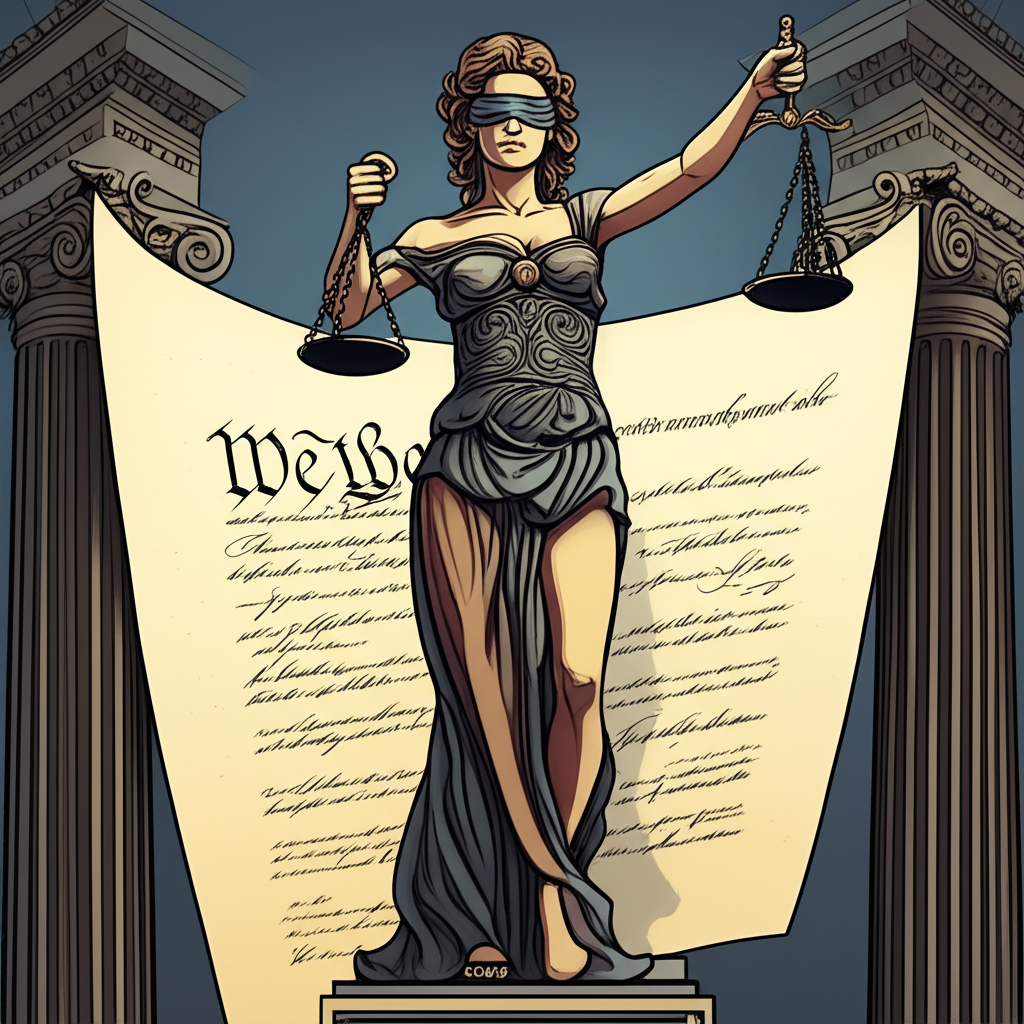
III. The Evolving Interpretation of Justice Through Law
The Constitution is not a static document; it is often referred to as a "living document," capable of adaptation and reinterpretation to meet the evolving understanding of justice in society.
A Living Document and Judicial Review
The amendment process allows the Constitution to be formally changed, reflecting societal shifts and new moral imperatives. However, much of its dynamism comes from judicial review—the power of the courts, particularly the Supreme Court, to interpret the Constitution and declare laws unconstitutional. This power, though not explicitly stated in the Constitution, was firmly established in Marbury v. Madison (1803) and has profoundly shaped the meaning of justice in America.
Judicial interpretation means that the Constitution's principles are constantly applied to new circumstances, from civil rights to technological advancements. This ongoing dialogue ensures that the framework for justice remains relevant, even as the nation itself transforms. Debates between originalism (interpreting the Constitution based on the framers' original intent) and a more adaptive, living constitutionalism highlight the philosophical tension inherent in maintaining a stable yet responsive legal system.
IV. Challenges and Aspirations for Constitutional Justice
While the Constitution provides a robust framework, the realization of perfect justice remains an ongoing human endeavor. The document itself is a product of its time, and its ideals have often been imperfectly applied throughout history.
Persistent Challenges to Constitutional Justice:
- The Struggle for Equality: Despite its foundational principles, the Constitution initially sanctioned slavery and did not grant equal rights to women or various minority groups. The ongoing fight for civil rights, women's suffrage, and LGBTQ+ rights demonstrates the continuous effort to expand the scope of constitutional justice to all.
- Tension Between Individual Rights and Collective Good: Striking the right balance between protecting individual liberties and promoting the welfare of the broader community is a perpetual challenge. Debates over public health mandates, environmental regulations, or national security measures often highlight this inherent tension.
- The Role of Public Discourse: A healthy democracy relies on informed and engaged citizens. The quality of public discourse and the willingness to uphold constitutional norms are critical for the effective functioning of the government and the sustained pursuit of justice.
The Constitution offers the blueprint, but the construction of a truly just society requires constant vigilance, ethical reflection, and a commitment from its citizens and leaders alike. It is a testament to the idea that justice is not merely given but must be perpetually sought and defended through the mechanisms of law and government it provides.
Conclusion
The U.S. Constitution, viewed through a philosophical lens, is far more than a legal document; it is a profound articulation of how a society can strive for justice through the careful design of law and government. Its philosophical underpinnings, from the social contract to natural rights, provide the moral compass, while its structural innovations—like the separation of powers and the Bill of Rights—offer the practical means. While the journey towards perfect justice is unending, the Constitution remains an indispensable framework, continuously challenging us to interpret, adapt, and uphold its ideals in an ever-changing world. It is a constant reminder that the pursuit of a just society is a shared responsibility, rooted in both historical wisdom and future aspirations.
📹 Related Video: What is Philosophy?
Video by: The School of Life
💡 Want different videos? Search YouTube for: ""Constitutionalism and the Rule of Law Philosophy""
📹 Related Video: What is Philosophy?
Video by: The School of Life
💡 Want different videos? Search YouTube for: ""Justice Theories in Political Philosophy""