

The Constitution: An Enduring Framework for Justice
The United States Constitution, often viewed as a mere legal document, is, from a philosophical perspective, a profound framework for understanding and pursuing justice. It is not just a set of rules for government, but a living testament to humanity's ongoing quest to balance individual liberty with collective order, establishing the very architecture within which justice can be sought, debated, and, hopefully, realized. This article explores the Constitution's philosophical underpinnings as a blueprint for justice, drawing connections to the enduring ideas found in the Great Books of the Western World.
I. Philosophical Roots: Justice in the Crucible of Thought
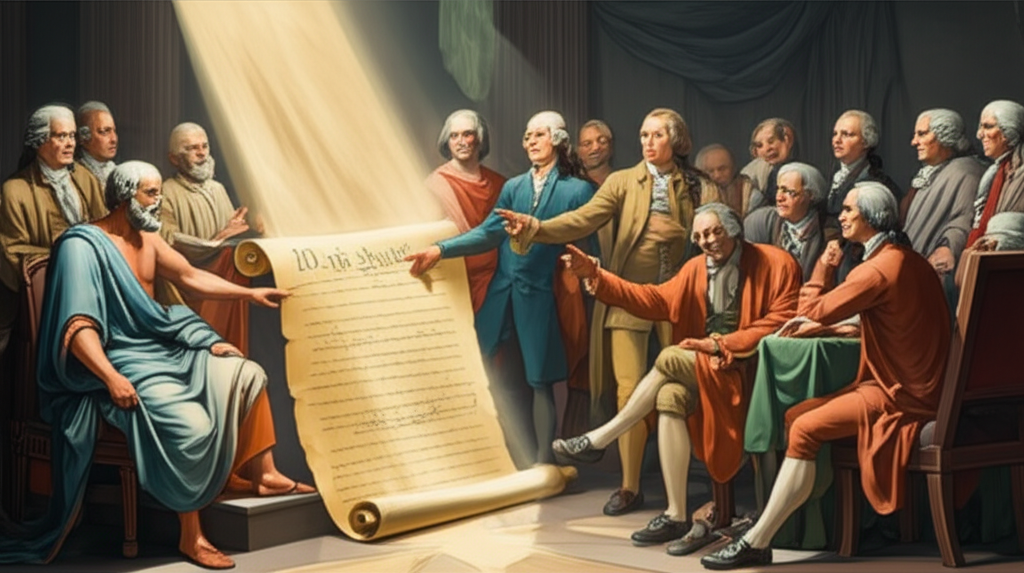
Long before the quill touched parchment in Philadelphia, philosophers grappled with the essence of a just society. The framers of the Constitution, well-versed in classical and Enlightenment thought, inherited a rich intellectual tradition that profoundly shaped their vision.
- Plato's Republic: In this foundational text, Plato explores the concept of justice as the harmonious ordering of the soul and the state. A just state, for Plato, is one where each part performs its function, leading to societal balance. While the American government rejected Plato's philosopher-king, the ideal of a well-ordered society, where justice prevails, resonated.
- Aristotle's Politics and Nicomachean Ethics: Aristotle delved into distributive justice (fair allocation of goods and honors) and corrective justice (rectifying wrongs). His emphasis on the rule of law – that law, not men, should govern – became a cornerstone of constitutional thought. He argued that law provides stability and impartiality, essential for a just society.
- John Locke's Two Treatises of Government: Locke's ideas on natural rights – life, liberty, and property – and the social contract were revolutionary. He posited that government derives its legitimate power from the consent of the governed and exists primarily to protect these inherent rights. This concept is directly embedded in the Declaration of Independence and implicitly in the Constitution's structure.
- Montesquieu's The Spirit of the Laws: Montesquieu's analysis of the separation of powers into legislative, executive, and judicial branches profoundly influenced the framers. He argued that this division was crucial to prevent tyranny and safeguard liberty, thereby ensuring justice by preventing any single entity from accumulating too much power.
These thinkers provided the conceptual bedrock upon which the American experiment in constitutional government was built, aiming to create a system where justice was not merely an abstract ideal but an achievable reality through structured law.
II. The Constitution as an Architecture of Justice
The U.S. Constitution is more than a set of administrative rules; it's an intricate design for fostering justice within a complex society. Its very structure reflects a deep philosophical engagement with the problems of power and human nature.
A. Establishing the Rule of Law
The Preamble's opening words, "We the People... in Order to form a more perfect Union, establish Justice," declare its primary intent. The Constitution establishes a government of laws, not of men, ensuring that everyone, including those in power, is subject to the same legal standards. This principle, drawn from ancient philosophy and reinforced by Enlightenment thinkers, is fundamental to a just society. The Supremacy Clause further solidifies this, making the Constitution and federal laws "the supreme Law of the Land."
B. Separation of Powers and Checks and Balances
One of the most ingenious aspects of the Constitution is its system of separated powers and checks and balances. This design directly addresses the classical concern about the corrupting nature of power, echoing Montesquieu's insights.
| Branch of Government | Primary Function | Check on Other Branches |
|---|---|---|
| Legislative | Makes Laws | Can impeach President/Judges; Override vetoes; Approve treaties/appointments |
| Executive | Enforces Laws | Veto legislation; Appoint judges; Command military |
| Judicial | Interprets Laws | Declare laws/executive actions unconstitutional |
This intricate dance between the three branches is designed to prevent any single faction or individual from usurping control, thereby protecting the citizenry from arbitrary rule and ensuring a fairer application of law and justice. As James Madison argued in Federalist No. 51, "Ambition must be made to counteract ambition."
C. Safeguarding Individual Rights
The Bill of Rights, added shortly after the Constitution's ratification, serves as a powerful declaration of fundamental human liberties. These are not privileges granted by the government but inherent rights that the government is bound to protect. These include:
- Freedom of Speech and Religion: Essential for intellectual and spiritual autonomy.
- Due Process of Law: Ensuring fair treatment and procedures in legal proceedings, a cornerstone of corrective justice.
- Protection Against Unreasonable Searches: Safeguarding privacy and property.
- Right to a Fair Trial: Crucial for upholding justice in the face of accusation.
These provisions are vital for ensuring that the pursuit of justice is not merely theoretical but is practically upheld in the daily lives of citizens.
III. The Dynamic Pursuit of Justice: Evolution and Interpretation
The Constitution is not a static artifact but a living document, capable of evolving to meet the changing demands of justice and society.
A. Amendments: The Living Document
The amendment process allows the Constitution to adapt, reflecting a societal re-evaluation of what justice entails. Landmark amendments include:
- 13th Amendment (1865): Abolished slavery, addressing a profound historical injustice.
- 14th Amendment (1868): Guaranteed equal protection under the law and due process, expanding the reach of justice to all citizens.
- 19th Amendment (1920): Granted women the right to vote, further extending the principles of democratic justice.
These changes demonstrate the Constitution's inherent capacity for moral growth and its role as a vessel for a more inclusive vision of justice.
B. Judicial Review and Interpretation
The power of judicial review, established in Marbury v. Madison (1803), allows the Supreme Court to interpret the Constitution and declare laws or executive actions unconstitutional. This creates a continuous philosophical dialogue about the meaning of justice and the scope of government power. Debates between originalism (interpreting the Constitution as the framers intended) and the "living Constitution" (interpreting it in light of contemporary values) highlight the ongoing philosophical struggle to define and apply justice in a modern context.
IV. Challenges to the Framework: Imperfection and Aspiration
While an extraordinary achievement, the Constitution has not been without its imperfections. The original document condoned slavery and limited suffrage, starkly contradicting its stated ideals of justice and equality. These historical shortcomings remind us that the pursuit of justice is an ongoing struggle, not a destination. The Constitution, therefore, stands as an aspirational document – a continuous project that demands vigilance, reinterpretation, and active civic engagement to fulfill its promise of "Justice for all."
The framework it provides is a sturdy, yet flexible, foundation upon which generations have built, debated, and strived to achieve a more perfect union. It encourages a perpetual dialogue about what justice means, how law should be applied, and what form our government should take to best serve its people.
Conclusion: A Perpetual Dialogue
The Constitution as a framework for justice is a testament to the enduring human quest for a well-ordered and equitable society. It is a document steeped in philosophical tradition, meticulously designed to balance power, protect rights, and provide a stable foundation for the rule of law. Its adaptability, through amendments and judicial interpretation, reflects an understanding that justice is not static but evolves with human consciousness. For anyone grappling with the profound questions of government, law, and societal fairness, the Constitution remains an indispensable text, inviting continuous philosophical engagement and a commitment to its ideals.
📹 Related Video: PLATO ON: The Allegory of the Cave
Video by: The School of Life
💡 Want different videos? Search YouTube for: ""Philosophical Foundations of the US Constitution""
📹 Related Video: PLATO ON: The Allegory of the Cave
Video by: The School of Life
💡 Want different videos? Search YouTube for: ""Justice: What's The Right Thing To Do? Michael Sandel""