

The Golden Chains and the Flourishing Soul: Deconstructing the Link Between Wealth and Happiness
Summary: The relationship between wealth and happiness is a perennial philosophical question, far more complex than simple correlation. While wealth can provide means to alleviate suffering and facilitate certain goods, classical philosophy, particularly from the Great Books of the Western World, consistently argues that true happiness (eudaimonia) stems not from material accumulation but from virtuous living, intellectual pursuit, and the proper alignment of desire. The pursuit of wealth, when untempered by wisdom, can often lead away from genuine fulfillment, blurring the lines between good and evil in our choices and actions.
Beyond the Glitter of Gold: An Introduction to a Timeless Inquiry
Since antiquity, humanity has grappled with the allure of wealth and its perceived connection to a joyful existence. Is the pursuit of riches a direct path to contentment, or a gilded cage trapping us in an endless cycle of want? From the bustling agora of ancient Athens to the quiet studies of Stoic philosophers, thinkers have meticulously dissected this intricate bond, often arriving at conclusions that challenge our modern, consumer-driven assumptions. This article delves into these profound insights, drawing from the wellspring of Western thought to illuminate the true nature of happiness and wealth's often misleading role.
1. The Ancient Pursuit of Happiness: More Than Mere Pleasure
For many, happiness is conflated with fleeting pleasures or the absence of discomfort. However, the philosophers of the Great Books, notably Aristotle, presented a more profound concept: eudaimonia. This isn't merely a feeling but a state of flourishing, living well, and doing well – an activity of the soul in accordance with virtue.
- Eudaimonia and the Good Life: Aristotle, in his Nicomachean Ethics, argued that happiness is the ultimate end of human activity, but it requires more than external goods. While health, friends, and a certain level of prosperity are contributing factors that make living virtuously easier, they are not happiness itself. A person can be wealthy yet miserable, lacking the virtues required for true flourishing.
- The Insufficiency of External Goods: Plato, too, in works like The Republic, emphasized that a just soul, ordered by reason, is the prerequisite for true happiness, irrespective of external fortune. Material possessions, while useful, are ultimately peripheral to the soul's inner state.
2. Wealth as a Catalyst for Desire: A Double-Edged Sword
Wealth undeniably offers power and opportunity. It can free us from immediate want, provide access to education, healthcare, and leisure, thereby facilitating the pursuit of higher goods. Yet, it also possesses a potent capacity to amplify and distort our desires.
- Facilitating the Good: When wealth is utilized judiciously, it can be a tool for good. It can support philanthropy, foster cultural development, and provide the leisure necessary for philosophical contemplation or artistic creation. In this sense, a modest amount of wealth can indeed contribute to a more stable and potentially happier life by removing obstacles.
- Feeding the Beast: The Perils of Insatiable Desire: The danger arises when wealth becomes the primary object of desire. Seneca, a prominent Stoic philosopher, warned against the insatiability of human wants. "No man is rich enough," he wrote, "who is not contented with what he has." The endless pursuit of more, driven by an unexamined desire, leads not to contentment but to perpetual dissatisfaction and anxiety. This is where wealth ceases to be a means and becomes an end, often leading to a spiritual impoverishment even amidst material abundance.
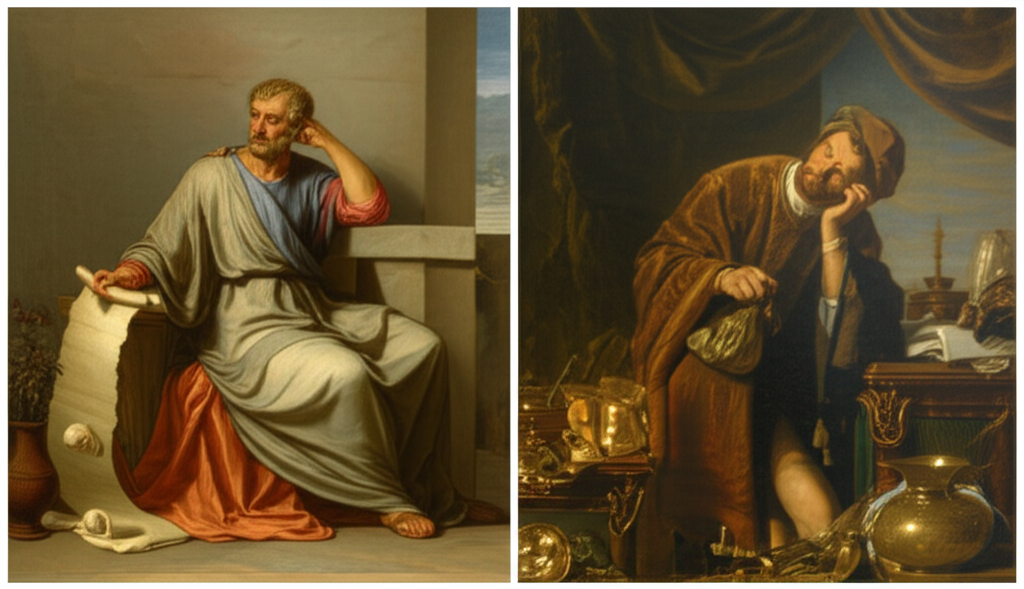
3. The Moral Compass: Navigating Wealth, Good, and Evil
The philosophical inquiry into wealth inevitably leads to questions of good and evil. How we acquire, use, and perceive wealth has profound moral implications.
- The Virtue of Moderation: Philosophers across the Great Books spectrum advocate for moderation. Aristotle's concept of the "golden mean" applies to wealth: neither extreme poverty nor excessive opulence is ideal for cultivating virtue. Seneca's Stoicism further reinforces this, urging detachment from external goods, recognizing that true freedom comes from within, not from what one possesses.
- When Wealth Corrupts: History and philosophy are replete with examples of how the unchecked desire for wealth can lead to moral decay. Greed, envy, exploitation, and injustice often spring from an idolatry of money. When the pursuit of riches overrides ethical considerations, the distinction between good and evil becomes blurred, leading individuals and societies down perilous paths. Plato's critique of the timocratic and oligarchic states in The Republic vividly illustrates how the love of wealth can undermine justice and virtue, ultimately leading to unhappiness for all.
4. Cultivating a Flourishing Life: A Philosophical Framework
Reconciling the practical necessity of wealth with the philosophical pursuit of happiness requires a conscious effort to align our values and actions. The wisdom of the ancients offers a powerful framework.
| Philosophical Principle | Impact on Happiness (Positive) | Impact (if ignored) (Negative) |
|---|---|---|
| Moderation | Contentment with sufficiency, reduced anxiety. | Insatiable desire, perpetual dissatisfaction. |
| Generosity | Joy of giving, strengthened community bonds. | Isolation, selfishness, spiritual emptiness. |
| Virtue | Inner peace, integrity, moral clarity. | Guilt, moral compromise, internal conflict. |
| Wisdom | Proper valuation of goods, informed choices. | Misguided pursuits, superficial goals. |
| Self-Sufficiency | Freedom from external dependencies, resilience. | Vulnerability to fortune, loss of agency. |
The key lies in understanding that wealth is an instrument, not an end. Its value is derived from how it is used to support a life of virtue, contribute to the common good, and facilitate genuine human flourishing. When it becomes the master, it transforms from a potential blessing into a source of immense suffering and moral compromise.
Conclusion: Reconciling Fortune with Philosophy
The connection between wealth and happiness is not a simple equation but a profound philosophical challenge. The Great Books of the Western World consistently remind us that while a certain level of material well-being can support a good life, it is never a substitute for virtue, wisdom, and the proper ordering of our desires. True happiness, or eudaimonia, is an internal state, cultivated through conscious effort and moral choices, guiding us away from the pitfalls of insatiable want and towards actions that truly reflect the good rather than succumbing to the temptations of evil. In the end, it is not what we possess, but how we live, that determines the richness of our souls.
YouTube: "Aristotle Eudaimonia Wealth"
YouTube: "Stoicism on Money and Desire"
📹 Related Video: What is Philosophy?
Video by: The School of Life
💡 Want different videos? Search YouTube for: "The Connection Between Wealth and Happiness philosophy"