

The Perilous Path: Connecting Oligarchy to the Rise of Tyranny
The annals of political philosophy, particularly those preserved within the Great Books of the Western World, offer a sobering and consistent warning: the concentration of power and wealth in the hands of a few (oligarchy) frequently creates the very conditions ripe for the emergence of absolute rule by one (tyranny). This article explores the profound and often tragic connection between these two forms of government, drawing deeply from the insights of classical thinkers like Plato and Aristotle, who meticulously charted the degeneration of states. At its core, oligarchy, with its inherent injustices and deep societal divisions, destabilizes the body politic, paving the way for a "strongman" to seize control, promising order and justice, only to impose a more severe despotism.
Unpacking the Pillars: Defining Oligarchy and Tyranny
Before we trace their dangerous connection, it's crucial to understand the distinct nature of oligarchy and tyranny as conceptualized by ancient philosophers.
- Oligarchy: As defined by both Plato in his Republic and Aristotle in his Politics, oligarchy is a form of government where power rests with a small, privileged class, typically the wealthy. Its defining characteristic is the valuation of property and riches above all else, leading to a system where political rights are determined by one's financial standing. The rulers govern not for the common good, but primarily for the benefit of their own class, perpetuating and increasing their wealth. This inevitably leads to a stark division within the state: the rich few and the impoverished many.
- Tyranny: In contrast, tyranny describes a government where supreme power is concentrated in the hands of a single individual, the tyrant. This rule is often seized by force or cunning, rather than legitimate succession or election, and is exercised arbitrarily, without adherence to law or justice. The tyrant governs solely for personal gain and pleasure, maintaining power through fear, propaganda, and the suppression of dissent. It is, in essence, the ultimate corruption of kingship, driven by an insatiable lust for power and control.
The Philosophical Blueprint: How Oligarchy Breeds Tyranny
The classical philosophers meticulously outlined the cyclical degeneration of governments, showing how one form can naturally transition into another. The journey from oligarchy to tyranny is a particularly well-trodden and perilous path.
Plato's Descent into Despotism
In his magnum opus, The Republic, Plato vividly describes the five forms of government and their inevitable decline. He posits that oligarchy arises from a timocracy (a state ruled by honor) when the love of wealth supplants the love of honor. The insatiable desire for riches in an oligarchy leads to several critical developments:
- Extreme Wealth Disparity: The rich grow richer, and the poor grow poorer. The state becomes "two cities" – one of the wealthy, one of the destitute – perpetually at war with each other.
- Erosion of Law and Order: The oligarchs, focused on their own gain, neglect the laws and common good, leading to widespread injustice and resentment.
- Rise of the "Drones": A large class of dispossessed, indebted, and discontented individuals emerges, often referred to as "drones" by Plato. These are the fertile ground for revolutionary sentiment.
- The Emergence of the Tyrant: From the ranks of the people, a charismatic leader, often a demagogue, arises. This individual champions the cause of the poor against the wealthy oligarchs, promising to cancel debts, redistribute land, and restore justice. Initially hailed as a protector, this leader soon consolidates power, suppresses all opposition (both oligarchic and democratic), and establishes himself as a tyrant, ruling through fear and violence.
Aristotle's Pragmatic Analysis of Instability
Aristotle, in his Politics, offers a more empirical and equally compelling account of the connection. He views oligarchy as inherently unstable, primarily due to its narrow base of support and the fundamental injustice of its rule.
- Internal Conflict: Aristotle notes that oligarchies are prone to internal strife, not only between the rich and poor but also among the oligarchs themselves, who may fall out over wealth and power.
- Revolt of the Masses: The most common cause of revolution in an oligarchy, he argues, is the oppression of the poor by the rich. The majority, feeling exploited and denied their rightful share in the state, will eventually rise up.
- The Tyrant as a Consequence: When such a revolution occurs, a strong leader often emerges from the people to lead the charge against the oligarchs. This leader, initially seen as a liberator, can easily seize absolute power in the ensuing chaos, transforming the uprising against oligarchy into the birth of a tyranny. Aristotle explicitly states that "oligarchies often pass into tyrannies" when a strong individual exploits popular discontent to gain control.
Mechanisms of Transition: The Bridge from Few to One
The transition from oligarchy to tyranny is not accidental but follows discernible patterns, driven by the inherent flaws of the former.
Economic Inequality and Social Division
The most potent catalyst is the vast chasm between the opulent few and the struggling many. This inequality fosters deep-seated resentment, envy, and a sense of injustice, eroding social cohesion. When a society is fractured along economic lines, it becomes vulnerable to anyone promising to redress the balance, regardless of their true intentions.
Erosion of Law and Public Trust
Oligarchies, by their nature, tend to bend or break laws to serve their own interests. This manipulation of the legal system undermines the rule of law and public faith in institutions. When citizens lose trust in the fairness and efficacy of their government, they become susceptible to leaders who promise swift, decisive action outside the established (and perceived as corrupt) system.
The Allure of the 'Strongman'
In times of profound instability, economic hardship, and institutional failure, the appeal of a "strongman" becomes immense. This figure, often a populist, promises to restore order, punish the corrupt oligarchs, and champion the common person. They offer a simple, powerful narrative that resonates with a frustrated populace, willing to trade freedom for stability and a perceived sense of justice.
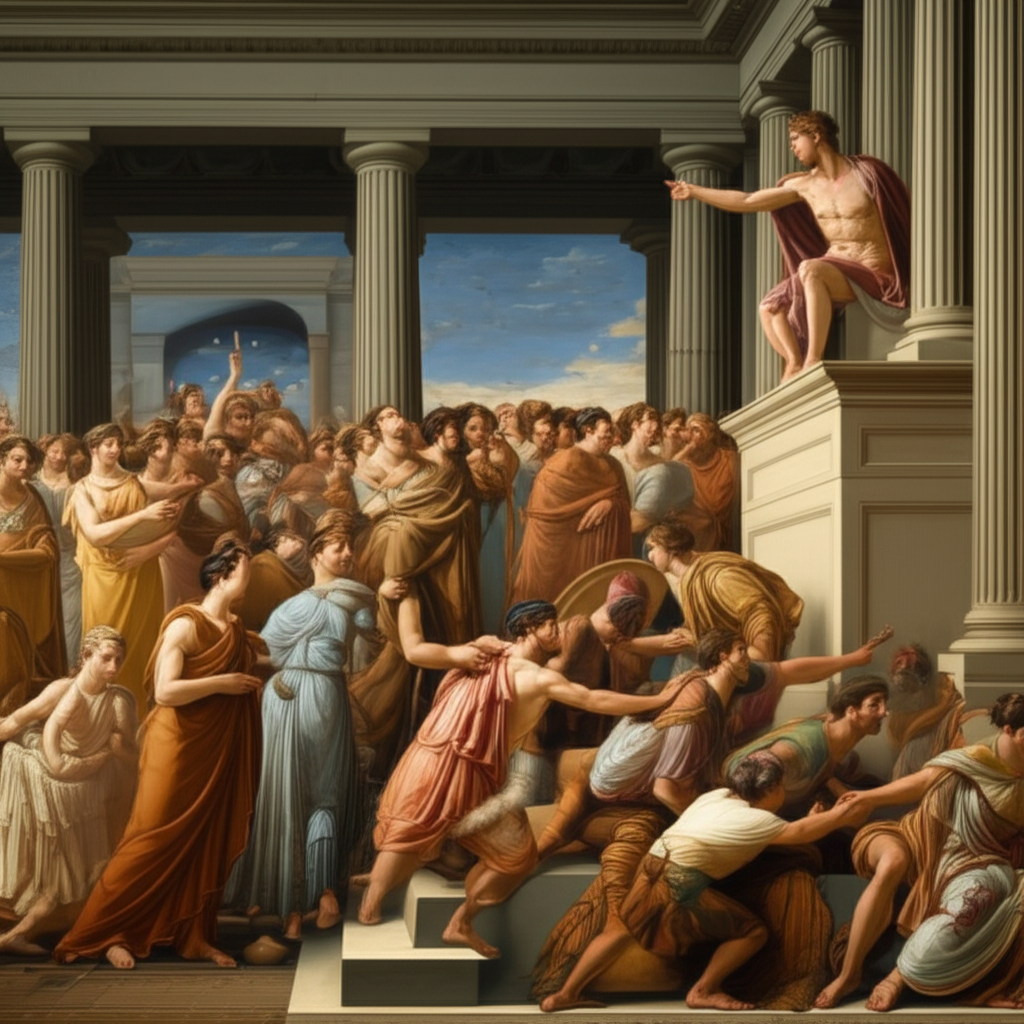
The Cycle of Degeneration: A Summary
The following table summarizes the key characteristics and transitions that connect oligarchy to tyranny:
| Stage of Government | Key Characteristics | Driving Force | Conditions for Transition | Potential Outcome |
|---|---|---|---|---|
| Oligarchy | Rule by the wealthy few; emphasis on private gain; significant wealth disparity; erosion of public trust; limited participation. | Love of wealth; desire for self-enrichment. | Growing discontent among the impoverished majority; internal conflicts among oligarchs; perceived injustice. | Tyranny (if a charismatic demagogue exploits popular anger) or Democracy (if popular uprising leads to broader, lawful participation). |
| Tyranny | Rule by a single individual; arbitrary power; suppression of dissent; personal gain; fear as a tool of governance. | Seizure of power by force or cunning; exploitation of societal instability. | Overthrow by internal factions or external forces; exhaustion of resources; widespread rebellion due to extreme oppression. | Aristocracy/Oligarchy (if a new elite consolidates power) or Democracy (if reform movements succeed). |
An Enduring Warning for Modern Governance
The connection between oligarchy and tyranny, though articulated millennia ago, remains profoundly relevant. The dynamics of concentrated wealth, political disenfranchisement, and the subsequent appeal of authoritarian solutions are not confined to ancient city-states. Wherever power becomes too centralized, and the government ceases to genuinely represent the interests of all its citizens, the seeds of instability are sown. The insights from the Great Books serve as a timeless reminder of the delicate balance required to maintain a just and free society, urging constant vigilance against the forces that would lead us down the perilous path from the rule of the few to the absolute rule of one.
Further Exploration
📹 Related Video: PLATO ON: The Allegory of the Cave
Video by: The School of Life
💡 Want different videos? Search YouTube for: ""Plato's Republic: The Degeneration of the State Explained""
📹 Related Video: ARISTOTLE ON: The Nicomachean Ethics
Video by: The School of Life
💡 Want different videos? Search YouTube for: ""Aristotle's Politics: The Causes of Revolution and Constitutional Change""