

The Inseparable Bond: Tracing the Connection Between Tyranny and Oligarchy
The philosophical tradition, particularly through the enduring insights of Plato and Aristotle found in the Great Books of the Western World, reveals a profound and often perilous connection between oligarchy and tyranny. Far from being isolated forms of government, they frequently emerge from one another, sharing a fundamental disregard for justice and the common good, ultimately leading to oppressive rule. Understanding this intricate connection is crucial for anyone seeking to comprehend the dynamics of government and the perennial threats to liberty.
Unpacking the Forms: Oligarchy and Tyranny Defined
Before we can fully appreciate their intricate relationship, it's essential to define these two distinct, yet often intertwined, forms of government. Both stand in stark contrast to ideals like true aristocracy or constitutional republics, precisely because they prioritize the interests of the few or the one over the many.
-
Oligarchy: Derived from the Greek oligos (few) and arkhein (to rule), an oligarchy is fundamentally the rule of the few. As Aristotle meticulously details in his Politics, this isn't merely about numerical superiority. The defining characteristic of oligarchy is that the ruling few govern in their own interest, typically based on wealth. It is, therefore, a government where political power is concentrated in the hands of a wealthy elite, who use that power primarily to preserve and increase their own fortunes and status, often at the expense of the broader populace. The pursuit of wealth becomes the primary virtue, and the state's policies are shaped to serve this end.
-
Tyranny: A tyranny, on the other hand, is the absolute rule of a single individual, the tyrant. This form of government is characterized by the seizure of power, often by force or through the manipulation of popular discontent, and its maintenance through fear, oppression, and the suppression of dissent. The tyrant governs solely for their own benefit, driven by personal ambition, self-preservation, and an insatiable desire for power. Justice is perverted, laws are arbitrary, and the citizens are reduced to subjects, their freedoms curtailed.
The Perilous Path: How Oligarchy Breeds Tyranny
The connection between these two forms of government is not merely theoretical; it's a recurring pattern observed by the ancient philosophers. Plato, in his Republic, vividly describes a cycle of governmental degeneration, where an oligarchy often sows the seeds of its own destruction, paving the way for tyranny.
- Economic Disparity and Social Division: An oligarchy, by its very nature, fosters extreme economic inequality. The wealthy few grow richer, while the masses become impoverished. This creates a society sharply divided into two factions: the rich and the poor.
- Internal Weakness and Instability: The relentless pursuit of wealth by the oligarchs leads to internal strife among themselves and a deep resentment among the dispossessed. This inherent instability weakens the government's authority and makes it vulnerable to external pressures or internal rebellion.
- Rise of the Demagogue: The exploited populace, yearning for relief from their economic hardship and political disenfranchisement, becomes susceptible to the promises of a charismatic leader. This individual, often a demagogue, pledges to champion the cause of the poor against the oppressive oligarchs.
- Seizure of Power: By galvanizing the discontented masses, the demagogue overthrows the existing oligarchic government. Initially hailed as a liberator, this individual quickly consolidates power, often through extra-legal means, and establishes themselves as the sole ruler – a tyrant. The promise of freedom from the few is replaced by the oppression of the one.
Aristotle, in his Politics, echoes this sentiment, detailing how revolutions and changes in government frequently arise from the injustices inherent in an oligarchy. When the wealthy few abuse their power, it creates a fertile ground for a strongman to emerge and seize control, thereby transitioning from oligarchy to tyranny.
Shared Characteristics: The Undercurrents of Oppression
Despite their structural differences (rule by few vs. rule by one), oligarchy and tyranny share several critical underlying characteristics that highlight their deep connection and explain why one can so easily morph into the other.
- Rule for Self-Interest: Both forms prioritize the benefit of the rulers (the wealthy elite or the single tyrant) over the common good of the citizenry. This is their fundamental departure from just forms of government.
- Absence of True Justice: In both oligarchies and tyrannies, the rule of law is either subverted or manipulated to serve the interests of the powerful. Justice is not blind; it is an instrument of control.
- Economic Exploitation: While more overt in oligarchy, tyranny also relies on the exploitation of resources and labor to maintain the tyrant's lavish lifestyle and apparatus of control.
- Suppression of Dissent: To maintain power, both require the suppression of opposition. Oligarchies do so through economic leverage and selective enforcement of laws, while tyrannies use overt force, surveillance, and propaganda.
- Inherent Instability: Both forms are inherently unstable. Oligarchies suffer from internal divisions among the wealthy and external pressure from the poor. Tyrannies are constantly threatened by conspiracies, popular uprisings, and the tyrant's own paranoia.
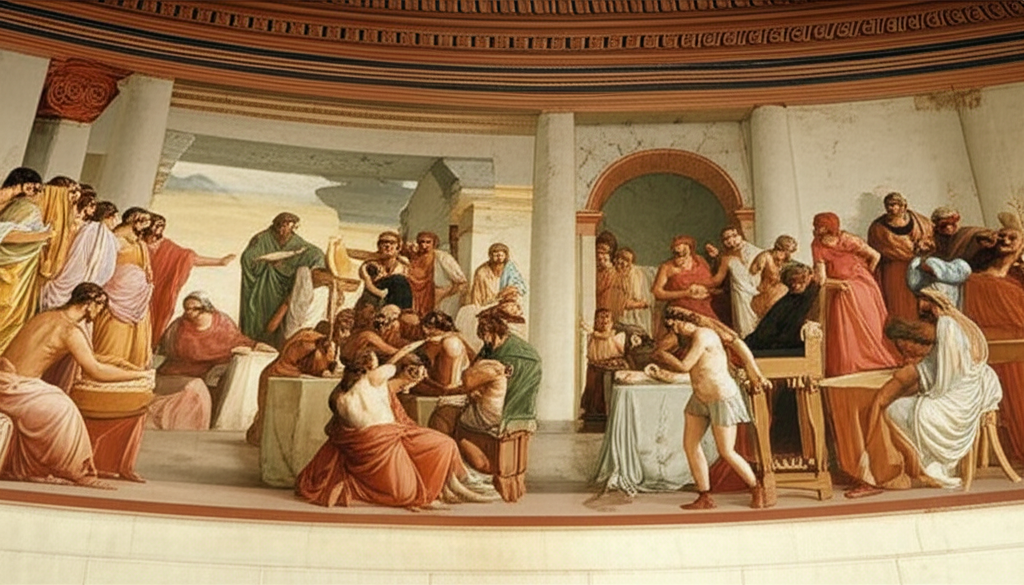
Philosophical Insights from the Great Books
The profound analyses offered by Plato and Aristotle remain cornerstones for understanding this connection.
-
Plato's Republic: Plato's detailed account of the degeneration of states, particularly the transition from oligarchy to democracy and then to tyranny, serves as a cautionary tale. He argues that the insatiable desire for wealth in an oligarchy creates a society where "the rich become richer, and the poor poorer," eventually leading to a breakdown that a clever demagogue can exploit to become a tyrant. The very excesses of the few create the conditions for the absolute rule of the one.
-
Aristotle's Politics: Aristotle categorizes oligarchy as a "deviant" form of government, alongside tyranny and democracy (in its extreme form). He meticulously examines the causes of revolutions (stasis), noting that the abuse of power by the wealthy in an oligarchy is a primary driver for political upheaval. Such unrest can easily be seized upon by an individual seeking to establish a tyranny, presenting themselves as a protector of the people against the corrupt elite.
Conclusion: A Timeless Warning
The connection between oligarchy and tyranny is a powerful testament to the cyclical nature of political decay when government deviates from the principles of justice and the common good. The ancient philosophers, drawing from their keen observations of city-states, provided a timeless warning: unchecked wealth and power in the hands of a few can create such profound societal divisions and instability that the stage is set for a single, absolute ruler to emerge. Understanding this perilous transition is not merely an academic exercise; it is a vital lesson for safeguarding the principles of just government and preventing the descent into oppression.
YouTube Video Suggestions:
-
📹 Related Video: PLATO ON: The Allegory of the Cave
Video by: The School of Life
💡 Want different videos? Search YouTube for: "Plato's Political Philosophy: Forms of Government"
-
📹 Related Video: ARISTOTLE ON: The Nicomachean Ethics
Video by: The School of Life
💡 Want different videos? Search YouTube for: "Aristotle's Politics Explained: Oligarchy and Tyranny"