

The Intricate Connection Between Revolution and Justice
The relationship between revolution and justice is one of philosophy's most enduring and often paradoxical inquiries. At its core, revolution frequently emerges from a profound sense of injustice, aiming to dismantle existing structures deemed oppressive or unfair and erect a new State founded on more equitable principles. However, the path of revolution itself is rarely untainted by injustice, presenting a complex ethical dilemma: can a just end be achieved through means that are, by their very nature, disruptive, violent, and often arbitrary? This article delves into the philosophical connection between these two powerful concepts, drawing upon the insights of classical thinkers to explore how the yearning for justice fuels revolution, and the profound challenges in ensuring that revolutionary change truly serves its noble aims.
Unpacking the Concepts: Revolution and Justice
To truly grasp the connection, we must first define our terms, as they are often loaded with historical and emotional baggage.
What is Revolution?
Philosophically, revolution is more than mere rebellion or coup d'état. It signifies a fundamental and often rapid transformation of the political, social, or economic order, typically involving the overthrow of an existing State or governing authority. Thinkers from the Great Books of the Western World like John Locke, in his Second Treatise of Government, posited a right to revolution when the government systematically violates the natural rights of its citizens, essentially breaking the social contract. For Locke, revolution is a last resort, a return to a state of nature to re-establish a just political society.
What is Justice?
Justice is perhaps even more multifaceted. Ancient Greek philosophers, notably Plato in The Republic, conceived of justice both within the individual soul and in the ideal State – a harmonious balance where each part performs its proper function. Aristotle, in his Nicomachean Ethics and Politics, distinguished between different forms:
- Distributive Justice: Concerned with the fair allocation of resources, honors, and opportunities based on merit or need.
- Retributive Justice: Deals with punishment for wrongdoing, ensuring that penalties are proportionate to the offense.
- Corrective Justice: Aims to restore equality when it has been disturbed, such as in cases of contract disputes or injury.
For many, justice embodies fairness, equality before the law, protection of rights, and the equitable distribution of burdens and benefits within a society.
The Philosophical Nexus: When Justice Demands Revolution
The connection between revolution and justice becomes undeniable when the existing State is perceived as fundamentally unjust. When the mechanisms for peaceful reform are exhausted, and the ruling power systematically denies basic rights, perpetuates inequality, or exploits its populace, the call for revolution often arises as the ultimate demand for justice.
The Social Contract and Its Breach
Thinkers like Locke and Jean-Jacques Rousseau (in The Social Contract) laid the groundwork for understanding revolution as a legitimate response to governmental failure. They argued that the State derives its legitimacy from the consent of the governed, forming a social contract to protect mutual rights and liberties. When the State becomes tyrannical, violating these fundamental agreements, it forfeits its authority.
- Locke: Argued that when a government acts contrary to the trust placed in it by the people, the people have the right to dissolve it and establish a new one. This is a direct philosophical justification for revolution in the name of justice.
- Rousseau: While more cautious about outright revolution, his concept of the "general will" implies that a legitimate State must always act in the collective interest. A government that consistently deviates from the general will, serving only particular interests, loses its claim to legitimacy and implicitly invites radical change.
The State of Injustice: Plato and Aristotle
Even without explicitly endorsing revolution, ancient philosophers recognized the conditions that could lead to societal upheaval.
- Plato: His ideal Republic is a just State. He meticulously describes the degeneration of states (timocracy, oligarchy, democracy, tyranny) as a departure from justice. While he didn't advocate for revolutionary overthrow, his analysis implicitly suggests that a state that becomes tyrannical is inherently unjust and unstable, ripe for internal conflict.
- Aristotle: In his Politics, Aristotle examines various constitutions and their tendencies towards stability or instability. He notes that imbalances in wealth and power, and the failure of the State to uphold justice for all citizens, are primary causes of sedition and civil strife. For Aristotle, a truly just State would be one that aims for the common good, thereby minimizing the impetus for revolutionary change.
The Paradox of Revolutionary Justice
Herein lies the profound dilemma: while revolutions are often born from a fervent desire for justice, their execution can be anything but just. The very act of overthrowing an established order often necessitates violence, coercion, and the suspension of existing laws – actions that, in other contexts, would be deemed unjust.
Key Challenges to Justice During Revolution:
- Means vs. Ends: Can widespread suffering, loss of life, and the suppression of dissent be justified by the promise of a more just future? This question plagued thinkers observing events like the French Revolution's Reign of Terror, where ideals of liberty and equality were seemingly betrayed by brutal purges.
- Defining the "New Justice": Who decides what constitutes justice in the aftermath of a revolution? The victors often impose their vision, which may not be universally accepted or truly just for all segments of society.
- The Problem of Authority: During the transitional period, the absence of a clear, legitimate authority can lead to chaos, arbitrary rule, and new forms of injustice. Establishing a stable, just State after the old one is dismantled is a monumental task.
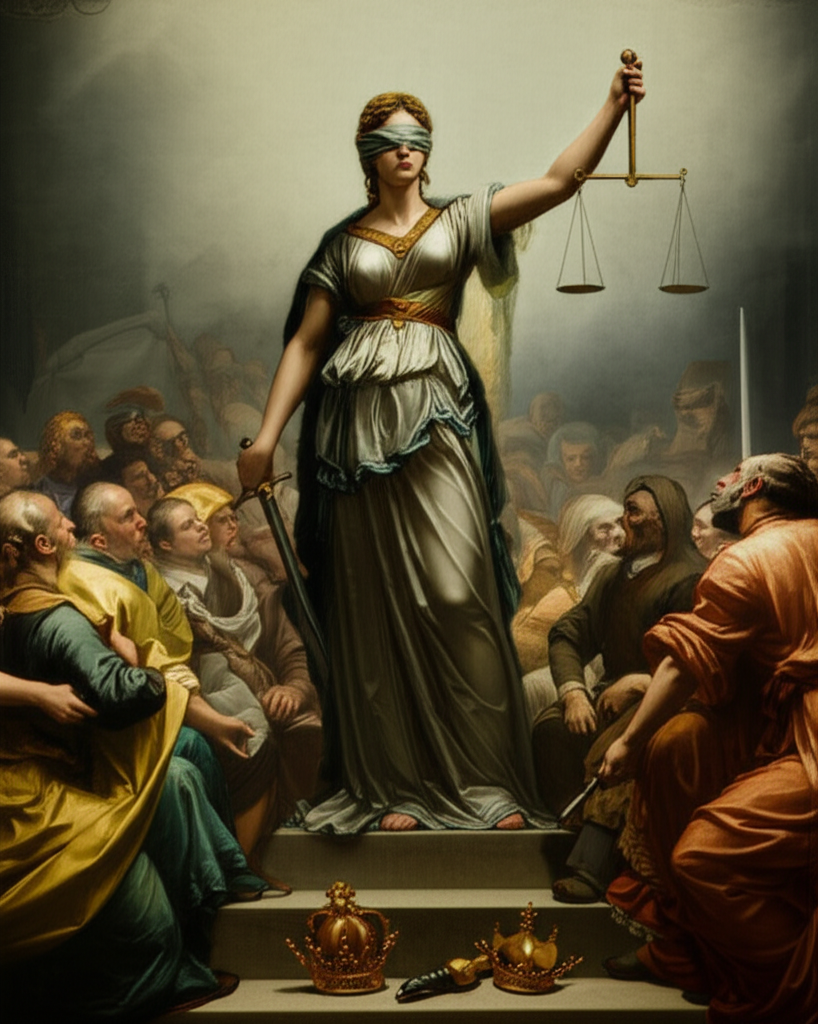 looking up at her with a mix of hope and apprehension, all against a tumultuous background suggesting societal upheaval.)
The Enduring Connection: Justice as the Aim
Despite the inherent perils, the connection between revolution and justice remains indelible. The aspiration for justice is often the moral engine that drives revolutionary movements. When systems of power become so entrenched and oppressive that they preclude any possibility of justice through conventional means, revolution emerges as a desperate, yet often necessary, act of self-preservation and a profound demand for human dignity.
Ultimately, the success of a revolution, from a philosophical perspective, is measured not just by its ability to overthrow an old regime, but by its capacity to establish a genuinely more just State and society. This requires not only the dismantling of old injustices but also the careful construction of new institutions, laws, and ethical frameworks that embody and protect the principles of justice for all.
YouTube Video Suggestions:
-
📹 Related Video: PLATO ON: The Allegory of the Cave
Video by: The School of Life
💡 Want different videos? Search YouTube for: "John Locke Social Contract Theory Revolution"
-
📹 Related Video: PLATO ON: The Allegory of the Cave
Video by: The School of Life
💡 Want different videos? Search YouTube for: "Plato Aristotle Justice State Philosophy"