

The Indelible Mark: How Wealth and Slavery Have Intertwined Through History
The connection between wealth and slavery is not merely historical; it is a profound philosophical entanglement, a stark reminder of humanity's capacity for exploitation in the relentless pursuit of accumulation. From the ancient world's grand empires built on forced labor to the insidious economic coercions of today, the freedom of some has often been predicated on the bondage of others. Understanding this link is crucial for any genuine pursuit of justice.
The Ancient Foundations: Labor as the Engine of Wealth
In the annals of the Great Books, we find countless examples where the flourishing of civilizations was directly underpinned by systems of slavery. Aristotle, in his Politics, famously described the slave as a "living tool" – an instrument of production essential for the master's leisure and the polis's economic stability. This perspective, while abhorrent to modern sensibilities, reveals a stark truth: the accumulation of significant private and public wealth in antiquity was largely a function of unpaid or coerced labor.
- Ancient Greece: The Athenian democracy, often hailed as the cradle of Western thought, relied heavily on chattel slavery to power its agriculture, mines, and workshops, freeing citizens for civic and philosophical pursuits.
- Roman Empire: The vast expansion and prosperity of Rome were inseparable from its immense slave population, acquired through conquest and integral to every facet of its economy, from farming vast estates (latifundia) to gladiatorial spectacle.
The philosophical justification for such systems often revolved around perceived natural hierarchies or the spoils of war. The very definition of citizenship, and thus the right to participate in the creation and enjoyment of wealth, was often exclusionary, with those deemed "barbarians" or "unfree" relegated to the realm of perpetual labor and servitude.
The Transatlantic Horror and the Birth of Modern Capital
The most brutal and systematic manifestation of this connection emerged with the transatlantic slave trade. Here, the pursuit of immense wealth through colonial expansion found its ultimate engine in the commodification of human beings.
The Economic Imperative of Chattel Slavery:
- Mass Production: Plantations in the Americas, producing cash crops like sugar, tobacco, cotton, and coffee, demanded an enormous, consistent, and cheap labor force.
- Capital Accumulation: The profits generated from slave-grown commodities fueled the industrial revolution in Europe, providing capital for banks, factories, and trade networks.
- Dehumanization as Justification: Elaborate philosophical and theological arguments were constructed to strip enslaved Africans of their humanity, making their exploitation seem permissible, even divinely ordained. This was a necessary precursor to treating them purely as property, as capital assets.
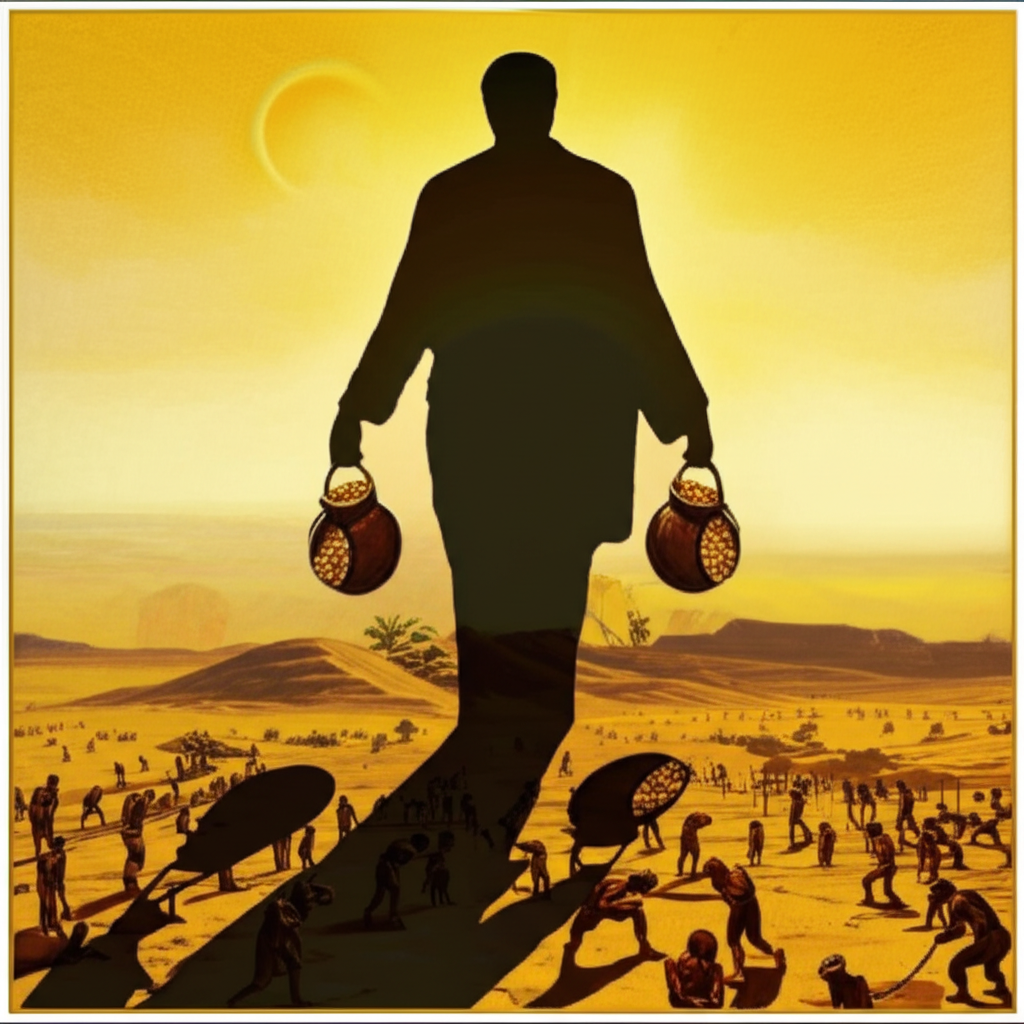
The irony is profound: the very Enlightenment thinkers who championed liberty and individual rights often benefited directly or indirectly from this system. The concept of property rights, so central to thinkers like Locke, was tragically extended to encompass human beings, making the abolition of slavery an economic as much as a moral challenge.
Modern Chains: Economic Coercion and Wage Slavery
While chattel slavery has been largely outlawed, the philosophical question of slavery in relation to wealth persists in more subtle forms. The critiques of industrial capitalism, famously articulated in works found in the Great Books, questioned whether the "freedom" offered by wage labor was truly liberating.
- Wage Slavery: The idea that individuals, lacking ownership of the means of production, are compelled to sell their labor for wages that barely sustain them, thus remaining perpetually bound to an employer for survival. This is a form of economic coercion, where the "choice" to work is not truly free.
- Global Supply Chains: Today, vast amounts of wealth are generated through global supply chains that often rely on exploitative labor practices in developing nations. Workers face unsafe conditions, meager wages, and limited rights, mirroring historical patterns of extraction where raw materials (and human labor) are cheap.
- Debt Bondage: A contemporary form of slavery where individuals are forced to work to pay off a debt, often with exorbitant interest rates, making escape virtually impossible. This traps individuals and even generations in cycles of unfree labor.
The pursuit of infinite wealth in a finite world invariably creates pressure points, often manifesting as pressure on labor. The philosophical challenge remains: how do we structure our economic systems to ensure that wealth creation does not inherently lead to forms of human subjugation, whether overt or covert?
The Quest for Justice and a Redefined Wealth
The enduring connection between wealth and slavery forces us to confront fundamental questions of justice. Is a society truly prosperous if its wealth is built on the deprivation of others? Can justice truly exist when economic systems incentivize exploitation?
The path forward requires a re-evaluation of what constitutes true wealth. It must extend beyond mere financial accumulation to encompass human well-being, ecological sustainability, and equitable distribution. This calls for:
- Ethical Consumption and Investment: Demanding transparency in supply chains and supporting businesses that uphold fair labor practices.
- Stronger Labor Protections: Advocating for robust workers' rights, living wages, and safe working conditions globally.
- Challenging Economic Dogmas: Questioning the ideologies that prioritize profit above human dignity and environmental health.
The Great Books offer us not just historical context but philosophical tools to dissect these complex issues. They remind us that the struggle for human freedom and justice is an ongoing one, deeply intertwined with how we define, create, and distribute wealth. The shadows of ancient slavery still linger, demanding our vigilance and our commitment to a more just future.
📹 Related Video: PLATO ON: The Allegory of the Cave
Video by: The School of Life
💡 Want different videos? Search YouTube for: ""Plato's Republic and the Concept of Justice""
📹 Related Video: ARISTOTLE ON: The Nicomachean Ethics
Video by: The School of Life
💡 Want different videos? Search YouTube for: ""Karl Marx and the Critique of Capitalism Explained""