

The Enduring Chains: Unpacking the Connection Between Money (Wealth) and Slavery
Summary
This article explores the profound and often uncomfortable historical and philosophical connection between the accumulation of wealth and the practice of slavery. From ancient civilizations to modern economic systems, the drive for prosperity has frequently relied upon the exploitation of labor, blurring the lines between voluntary work and various forms of servitude. We will delve into how philosophical thought has grappled with these concepts, examining the ethical dimensions of labor, the pursuit of justice, and the persistent challenge of ensuring human dignity in the face of economic imperatives.
The Uncomfortable Alliance of Prosperity and Servitude
Across the annals of human civilization, a stark and often disturbing pattern emerges: the rise of significant wealth has frequently been predicated upon the subjugation of human labor. Whether through overt chattel slavery, serfdom, debt bondage, or the more subtle coercions of modern economic systems, the quest for material abundance has, for millennia, found common cause with the diminution of human freedom. This is not merely a historical observation but a profound philosophical challenge, compelling us to interrogate the very nature of wealth, labor, and the elusive ideal of justice.
The Ancient Foundations: Wealth's Demand for Labor
In the great civilizations of antiquity, from the empires of Egypt and Mesopotamia to the city-states of Greece and the vast Roman Republic, slavery was an integral, if morally troubling, component of the economic engine. Philosophers like Aristotle, while recognizing the inherent rationality of all humans, nevertheless posited a category of "natural slaves" – those whose very nature, he argued, made them suited to be instruments for others' ends. This perspective, however flawed and ethically indefensible by modern standards, reveals a critical insight into the relationship between wealth and labor:
- The foundational premise: Wealth requires Labor. Without a vast, often unpaid or minimally paid, workforce, the monumental architectural feats, agricultural surplus, and luxurious lifestyles of the elite would have been impossible.
- The commodification of the human being: Slavery reduced individuals to property, their labor a resource to be extracted for the master's benefit, directly contributing to the master's wealth.
- The inherent power imbalance: The master's wealth afforded power, which was then used to control and exploit the slave's labor, perpetuating the cycle.
This ancient model sets a precedent, demonstrating how societies rationalized and institutionalized the forced extraction of labor as a primary means of wealth generation.
From Chattel to Economic Chains: The Evolving Nature of Slavery
While overt chattel slavery – the literal ownership of another person – has been largely abolished globally, the underlying mechanisms that connect wealth and exploitation have mutated rather than disappeared. The concept of slavery itself can be understood on a spectrum, moving beyond physical chains to encompass various forms of economic bondage.
Consider the historical progression:
- Chattel Slavery: Direct ownership, absolute control over body and labor.
- Serfdom: Bound to the land, owing labor or produce to a lord, limited mobility and rights.
- Debt Bondage: Individuals compelled to work to repay a debt, often with exploitative terms that make repayment impossible, trapping them in perpetual servitude.
- Wage Slavery (Philosophical Critique): A concept arising from industrial capitalism, where individuals, though legally free, are compelled by economic necessity to sell their labor under conditions that may strip them of dignity, autonomy, and the full value of their work.
The true measure of freedom is control over one's labor and the fruits thereof. When economic conditions or systemic structures deny this control, we approach a form of servitude, even if not legally defined as slavery.
The Philosophical Scrutiny of Labor and Justice
Great thinkers throughout history have wrestled with the ethical implications of labor, wealth, and slavery, seeking to define the boundaries of justice.
- Aristotle and the "Tool": As mentioned, Aristotle's problematic categorization of "natural slaves" highlights a historical justification for exploitation, viewing certain humans as mere instruments for the production of wealth. His ideal citizen was free from manual labor, allowing for philosophical contemplation – a freedom often afforded by the labor of others.
- John Locke and Property in One's Labor: Locke's foundational ideas on natural rights posited that every individual has property in their own person, and thus in their labor. When one mixes their labor with something, it becomes their property. This concept, while empowering, also lays the groundwork for the exchange of labor for wages, raising questions about whether the sale of one's labor can, under certain conditions, diminish one's autonomy.
- The Capitalist Imperative and the Wage-Slave: Later philosophical critiques, particularly those associated with the "Great Books" tradition, such as Rousseau's concern for true freedom in society or Marx's analysis of alienation, questioned whether the capitalist system, driven by the accumulation of wealth, inherently commodifies labor to such an extent that workers are effectively "wage slaves." They are free to choose their master, but not to escape the necessity of having one.
Key Philosophical Interrogations:
- Who truly owns the fruits of labor when the means of production are concentrated in the hands of the few?
- At what point does economic necessity, driven by the need for survival, become a form of compulsion that undermines genuine freedom?
- Is true justice possible in a society where vast disparities of wealth create inherent power imbalances that allow for the exploitation of labor?
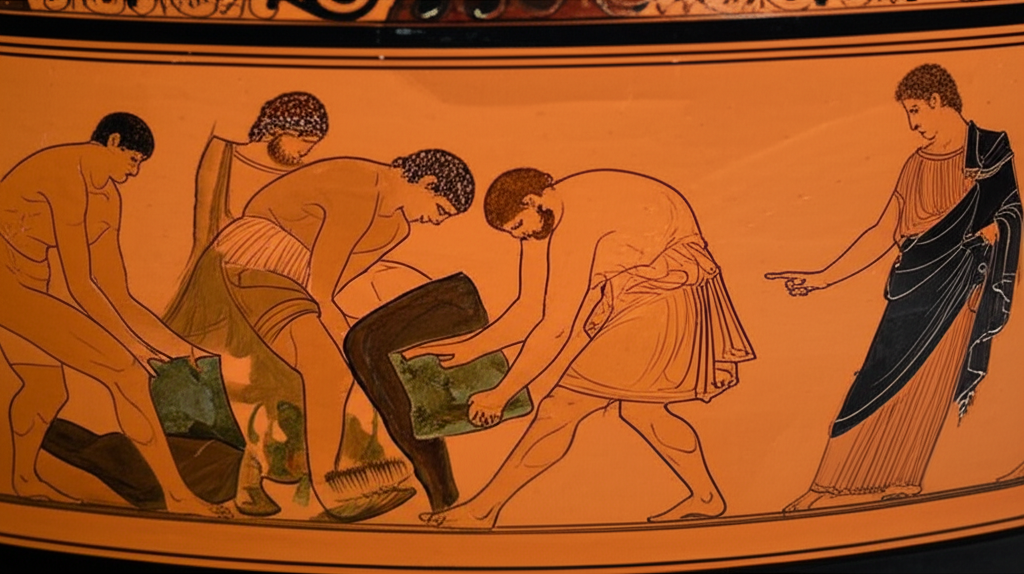
Modern Echoes: Precarious Labor and Systemic Injustice
The connection between wealth and various forms of slavery is not confined to history. Contemporary global capitalism, despite its advancements, continues to grapple with these ethical dilemmas.
- Global Supply Chains: The pursuit of ever-cheaper goods and increased corporate wealth often leads to exploitative conditions in developing nations, where workers toil for meager wages in unsafe environments, reminiscent of historical forms of servitude.
- Debt Traps: Modern debt, whether personal or national, can create a powerful form of economic bondage, forcing individuals and even entire nations into cycles of labor to service obligations, often at the expense of social well-being and sovereign autonomy.
- The Gig Economy and Precarious Work: While offering flexibility, many modern employment models push the risk onto the individual, creating a class of workers whose labor is precarious, lacking benefits, and subject to the whims of algorithms or market fluctuations. The drive for corporate wealth can inadvertently create conditions where workers are constantly on the edge of economic desperation.
These modern manifestations highlight the persistent challenge to achieve justice in economic systems designed primarily for wealth accumulation.
Reclaiming Autonomy: Pathways to Justice and Authentic Wealth
To sever the historical link between wealth and slavery, we must engage in a profound re-evaluation of our economic and philosophical paradigms.
- Redefining Wealth: Can wealth be understood not merely as accumulated capital, but as the flourishing of human potential, social well-being, and ecological balance?
- Valuing Labor Justly: Ensuring fair wages, safe working conditions, and respect for worker rights are fundamental steps towards dignifying labor and dismantling exploitative practices.
- Ethical Economic Structures: Designing systems that prioritize distributive justice, limit excessive concentrations of wealth, and empower individuals to control their labor and its fruits.
- Philosophical Vigilance: Continuously questioning the ethical implications of economic policies and technological advancements to prevent new forms of servitude from emerging.
Conclusion: The Enduring Shadow and the Call for Justice
The connection between money (wealth) and slavery is a dark thread woven deeply into the tapestry of human history. From the overt brutalities of ancient chattel slavery to the subtle coercions of modern economic systems, the drive for accumulation has frequently come at the cost of human freedom and dignity. This persistent challenge compels us, as inheritors of the great philosophical traditions, to remain vigilant. The pursuit of justice demands that we critically examine the origins and distribution of wealth, ensure the fair valuation of labor, and strive to build societies where no individual is compelled into servitude, whether by chains of iron or by the invisible bonds of economic despair. The shadow of slavery reminds us that true wealth is measured not just in material abundance, but in the freedom, dignity, and justice afforded to all.
📹 Related Video: ARISTOTLE ON: The Nicomachean Ethics
Video by: The School of Life
💡 Want different videos? Search YouTube for: ""Philosophical perspectives on labor and exploitation""
📹 Related Video: ARISTOTLE ON: The Nicomachean Ethics
Video by: The School of Life
💡 Want different videos? Search YouTube for: ""The ethics of wealth distribution and justice""