

The Unsettling Nexus: How Money (Wealth) Forges Chains of Slavery
The pursuit of wealth, in its most relentless forms, has historically and philosophically been intertwined with systems of human exploitation, often culminating in or resembling slavery. At its core, this connection reveals how the commodification of human labor—reducing individuals to mere means of production—undermines fundamental principles of justice and human dignity. From ancient empires built on chattel slavery to modern critiques of wage exploitation, the shadow of servitude often looms large behind the gleaming facade of affluence.
The Ancient Roots of Inequality: Wealth, Power, and the Instrumentalization of Man
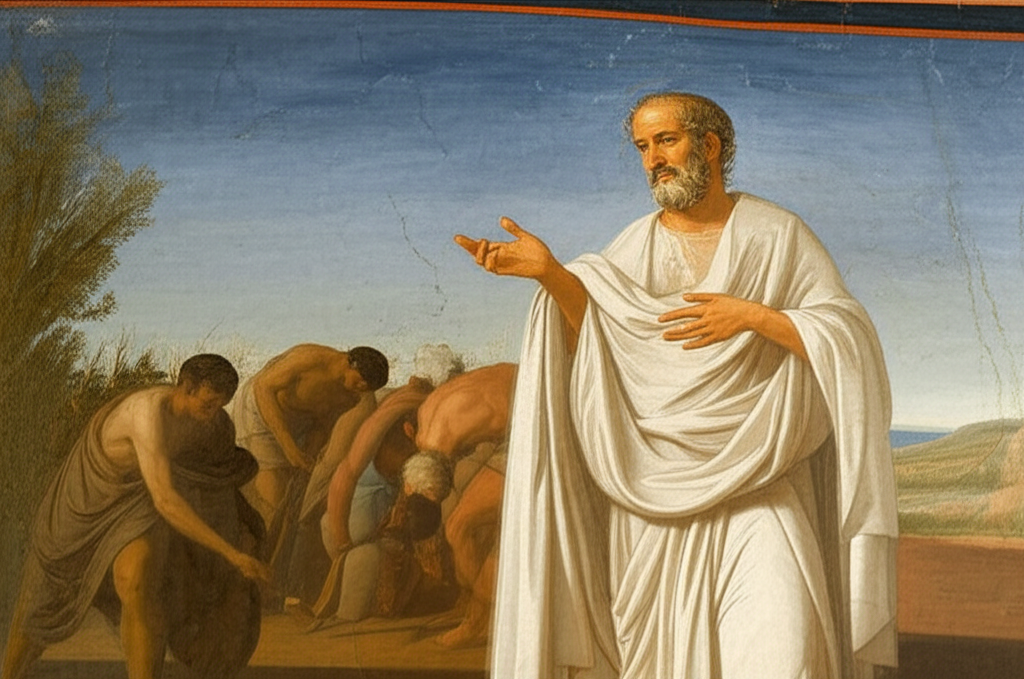
Throughout history, particularly within the foundational texts of the Great Books of the Western World, we observe how societies accumulated immense wealth by systematically denying freedom to a segment of their population. Ancient Greece and Rome, bastions of philosophy, law, and art, were simultaneously societies whose economic engines ran on the forced labor of slaves.
- Aristotle's Politics: Here, the concept of "natural slavery" is introduced, positing that some individuals are by nature suited to be instruments for others. This philosophical justification provided a moral veneer for a system where a master's leisure and intellectual pursuits—the very hallmarks of their wealth and status—were directly enabled by the complete control over another's life and labor. The slave was, in essence, a living tool, an extension of the master's property.
- Plato's Republic: While not explicitly endorsing slavery, Plato's ideal state outlines a rigid social hierarchy where each class performs its function. The economic foundation upon which the philosopher-kings and guardians operate implicitly relies on the productive labor of others, often without the full rights and freedoms enjoyed by the elite.
In these classical societies, the accumulation of private and public wealth was inextricably linked to the availability of cheap, controllable labor. The denial of freedom was not merely an unfortunate byproduct but often a deliberate strategy to maximize economic output and maintain social order, demonstrating a profound disregard for universal justice.
The Philosophical Anatomy of Labor and Servitude
To understand the connection, we must dissect the concepts of labor and slavery themselves.
- Labor as a Human Endeavor: From John Locke's assertion that property is gained through the mixing of one's labor with nature, to the inherent human drive to create and transform, labor is often understood as an expression of self, a means of contributing to the world and securing one's existence.
- Slavery as the Alienation of Labor: When labor is coerced and its fruits appropriated by another, it ceases to be an act of self-expression and becomes an instrument of another's will. This is the essence of slavery: the radical denial of an individual's autonomy over their own body, time, and productive capacity.
This philosophical lens reveals that the transition from free labor to servitude is often catalyzed by the perceived economic advantage of controlling another's productive output without fair compensation or recognition of their inherent rights. The more valuable the labor or the greater the demand for it, the stronger the historical temptation for the powerful to resort to coercive means, transforming human beings into commodities.
Wealth's Insatiable Appetite and the Commodification of Man
The relentless pursuit of wealth and capital accumulation, particularly in systems driven by profit maximization, creates a powerful incentive to minimize the cost of labor. This drive can push ethical boundaries, leading to conditions that echo historical forms of slavery.
Consider the following forms of exploitation, which, while not always chattel slavery, share its core injustice:
- Debt Bondage: Individuals are forced to labor to repay a debt, often under exploitative terms that ensure the debt can never truly be repaid, trapping them in perpetual servitude.
- Indentured Servitude: Historically, a contractual agreement for a fixed period of labor in exchange for passage or training, but often abused to create conditions akin to slavery.
- Wage Slavery (Marxist Critique): Karl Marx argued that under capitalism, the worker, though nominally "free," is compelled to sell their labor power to survive. The capitalist, seeking to maximize wealth, pays only what is necessary to reproduce the worker's labor, appropriating the surplus value. This, Marx contended, is a form of exploitation that alienates the worker from their labor and its products, akin to a subtle, systemic slavery.
- Human Trafficking: A contemporary manifestation where individuals are coerced, deceived, or forced into labor or sexual exploitation, often across borders, for the wealth of their traffickers.
In each instance, the accumulation of wealth by one party is predicated upon the severe restriction or outright denial of another's freedom and the just compensation for their labor.
Justice Denied: The Ethical Core of Slavery
At the heart of any system of slavery lies a profound and irreconcilable violation of justice. Philosophers from various traditions have grappled with the concept of justice, often defining it as fairness, equity, and the recognition of inherent rights.
- Distributive Justice: When wealth and the burdens of labor are distributed so unevenly that some must toil without freedom for the benefit of others, it represents a catastrophic failure of distributive justice.
- Retributive Justice: The idea that wrongdoers should be punished is inverted in slavery, where the innocent are punished with bondage and their oppressors reap the rewards.
- Natural Rights: The Enlightenment philosophers, such as Locke, posited fundamental rights to life, liberty, and property. Slavery directly contravenes these, reducing a human being to property, denying their liberty, and often threatening their very life.
The connection between wealth and slavery is thus not merely economic; it is deeply ethical. It reveals how the pursuit of material gain, unchecked by moral considerations, can lead to the gravest injustices, transforming human beings into mere instruments for another's prosperity.
Contemporary Echoes and Enduring Challenges
While chattel slavery is legally outlawed in most parts of the world, the insidious connection between wealth and exploitation persists. Modern forms of forced labor, exploitative supply chains, and economic systems that perpetuate extreme inequality continue to raise pressing questions about justice and human dignity. The philosophical insights from the Great Books remind us that the struggle against slavery and for true justice is an ongoing one, demanding constant vigilance against the forces that seek to commodify human labor for the sake of accumulating wealth.
YouTube Video Suggestions:
-
📹 Related Video: ARISTOTLE ON: The Nicomachean Ethics
Video by: The School of Life
💡 Want different videos? Search YouTube for: ""Aristotle on Slavery and the Good Life in Ancient Greece""
-
📹 Related Video: ARISTOTLE ON: The Nicomachean Ethics
Video by: The School of Life
💡 Want different videos? Search YouTube for: ""Karl Marx's Theory of Alienation and the Nature of Wage Labor Explained""