

The Enduring Connection Between Law and Justice: A Philosophical Inquiry
The relationship between law and justice is one of philosophy's most enduring and complex questions, a perennial subject that underpins the very legitimacy of the State and the fabric of civil society. While often used interchangeably in common parlance, a deeper philosophical examination reveals that law and justice are distinct yet inextricably linked concepts. Law, in its essence, represents the codified rules and regulations enforced by a governing authority, designed to maintain order and structure. Justice, conversely, is a moral ideal, a principle of fairness and equitable treatment that often serves as the aspirational benchmark against which laws are measured. This article explores the profound connection between these two pillars, drawing insights from the rich tradition of Western thought to illuminate their interdependence, their points of divergence, and their collective imperative for a well-ordered society.
The Inseparable Yet Distinct Concepts
At first glance, the notion that law and justice are interconnected seems self-evident. We intuitively expect our laws to be just, and we perceive the application of justice as inherently lawful. Yet, history is replete with examples of laws that were anything but just, and acts of justice that defied prevailing legal norms. This tension highlights the crucial distinction:
- Law: A set of rules, principles, and institutions established by human authority (the State) to regulate behavior, resolve disputes, and maintain order. It is concrete, enforceable, and often prescriptive.
- Justice: A moral and ethical principle that dictates fairness, impartiality, and the equitable distribution of rights, responsibilities, and resources. It is an abstract ideal, often subjective, and serves as a criterion for evaluating the moral legitimacy of laws and actions.
The connection between them is not one of identity, but of aspiration and critique. Law aims for justice, but does not always achieve it. Justice demands expression through law, but can also stand in judgment of it.
Historical Perspectives on the Connection
The Great Books of the Western World offer a profound lineage of thought on this vital connection, demonstrating how different eras and philosophers grappled with defining, aligning, and sometimes separating law and justice.
Ancient Greek Foundations: Plato and Aristotle
The foundational discussions often begin with the ancient Greeks.
- Plato, in his Republic, explored the concept of justice not merely as a legal construct, but as the proper ordering of the soul and the State. For Plato, true law would naturally reflect this ideal justice, guiding citizens towards virtue. An unjust law was, by definition, a corruption of the ideal State.
- Aristotle, in Nicomachean Ethics and Politics, distinguished between distributive justice (fair allocation of goods and honors) and corrective justice (redressing wrongs). He saw the rule of law as paramount, arguing that "the law is reason unaffected by desire." For Aristotle, laws, when rightly conceived, embody a form of practical wisdom aimed at the common good, thereby serving as the primary mechanism for achieving justice within the State.
Roman and Medieval Insights: Cicero and Aquinas
The Roman and Medieval periods further elaborated on the connection.
- Cicero, a Roman statesman and philosopher, articulated the concept of Natural Law in On the Republic and On the Laws. He posited that there is a universal, immutable law, discoverable by reason, which transcends human statutes. "True law is right reason in agreement with nature; it is of universal application, unchanging and everlasting." For Cicero, human laws that contravened this natural law were not truly laws at all, thereby directly linking the legitimacy of law to an inherent sense of justice.
- Thomas Aquinas, in his Summa Theologica, systematized this concept, distinguishing between Eternal Law, Natural Law, Divine Law, and Human Law. He argued that human laws derive their validity and moral force from their conformity to natural law, which itself is a reflection of Eternal Law. An unjust human law, for Aquinas, "is not a law but a perversion of law," implying a moral duty to resist such laws when they contradict higher principles of justice.
The Dawn of Modernity: Hobbes, Locke, and Rousseau
The Enlightenment thinkers reshaped the discussion, often grounding the connection in the social contract and the purpose of the State.
- Thomas Hobbes, in Leviathan, presented a more positivist view. In his state of nature, life is "solitary, poor, nasty, brutish, and short." To escape this, individuals enter a social contract, surrendering rights to a sovereign. For Hobbes, law is simply the command of the sovereign, and justice is defined by adherence to these commands. The connection is thus primarily one of order and obedience, with the law establishing the very conditions for justice to exist.
- John Locke, in his Two Treatises of Government, offered a counterpoint. He argued that individuals possess inherent natural rights (life, liberty, property) that pre-exist the State. The purpose of law is to protect these natural rights, and a government's legitimacy rests on its ability to do so. Unjust laws, those that violate natural rights, empower the people to resist or even overthrow the government. Here, the connection is forged by law's role in safeguarding pre-existing justice.
- Jean-Jacques Rousseau, in The Social Contract, proposed that legitimate law arises from the "General Will" of the people, aiming for the common good. For Rousseau, laws are just when they are self-imposed by a free people, reflecting their collective interest. The connection is therefore organic, with law serving as the direct expression of a community's shared understanding of justice.
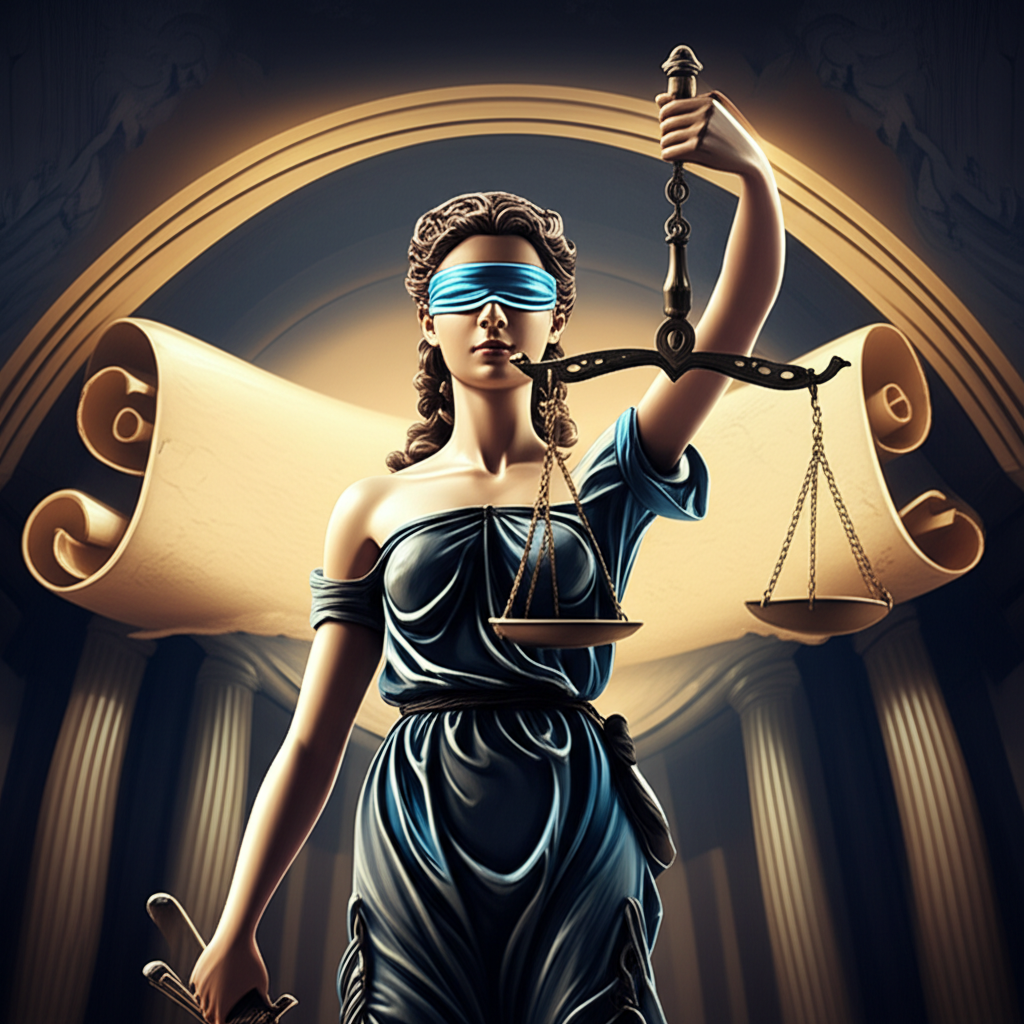
Image Description
The Tension and Interdependence
The history of philosophical thought reveals a constant tension:
- When Law Deviates from Justice: History offers stark reminders of legal systems that codified injustice – slavery, apartheid, tyrannical decrees. In such instances, the philosophical and moral imperative shifts towards questioning the law's legitimacy. Is an unjust law truly a law? This is where the concept of civil disobedience often arises, as individuals or groups act on a higher moral conviction of justice, even if it means breaking the law.
- When Justice Seeks to Transcend Law: Conversely, the pursuit of justice can sometimes challenge the rigid structures of existing law. This can manifest in demands for legal reform, the creation of new laws to address emerging injustices, or the application of equity principles to mitigate the harshness of strict legal interpretation. The State plays a critical role in navigating this dynamic, striving to ensure its legal framework remains adaptable and responsive to evolving notions of justice.
The connection is therefore one of mutual critique and constant striving. Law provides the structure and enforceability, while justice provides the moral compass and the ultimate goal.
Mechanisms of Connection: How Law Strives for Justice
Despite the inherent tension, legal systems are often designed with mechanisms intended to foster the connection to justice:
- Rule of Law: The principle that all individuals and institutions, including the State itself, are accountable to laws that are publicly promulgated, equally enforced, and independently adjudicated. This ensures fairness and predictability, foundational aspects of justice.
- Due Process: Legal requirements that the State must respect all legal rights owed to a person. This includes fair hearings, impartial tribunals, and access to legal representation, all designed to ensure a just outcome.
- Equity: A body of law that developed to provide remedies where common law was too rigid or failed to achieve a just result. It allows for flexibility and consideration of individual circumstances to achieve fairness.
- Legal Interpretation and Evolution: Courts and legal scholars constantly interpret and reinterpret laws in light of societal changes and evolving ethical standards, seeking to align legal outcomes with contemporary understandings of justice.
Conclusion: A Perpetual Pursuit
The connection between law and justice is not a static state of perfect alignment, but rather a dynamic and perpetual pursuit. For any State to maintain its legitimacy and foster a flourishing society, it must constantly strive to bridge the gap between its codified laws and the moral imperative of justice. Philosophers from Plato to the present have underscored that laws derive their ultimate authority not merely from their enforcement, but from their perceived fairness and their capacity to uphold the dignity and rights of individuals. The ongoing dialogue, the critical examination of existing statutes, and the continuous effort to reform and refine legal systems are all testaments to the enduring and vital connection between law and justice – a connection that remains at the very heart of human civilization.
YouTube Video Suggestions
- YouTube: 'Philosophy of Law: Justice and Legal Systems Explained'
- YouTube: 'Great Books of the Western World: Justice & The State'
📹 Related Video: What is Philosophy?
Video by: The School of Life
💡 Want different videos? Search YouTube for: "The Connection Between Law and Justice philosophy"