

The Invisible Threads: Unraveling the Connection Between Language and Sign
The connection between language and sign is not merely incidental; it is fundamental to how we think, communicate, and perceive reality. Every word we utter, every sentence we construct, every written character we decipher, functions as a sign or symbol, pointing beyond itself to an idea or a thing in the world. This article explores this profound and often overlooked relationship, drawing insights from the rich tapestry of philosophical thought found within the Great Books of the Western World, revealing how deeply embedded signs are in the very fabric of our linguistic existence.
The Profound Intertwining of Language and Sign
At its core, language is a sophisticated system built upon signs. These signs are not just arbitrary markers; they are the vehicles through which our ideas travel from one mind to another, bridging the gap between internal thought and external expression. Without the ability to represent concepts through signs – be they spoken sounds, written marks, or even gestures – human communication as we know it would be impossible. To truly understand language, we must first grapple with the nature of the sign itself and its inseparable connection to the ideas it seeks to convey.
Echoes from Antiquity: Language as a System of Signs
The philosophical inquiry into the nature of language and its relationship to meaning began millennia ago. Ancient thinkers grappled with questions that remain central to our understanding today.
Plato's Inquiry into Names
In Plato's dialogue Cratylus, Socrates, Cratylus, and Hermogenes debate whether names (a primary form of linguistic sign) have a natural fitness for their objects or if they are purely conventional. This early exploration highlights a crucial tension:
- Naturalism: Do words inherently reflect the essence of what they name? (e.g., "buzz" sounds like a bee)
- Conventionalism: Are words merely agreed-upon labels, their meaning assigned by human consensus?
While the dialogue doesn't offer a definitive answer, it undeniably establishes words as signs, whose efficacy and truthfulness are paramount to philosophical discourse and the pursuit of knowledge. The very act of naming is an act of signing.
Aristotle's Articulation of Symbols
Aristotle, in his seminal work On Interpretation, provides a foundational statement on the nature of linguistic signs. He posits:
"Spoken words are the symbols of affections in the soul, and written words are the symbols of spoken words."
This concise statement reveals several key connections:
- Spoken words are primary symbols (signs) of internal mental states or ideas ("affections in the soul").
- Written words are secondary symbols, representing the spoken.
- The idea in the mind is the ultimate referent, making the sign a bridge between inner thought and outer expression.
For Aristotle, the connection between the spoken word and the mental idea is conventional, yet the ideas themselves are reflections of things in the world, common to all humans.
Medieval Meditations: Augustine on Words and Things
Moving into the medieval period, St. Augustine of Hippo offered profound insights into signs in his On Christian Doctrine. He famously distinguished between "things" (res) and "signs" (signa).
The Dual Nature of Reality: Things and Signs
Augustine's framework is elegantly simple yet deeply influential:
- Things: Entities that exist for their own sake, not used to signify something else (e.g., a human, a tree, God).
- Signs: Entities that are used to signify something else. They exist to point beyond themselves.
He then categorizes signs, placing words – the building blocks of language – as the most prominent and powerful type of sign. For Augustine, the primary purpose of a sign, especially a word, is to convey an idea or a concept to another. This underscores the instrumental role of signs in human communication and the transmission of knowledge, particularly divine knowledge in his context.
Enlightenment Explorations: Locke and the Mind's Ideas
Centuries later, John Locke, in his An Essay Concerning Human Understanding, further refined our understanding of the connection between language, signs, and ideas.
Words as Marks of Internal Conceptions
Locke argued that words primarily serve as sensible signs of ideas in the mind of the speaker. His emphasis was on the subjective nature of these connections:
- Words stand for ideas: A word like "tree" doesn't directly stand for the physical tree, but for the idea of a tree in the speaker's mind.
- Communication of ideas: The chief end of language is to communicate these ideas to others.
- Arbitrary connection: The link between a particular sound (word) and a particular idea is largely arbitrary and conventional, agreed upon by a society.
This perspective highlights the crucial role of the idea as the intermediary. Without an underlying idea, a word is an empty sound, a sign without a signified.
Understanding the Mechanics: What is a Sign, What is a Symbol?
While often used interchangeably, a subtle distinction between sign and symbol can illuminate their roles in language.
A Philosophical Distinction
| Feature | Sign | Symbol |
|---|---|---|
| Nature | Direct, often conventional or indicative | Often richer, more complex, culturally laden |
| Relation | Points to a specific referent or idea | Evokes a range of ideas or associations |
| Example | A stop sign (direct command) | A dove (peace, purity, holy spirit) |
| Function | Primarily informative, communicative | Primarily evocative, representative, suggestive |
In the context of language, individual words often function as signs (e.g., "cat" signifies the animal). However, phrases, metaphors, and narratives often employ words to create symbols that resonate with deeper, more complex ideas and cultural meanings.
The Idea: The Crucial Bridge
Regardless of the precise distinction, the idea remains the linchpin. A sign or symbol in language is effective only insofar as it successfully evokes a corresponding idea in the mind of the receiver. This mental connection is what transforms mere sounds or marks into meaningful communication.
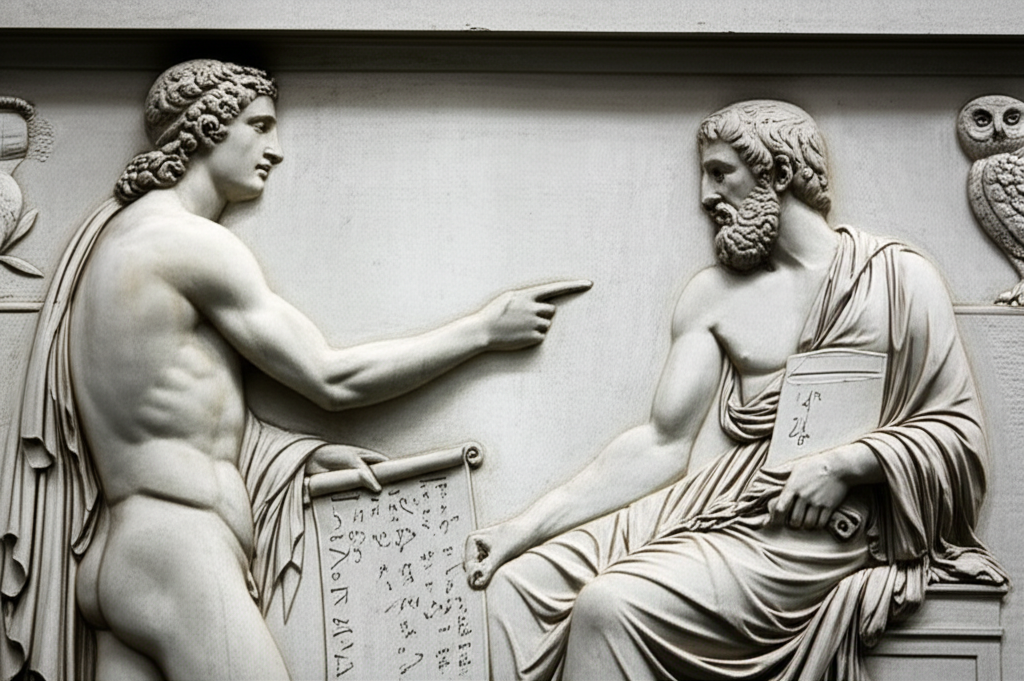 subtly integrated into the background, symbolizing the transmission of knowledge and ideas through symbolic forms.)
The Inseparable Dance: How Language Employs Signs
The very structure of language is a testament to its reliance on signs. From the smallest phoneme to the most intricate literary metaphor, signs are at play.
The Fabric of Communication
- Phonemes & Graphemes: The basic sound units (phonemes) and written units (graphemes) of a language are themselves minimal signs, distinguishing one word from another.
- Morphemes & Words: These are the most obvious signs, each carrying a specific meaning or grammatical function.
- Syntax & Grammar: The rules governing how words combine are essentially rules for arranging signs to form coherent ideas and propositions.
- Semantics & Pragmatics: These fields explore how signs convey meaning and how their interpretation is shaped by context.
The connection is so profound that we often fail to notice it. We look through the sign (the word) to the idea or thing it represents, much like we look through a window to see the landscape beyond. Yet, without the window, our view would be entirely different, or non-existent.
Conclusion: Beyond Mere Words
The journey through the Great Books of the Western World reveals a consistent philosophical thread: language is intrinsically, undeniably, and profoundly connected to signs. From Plato's debate on names to Aristotle's definition of words as symbols of mental affections, from Augustine's distinction between things and signs to Locke's emphasis on words as marks of ideas, the fundamental role of the sign is undeniable.
To speak is to sign, to write is to sign, to understand is to interpret signs. This invisible yet ever-present connection shapes our reality, allowing us to share our innermost thoughts and build complex civilizations. By recognizing the power and subtlety of the sign within language, we gain a deeper appreciation for the miraculous act of human communication and the intricate dance between our inner world of ideas and the external world of expression.
📹 Related Video: PLATO ON: The Allegory of the Cave
Video by: The School of Life
💡 Want different videos? Search YouTube for: "Plato Cratylus summary analysis"
📹 Related Video: What is Philosophy?
Video by: The School of Life
💡 Want different videos? Search YouTube for: "John Locke words and ideas philosophy"