

The Inseparable Weave: Education and the March of Progress
The relationship between education and progress is not merely correlative; it is fundamentally causal, a dynamic interplay that has shaped civilizations and propelled humanity forward. From the Socratic dialogues to the Enlightenment's grand treatises, philosophers across millennia have recognized that the cultivation of the mind, the dissemination of knowledge, and the fostering of critical thought are the bedrock upon which genuine societal advancement is built. Without a robust commitment to education, the very notion of progress remains an elusive phantom, a potential unrealized.
The Foundation: Education as the Crucible of Knowledge
At its heart, education is the systematic process of acquiring and transmitting knowledge, skills, values, and habits. It extends far beyond the confines of formal schooling, encompassing self-study, mentorship, and the lifelong pursuit of understanding. It is the crucible in which raw curiosity is refined into informed inquiry, and where isolated facts coalesce into comprehensive wisdom.
- Acquisition of Knowledge: Education provides the tools and frameworks for understanding the world, both natural and human. It equips individuals with the capacity to analyze, synthesize, and create.
- Development of Critical Thinking: More than just memorization, true education fosters the ability to question assumptions, evaluate evidence, and formulate independent judgments. This critical faculty is indispensable for challenging existing paradigms and envisioning new possibilities.
- Transmission of Culture and Values: Education is how societies pass down their heritage, ethical frameworks, and collective experiences, ensuring continuity while also allowing for critical re-evaluation and adaptation.
For thinkers like Plato, whose Republic is a cornerstone of the Great Books of the Western World, education was not merely a personal enrichment but a civic imperative. The ideal State depended on citizens, especially its rulers, being rigorously educated to discern truth and govern justly. His allegory of the cave powerfully illustrates how education liberates individuals from the shadows of ignorance into the light of knowledge, a prerequisite for any meaningful progress.
Defining Progress: A Multifaceted Ascent
The concept of progress is often narrowly interpreted as technological advancement or economic growth. While these are certainly components, a philosophical understanding of progress is far richer and more complex. It encompasses:
- Intellectual Progress: The expansion of human understanding in science, philosophy, and the arts. This includes new discoveries, theories, and creative expressions.
- Moral and Ethical Progress: The evolution of societal values towards greater justice, equality, compassion, and human rights. This often involves questioning traditional norms and striving for more inclusive frameworks.
- Social and Political Progress: The development of more equitable, stable, and just forms of governance and social organization, allowing for greater individual freedom and collective well-being.
- Human Flourishing: Ultimately, progress aims at creating conditions where individuals can realize their full potential, live meaningful lives, and contribute positively to their communities.
Immanuel Kant, another giant within the Great Books of the Western World, famously articulated the spirit of the Enlightenment as humanity's emergence from its self-imposed immaturity. For Kant, progress was inextricably linked to the courage to use one's own reason – "Sapere Aude!" (Dare to know!) – and the public use of that reason, which is fundamentally an educational endeavor.
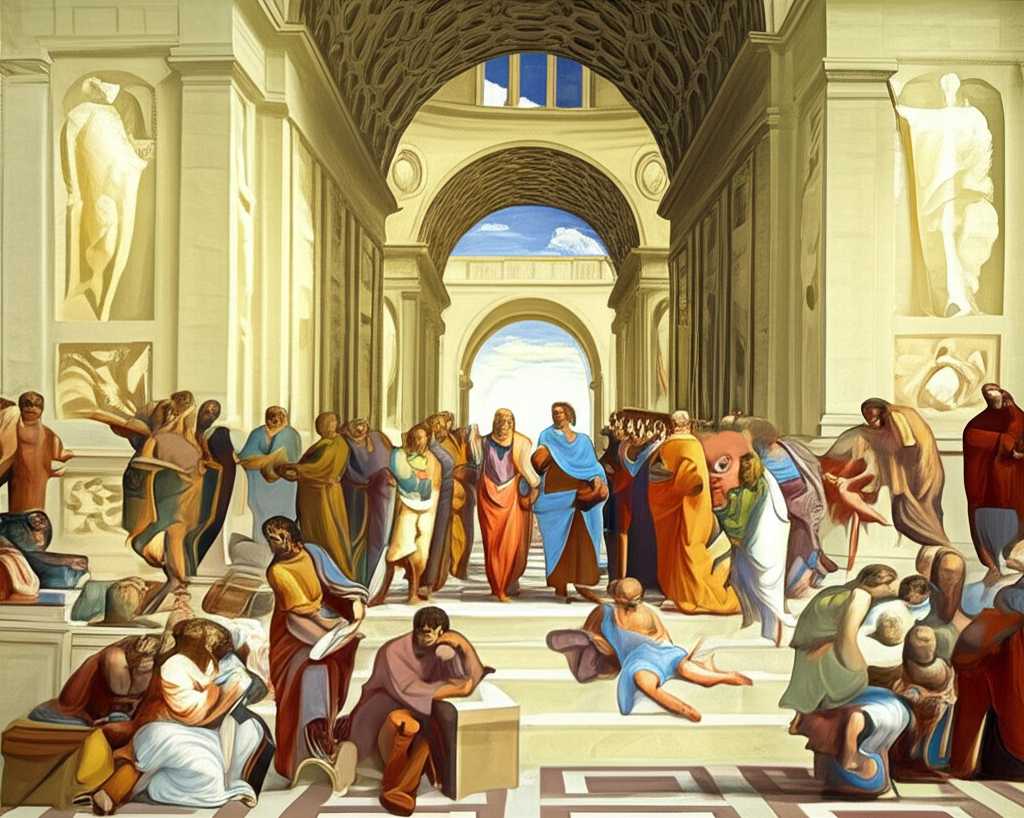
The State's Imperative: Nurturing Education for Collective Advancement
The role of the State in fostering both education and progress is undeniable. From ancient city-states to modern democracies, the collective good has often been tied to the intellectual capacity of its populace.
Historically, the State has been seen as having a vested interest in the education of its citizens for several reasons:
- Informed Citizenship: A well-educated populace is better equipped to participate in democratic processes, make informed decisions, and hold their leaders accountable. John Locke, whose writings on government are essential to the Great Books of the Western World, emphasized that legitimate government rests on the consent of the governed, which implies an educated populace capable of rational consent.
- Economic Prosperity: A skilled and knowledgeable workforce drives innovation, productivity, and economic growth, benefiting the entire State.
- Social Cohesion and Stability: Education can instill shared values, promote understanding across diverse groups, and reduce social friction, contributing to a more stable and cohesive society.
- National Security and Defense: In an increasingly complex world, intellectual prowess and scientific advancement are crucial for a nation's security and its ability to adapt to global challenges.
Conversely, a State that neglects education risks stagnation, social unrest, and a decline in its overall capacity for progress. The suppression of knowledge and critical thought by authoritarian regimes throughout history stands as a stark testament to the power of education as a force for liberation and change, often perceived as a threat to entrenched power structures.
Historical Perspectives from the Great Books of the Western World
The enduring wisdom contained within the Great Books of the Western World offers a rich tapestry of thought on this vital connection.
-
Ancient Foundations:
- Plato's Republic: Envisions an ideal State where education is meticulously structured from childhood through adulthood, designed to cultivate philosopher-kings capable of leading society towards justice and truth. For Plato, the progress of the State is directly proportional to the wisdom of its educated rulers.
- Aristotle's Politics: While differing from Plato on specifics, Aristotle also emphasized the importance of public education for citizens to develop virtue and practical wisdom (phronesis), essential for the functioning of a good polis. He believed that the State has a duty to ensure its citizens are properly educated to fulfill their roles and contribute to the common good.
-
Enlightenment Visions:
- John Locke's Some Thoughts Concerning Education: Argued for an education based on reason and experience, emphasizing the development of a sound mind in a sound body. His empiricist philosophy, foundational to the Great Books, suggests that knowledge is acquired through experience, making education paramount for shaping individuals and, by extension, society.
- Jean-Jacques Rousseau's Emile, or On Education: While controversial, Rousseau's work in the Great Books challenged traditional education, advocating for a natural development that allows innate goodness to flourish, believing that proper education could lead to a more authentic form of human progress.
- Immanuel Kant's "What is Enlightenment?": This essay, a pivotal text in the Great Books, champions the individual's courage to use their own reason, asserting that enlightenment and societal progress are contingent upon the freedom to think and express one's knowledge publicly.
-
Modern Critiques and Continuations:
- Later thinkers, some represented in the Great Books, like Karl Marx, while often critical of the educational systems of their time, implicitly underscored the transformative power of knowledge and critical consciousness in achieving societal progress and overcoming oppression. His emphasis on understanding historical materialism suggests that education in the true nature of society is crucial for revolutionary change.
Challenges and Considerations for Sustained Progress
Despite the clear connection, the path from education to progress is not always linear or assured. Challenges persist:
- Equity and Access: Disparities in educational opportunities based on socioeconomic status, geography, or other factors hinder the full realization of human potential and impede collective progress.
- Quality vs. Quantity: Simply providing access to schooling does not guarantee quality education. The curriculum, teaching methods, and resources must be effective in fostering critical thinking and genuine knowledge acquisition.
- The Nature of Knowledge: In an age of information overload, discerning reliable knowledge from misinformation becomes a crucial educational task.
- Adaptability: Educational systems must continually adapt to new discoveries, technological advancements, and evolving societal needs to remain relevant and effective drivers of progress.
📹 Related Video: PLATO ON: The Allegory of the Cave
Video by: The School of Life
💡 Want different videos? Search YouTube for: ""Plato's Philosophy of Education" and "Kant on Enlightenment and Progress""
Conclusion: A Continuous Journey
The connection between education and progress is an enduring philosophical truth, woven through the fabric of human history and critically examined in the Great Books of the Western World. It underscores the profound responsibility of individuals, communities, and the State to invest in the cultivation of knowledge and critical thought. As Grace Ellis, I believe that true progress is not a destination but a continuous journey, propelled by an unwavering commitment to learning, questioning, and striving for a more enlightened and just existence. The future of humanity hinges on our collective capacity to educate, to innovate, and to ever push the boundaries of what is known and what is possible.