

The Inseparable Dance: Unpacking the Connection Between Beauty and Form
The profound connection between beauty and form has captivated philosophers and artists for millennia, suggesting that our aesthetic appreciation is deeply rooted in the structural integrity, proportion, and organization of an object or idea. From ancient Greek ideals to contemporary art, the concept that something's inherent shape, arrangement, and composition dictate its capacity to evoke wonder and admiration remains a cornerstone of aesthetic theory. This article explores how form is not merely a container for beauty, but often its very essence.
Introduction: The Enduring Quest for Aesthetic Understanding
Since the dawn of human reflection, we’ve been drawn to things that please the eye, stir the soul, or resonate with an inner sense of rightness. What is it about a perfectly sculpted vase, a harmonious piece of music, or a breathtaking landscape that evokes such a powerful response? Philosophers throughout history, from the pages of the Great Books of the Western World, have consistently pointed to form as a crucial, perhaps even indispensable, element in the experience of beauty. It suggests that beauty is not merely in the eye of the beholder, but is often an intrinsic quality arising from the way something is structured and composed.
The Ancient Roots: Plato and Aristotle on Form and Beauty
The philosophical inquiry into the connection between beauty and form finds its robust genesis in ancient Greece, shaping Western thought for centuries.
Plato's Ideal Forms and the Reflection of Beauty
For Plato, as explored in dialogues like Phaedrus and Symposium, beauty itself is an eternal, unchanging Form existing in a transcendent realm. The physical world, with all its transient objects, merely participates in or reflects these perfect Forms. A beautiful object, be it a person, a statue, or a geometric proof, is beautiful because its form — its specific arrangement, proportion, and harmony — allows it to imperfectly mirror the ultimate Form of Beauty. The more closely a physical form approximates its ideal counterpart, the more beautiful it is perceived to be. This implies an objective standard of beauty attainable through the rational apprehension of form.
Aristotle's Emphasis on Order, Proportion, and Wholeness
Aristotle, while diverging from Plato's transcendent Forms, also placed significant emphasis on form as integral to beauty. In works like Poetics and Metaphysics, he argued that beauty in perceptible things arises from qualities such as taxis (order), symmetria (proportion), and horismenon (definiteness or wholeness). A beautiful tragedy, for instance, must have a coherent plot with a beginning, middle, and end, where each part contributes to the overall effect. The form of the narrative, its structure and internal logic, is what grants it its aesthetic power. For Aristotle, beauty is not just about mirroring an ideal, but about the inherent excellence of a thing's design and execution in the world.
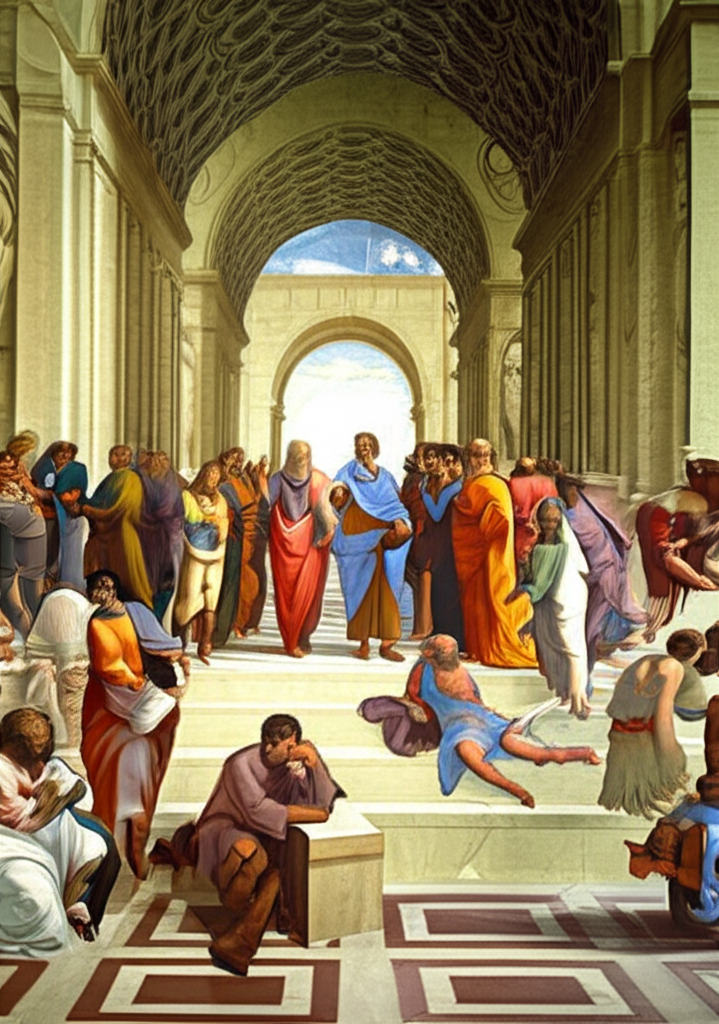
The Renaissance and Beyond: Art as the Embodiment of Form
The philosophical insights of the ancients profoundly influenced later periods, particularly the Renaissance, where art became a primary medium for exploring the connection between beauty and form.
How Artists Translated Philosophical Ideas into Visual Form
Renaissance artists like Leonardo da Vinci and Michelangelo, deeply steeped in classical texts and humanist ideals, consciously sought to imbue their works with ideal form. They studied anatomy, perspective, and composition with scientific rigor, believing that understanding the underlying structure of the human body or a scene was essential to rendering its beauty. The golden ratio, symmetry, and geometric precision were not just technical tools but philosophical expressions of universal harmony. The "perfect" human form in sculpture or painting was an attempt to capture an ideal beauty through meticulous attention to proportion and structure.
The Role of Symmetry and Harmony in Aesthetic Appreciation
Throughout subsequent centuries, from the Neoclassical period to various movements in art and architecture, the principles of symmetry, balance, and harmony—all facets of form—remained central to the definition of beauty. Whether in the balanced facade of a Georgian building or the intricate counterpoint of a Baroque fugue, the ordered arrangement of parts into a cohesive whole was seen as inherently pleasing.
Consider the following elements that contribute to formal beauty:
- Proportion: The pleasing relationship of parts to a whole and to each other.
- Symmetry: Balance and harmony, often achieved by identical or similar forms on opposite sides of a dividing line or plane.
- Rhythm: The organized movement or recurrence of elements.
- Unity: The sense that all parts of a composition belong together and contribute to a unified whole.
- Clarity: The distinctness and intelligibility of the structure.
Modern Interpretations: Form's Enduring Influence
While the definition of beauty has expanded considerably in modern times, moving beyond purely classical ideals, the underlying significance of form persists.
Beyond the Classical: Finding Beauty in Abstract Forms
The 20th century saw a revolution in art with movements like Cubism, Futurism, and Abstract Expressionism, which challenged traditional notions of representational beauty. Yet, even in abstract art, the success of a piece often hinges on its internal form – the dynamic tension of its lines, the balance of its masses, the coherence of its colors, and the overall composition. A Kandinsky painting, while not depicting a recognizable object, derives its aesthetic power from the interplay of its abstract forms, colors, and their arrangement. Here, beauty is found not in mirroring a perceived reality, but in the inherent qualities of the artistic form itself.
The Subjectivity vs. Objectivity Debate Revisited
The ongoing philosophical debate about whether beauty is subjective or objective often circles back to form. If beauty is purely subjective, then form is merely a vehicle for individual preference. However, if there are universal principles of form that consistently evoke aesthetic pleasure across cultures and individuals, then form offers a compelling argument for an objective component to beauty. The enduring appeal of certain architectural styles, musical structures, or narrative arcs suggests that some formal arrangements possess an inherent capacity to resonate with human perception and cognition.
📹 Related Video: PLATO ON: The Allegory of the Cave
Video by: The School of Life
💡 Want different videos? Search YouTube for: "Plato's Theory of Forms explained, Aristotle on Art and Beauty"
The Enduring Connection
The connection between beauty and form is not a static concept but a dynamic interplay that has evolved with human thought and creativity. From the ancient philosophers who sought ideal structures to the modern artists who manipulate form to evoke new sensations, the idea that the way something is constituted, arranged, and presented is fundamental to its aesthetic impact remains profoundly relevant. Whether we are discussing a Greek temple, a Renaissance masterpiece, or a piece of contemporary design, the intrinsic form often holds the key to unlocking its unique beauty, inviting us to look deeper than the surface and appreciate the masterful construction beneath.
📹 Related Video: What is Philosophy?
Video by: The School of Life
💡 Want different videos? Search YouTube for: "The Golden Ratio in Art and Architecture, Philosophy of Aesthetics: Beauty and Form"