

The Enduring Connection Between Beauty and Form
The pursuit of understanding beauty has captivated philosophers for millennia, often leading us back to its intrinsic connection with form. From ancient Greece to contemporary aesthetics, the idea that beauty resides, at least in part, in the structure, arrangement, and inherent order of things—their form—has been a cornerstone of Western thought. This article explores how this profound connection has been articulated, particularly through the lens of the Great Books, revealing that whether in nature or art, the harmonious organization of elements is often the very essence of what we perceive as beautiful.
Unpacking the Essence: What is Form?
Before delving into the connection, it's crucial to understand what we mean by form. In philosophy, form isn't merely the outer shape; it encompasses the internal structure, organization, pattern, and essential nature of a thing. It's what makes something what it is, distinguishing it from other things. When we speak of a beautiful vase, we're not just admiring its color, but its elegant proportions, its symmetrical curves, its balanced composition—its form.
Plato's Ideal Forms: Beauty as Participation
Perhaps no philosopher more profoundly linked beauty to form than Plato. For Plato, as explored in works like the Symposium and Phaedrus (found in the Great Books of the Western World), true beauty isn't found in a specific object, but in its participation in the transcendent, eternal Form of Beauty itself.
Key Platonic Ideas on Beauty and Form:
- The Form of Beauty: An ideal, unchanging, perfect essence existing independently of the physical world.
- Sensory Beauty as Reflection: Beautiful objects in our world are beautiful because they imperfectly reflect or participate in this ultimate Form of Beauty.
- Ascension to Understanding: Through appreciating beautiful physical forms (bodies, souls, laws, knowledge), one can gradually ascend to an understanding of the pure Form of Beauty.
For Plato, the form of a thing, its internal order and structure, is what allows it to approximate or hint at this ideal, making it beautiful to us. The more perfectly a physical form embodies the ideal, the more beautiful it is perceived to be.
Aristotle's Aesthetic Order: Form as Immanent Perfection
While Plato sought beauty in a transcendent realm, his student Aristotle brought the discussion back to the immanent world. In texts such as Poetics and Metaphysics, Aristotle emphasizes form as the intrinsic organizational principle of a thing. For him, beauty often arises from the proper arrangement of parts, from order, symmetry, and definiteness.
Aristotle's Contributions to the Connection:
- Unity and Wholeness: A beautiful object or art piece must have a discernible beginning, middle, and end, possessing an organic unity. Its form dictates its completeness.
- Magnitude and Order: Beauty requires appropriate size and order. A creature that is too small to be perceived clearly, or too large to be grasped as a whole, cannot be beautiful. Similarly, a plot in a tragedy must have a coherent sequence of events.
- Formal Cause: In Aristotle's four causes, the "formal cause" is the structure or design of a thing. A beautiful statue's form is not just its material, but the shape the sculptor imposed upon it.
Aristotle's perspective highlights that beauty is not just an external adornment but is deeply embedded in the very form and function of an object or art work.
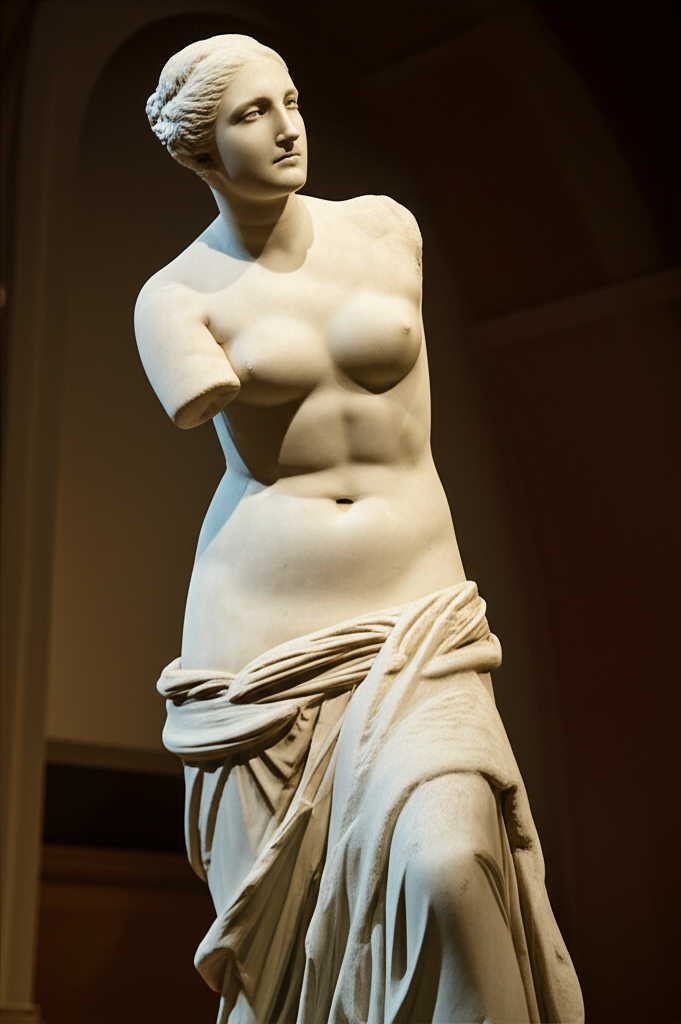
The Renaissance and Beyond: Harmony, Proportion, and Art
The classical ideas of beauty and form experienced a powerful resurgence during the Renaissance. Artists, architects, and theorists like Leon Battista Alberti and Leonardo da Vinci meticulously studied human anatomy, perspective, and mathematical ratios to achieve ideal forms in their art. They believed that universal laws of proportion and harmony dictated beauty.
- Mathematical Ratios: The "golden ratio" and other mathematical principles were seen as embodying perfect form, leading to aesthetically pleasing compositions in painting, sculpture, and architecture.
- Symmetry and Balance: These were not merely stylistic choices but were understood as fundamental aspects of beautiful form, reflecting order in the cosmos.
This period solidified the understanding that the deliberate manipulation of form—through composition, line, color, and structure—is the primary means by which art creates beauty.
The Enduring Significance of Form in Art
In the realm of art, the connection between beauty and form is perhaps most evident and directly manipulated. Whether it's the rhythm and meter in poetry, the melodic and harmonic structures in music, or the composition and perspective in painting, form is the scaffolding upon which beauty is constructed.
How Form Manifests Beauty in Art:
| Art Form | Aspect of Form Contributing to Beauty |
|---|---|
| Painting | Composition, line, color balance, perspective, spatial arrangement |
| Sculpture | Volume, mass, texture, silhouette, negative space, anatomical ratios |
| Music | Melody, harmony, rhythm, tempo, structure (sonata form, fugue) |
| Architecture | Proportion, symmetry, balance, spatial organization, structural integrity |
| Poetry | Meter, rhyme scheme, stanzaic structure, narrative arc, imagery |
Even in modern art, where traditional notions of beauty might be challenged, the artist's engagement with form—whether disrupting it, simplifying it, or reinterpreting it—remains central to the aesthetic experience. The deliberate choices regarding form are what give the artwork its unique identity and emotional resonance.
Conclusion: An Inseparable Bond
The connection between beauty and form is not merely a historical curiosity but a fundamental insight into human perception and aesthetic appreciation. From Plato's transcendent ideals to Aristotle's immanent order, and through the meticulous craftsmanship of Renaissance art, philosophers and artists alike have recognized that beauty is often, if not always, rooted in the elegant, harmonious, and purposeful form of a thing. To understand beauty is, in many ways, to understand its form. It is the structure that delights, the order that enchants, and the pattern that resonates deeply within us.
📹 Related Video: PLATO ON: The Allegory of the Cave
Video by: The School of Life
💡 Want different videos? Search YouTube for: ""Plato's Theory of Forms explained" and "Aristotle Poetics analysis beauty""