

The Celestial Bridge: Unpacking the Profound Connection Between Angel and God
For millennia, humanity has pondered the celestial hosts – those spiritual beings we often call angels. Their presence permeates sacred texts, philosophical treatises, and artistic expressions, consistently pointing towards a reality beyond our immediate grasp. Yet, their role is rarely understood in isolation. Instead, the very essence of an Angel is inextricably linked to God, forming a Connection that is both dynamic and deeply symbolic. This article delves into this profound relationship, drawing insights from the rich tapestry of the Great Books of the Western World to illuminate how angels function as divine instruments, reflections, and intermediaries in the grand cosmic design.
The Theological Framework: Angels as Divine Ministers
Within the vast landscape of Theology, angels are consistently portrayed not as independent deities, but as servants and messengers of the Most High. This fundamental understanding establishes the hierarchical nature of their Connection to God. As St. Thomas Aquinas meticulously details in his Summa Theologica, angels are pure intellectual substances, incorporeal beings created by God, distinct from both the divine and the material world. Their primary purpose is to glorify God and execute His divine will.
- Divine Agents: Angels are often depicted as carrying out God's commands, whether in acts of creation, revelation, or judgment. They are the instruments through which divine providence often operates in the world.
- Messengers of Revelation: The very word "angel" (from the Greek angelos) means "messenger." From biblical narratives to later theological elaborations, angels are consistently the bearers of divine messages, bridging the gap between God's transcendent wisdom and human understanding.
- Reflectors of Divine Perfection: As intellectual beings, angels possess a profound understanding of God's essence, albeit imperfectly compared to God Himself. Their existence and nature, therefore, serve as a mirror, reflecting aspects of divine wisdom, power, and goodness to the created order.
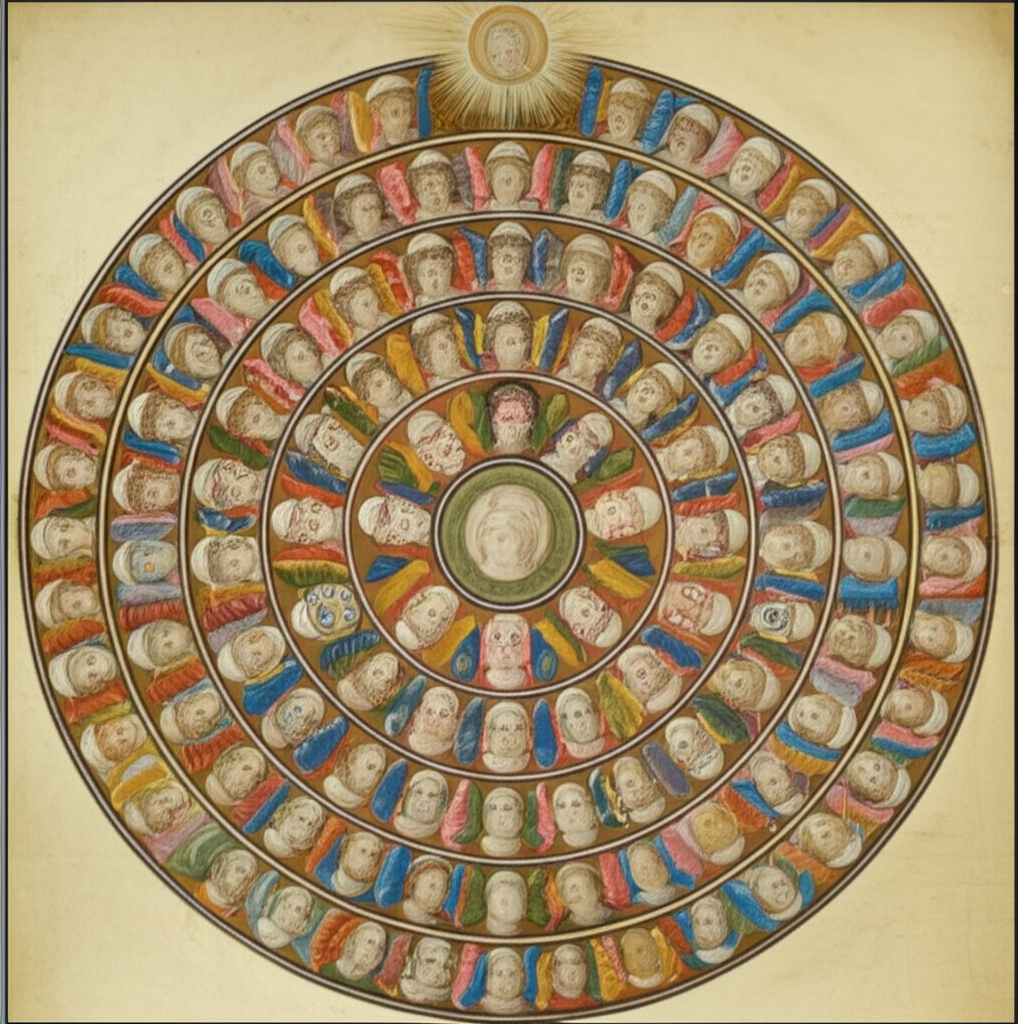 . The angels are shown in various postures of adoration and service, some holding scrolls or instruments, all gazing upwards towards the divine source. The overall impression is one of ordered majesty and divine emanation.)
Philosophical Underpinnings: Hierarchy and Intermediaries
The concept of intermediary beings between the ultimate divine and the material world is not unique to Abrahamic Theology. Ancient Greek philosophy, particularly the Platonic tradition, laid intellectual groundwork that would later influence Christian thought on angels. Plato's concept of Forms, existing in a realm of perfect, eternal ideas, necessitated a bridge to the imperfect material world. While not angels, these ideas of hierarchy and emanation provided a philosophical lens through which later thinkers could understand the role of spiritual beings.
Aristotle's Metaphysics, with its discussion of the Unmoved Mover and the intelligences that move the celestial spheres, also contributed to the philosophical landscape that would later accommodate the concept of angels as intellectual movers and intermediaries. These philosophical currents, when integrated with revelation, solidified the understanding of angels as part of a rational, ordered cosmos emanating from and directed by God.
The Nature of the Connection: How Angels Relate to God
The Connection between Angel and God is multifaceted and profound, extending beyond mere servitude.
| Aspect of Connection | Description | Theological Significance |
|---|---|---|
| Created Being | Angels are not divine, but created by God ex nihilo. | Emphasizes God's absolute sovereignty and creative power. Angels exist solely by His will. |
| Intellectual Reflection | Angels possess intellect and will, allowing them to know and love God, though their knowledge is finite. | Highlights God as the ultimate object of all intellectual and volitional activity. |
| Executive Will | Angels execute God's commands in the physical and spiritual realms. | Demonstrates God's active involvement in creation through agents, maintaining order and providence. |
| Adoration & Praise | Angels eternally worship and praise God, fulfilling their ultimate purpose. | Reinforces God's supreme worthiness of all adoration and glory. |
| Mediatorial Role | They act as conduits for divine grace, messages, and sometimes judgment. | Bridges the gap between the infinite, transcendent God and finite, immanent creation. |
This table illustrates that the Connection is one of absolute dependence and perfect alignment of will. Angels, in their very being and function, perpetually point towards God. They are, in essence, a testament to God's infinite wisdom in creating a diverse and ordered cosmos, populated with beings designed to reflect His glory at various levels.
The Enduring Significance for Theology and Philosophy
Understanding the Connection between Angel and God is not merely an academic exercise in ancient Theology; it offers profound insights into the nature of reality itself. It speaks to a universe that is not haphazard but structured, purposeful, and imbued with divine meaning. The existence and function of angels reinforce several key philosophical and theological tenets:
- Divine Transcendence and Immanence: Angels help to bridge the seemingly vast chasm between a transcendent God (beyond creation) and an immanent God (active within creation). They are the "hands" and "voices" of God in the world.
- Hierarchical Order of Creation: The angelic choirs demonstrate a divinely ordained hierarchy, where different beings possess different perfections and roles, all contributing to the harmonious functioning of the cosmos.
- The Power of Intellect and Will: Angels, as pure intellects, exemplify the highest created forms of knowledge and free will, underscoring their importance in God's plan and the potential for created beings to align their will with the divine.
Conclusion: The Unbroken Link
The Connection between Angel and God is a central theme in the philosophical and theological traditions of the West, meticulously explored by giants like Aquinas and influenced by the cosmological ideas of Plato and Aristotle. Angels are not merely celestial decorations; they are active participants in the divine economy, serving as vital links in the chain of being. Their existence speaks volumes about God's wisdom, power, and the intricate design of a universe where even the highest created intelligences find their ultimate purpose and perfection in their unwavering devotion and service to the Divine. They stand as a testament to an unbroken spiritual link, forever reflecting the glory of their Creator.
📹 Related Video: PLATO ON: The Allegory of the Cave
Video by: The School of Life
💡 Want different videos? Search YouTube for: ""Thomas Aquinas Angels Summa Theologica" and "Platonic Hierarchy of Being Metaphysics""