

The Concept of the Soul in Ancient Philosophy: A Journey Through Metaphysics and Being
The human quest to understand the soul is perhaps as old as philosophy itself, a profound inquiry into the very essence of Being that has shaped Western thought for millennia. From the earliest musings of the Pre-Socratics to the intricate systems of Plato and Aristotle, ancient thinkers grappled with the nature, origin, and destiny of this enigmatic entity. This pillar page delves into the diverse and often contradictory interpretations of the soul across various schools of ancient philosophy, exploring its fundamental role in metaphysics, ethics, and epistemology, as illuminated by the foundational texts found within the Great Books of the Western World. We shall navigate the intellectual currents that sought to define what it means to be alive, conscious, and distinctly human, unveiling how these ancient debates continue to resonate in our contemporary understanding of self and existence.
I. What is the Soul? Defining the Indefinable in Ancient Philosophy
The term "soul" (from the Greek psyche) in ancient thought encompassed far more than our modern psychological understanding. It was often synonymous with life itself, the animating principle that distinguished the living from the inanimate. Early philosophical inquiries into the soul were deeply intertwined with attempts to understand the cosmos and humanity's place within it.
Early Greek Notions: From Breath to Psyche
Initially, the soul was often conceived as a breath, a vital force that animated the body and departed upon death. Homeric epics, for instance, depict the psyche as a shadowy image that flits away to Hades. However, as philosophy began to emerge, this rudimentary concept evolved into a more sophisticated subject of metaphysical inquiry.
The Pre-Socratics: Material vs. Immaterial Souls
The Pre-Socratic philosophers, driven by a desire to identify the arche (the fundamental principle of the cosmos), offered various perspectives on the soul, often linking it to a primary element or a specific form of matter.
- Thales (c. 624–546 BCE): Suggested that the soul was a moving force, perhaps even present in seemingly inanimate objects like magnets, implying a form of hylozoism (the belief that all matter is in some sense alive).
- Anaximenes (c. 585–528 BCE): Believed air was the fundamental substance, and that the soul was composed of air, just as the cosmos was. "Just as our soul, being air, holds us together, so do breath and air encompass the whole world."
- Heraclitus (c. 535–475 BCE): Saw the soul as fiery, a dry and hot essence. A "dry soul is wisest and best," suggesting a connection between the soul's purity and its intellectual capacity.
- Empedocles (c. 494–434 BCE): Proposed that the soul was made of all four root elements (earth, air, fire, water), and its understanding of the world came from like perceiving like.
- Democritus (c. 460–370 BCE): As a leading atomist, he posited that the soul was composed of fine, smooth, spherical atoms, much like fire atoms, which permeated the entire body and were responsible for sensation and thought. Upon death, these atoms dispersed.
These early thinkers laid the groundwork, pushing the conversation from mythical explanations to more rational—albeit diverse—materialistic or energetic interpretations of the soul and its connection to Being.
II. Plato's Dualism: The Soul as the Seat of Reason and Immortality
With Plato (c. 428–348 BCE), the concept of the soul underwent a radical transformation, becoming the central focus of his metaphysics and ethics. For Plato, the soul was not merely an animating principle but an immortal, divine essence, fundamentally distinct from the mortal body. His dialogues, particularly Phaedo, Republic, and Phaedrus, are replete with arguments for the soul's pre-existence and immortality.
The Tripartite Soul: Reason, Spirit, Appetite
In the Republic, Plato famously described the soul as having three distinct parts, each with its own function and corresponding to a different virtue:
| Part of the Soul | Function | Virtue | Location (Metaphorical) |
|---|---|---|---|
| Reason (Logistikon) | Seeks truth, governs, calculates | Wisdom | Head |
| Spirit (Thymoeides) | Seeks honor, courage, indignation | Courage | Chest |
| Appetite (Epithymetikon) | Seeks bodily desires, pleasure | Temperance | Belly |
Plato argued that a just and harmonious individual is one in whom Reason, aided by Spirit, governs the unruly Appetites. This internal balance mirrors the ideal structure of his proposed state.
The Chariot Allegory and the World of Forms
In Phaedrus, Plato illustrates the tripartite soul through the Chariot Allegory:
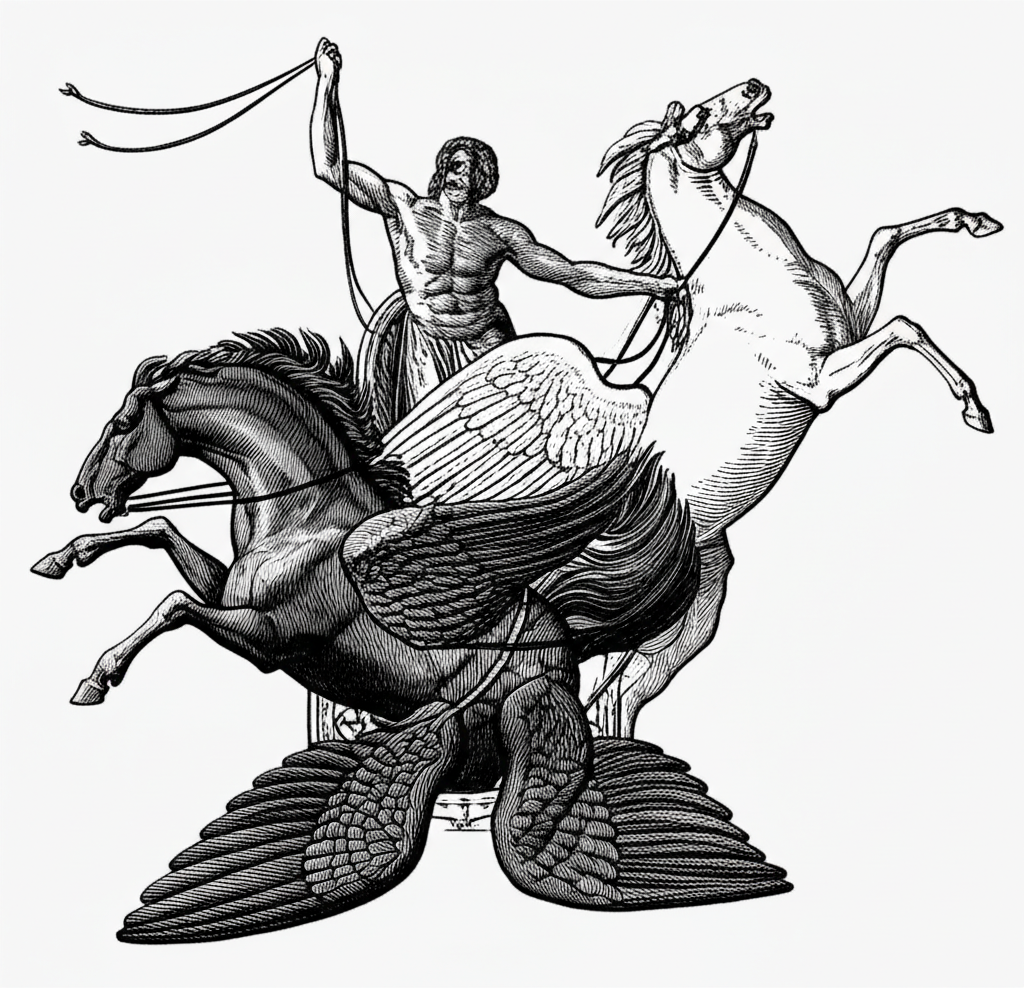
The charioteer represents Reason, striving to guide the two horses: one noble and well-bred (Spirit), the other unruly and dark (Appetite). The goal is to ascend to the realm of the Forms, the true reality of perfect, eternal essences. This ascent signifies the soul's yearning for knowledge and ultimate truth, confirming its non-material and eternal nature.
Recollection (Anamnesis) and the Soul's Pre-existence
Plato posited that the soul existed before birth in the World of Forms, where it directly apprehended perfect knowledge. Learning, therefore, is not acquiring new information but rather recollecting what the soul already knew. This theory of anamnesis is a cornerstone of his argument for the soul's immortality and its inherent connection to universal truths.
Implications for Ethics and Knowledge
Plato's metaphysics of the soul profoundly impacted his ethics. The well-ordered soul is virtuous, seeking the good and the beautiful. True knowledge is not derived from fleeting sensory experience but from the soul's rational engagement with the eternal Forms. The soul's ultimate purpose is to free itself from the distractions of the body and ascend to intellectual contemplation.
III. Aristotle's Functionalism: The Soul as the Form of the Body
Aristotle (384–322 BCE), Plato's most famous student, offered a strikingly different, yet equally influential, account of the soul. Rejecting Plato's sharp dualism, Aristotle, in his seminal work De Anima (On the Soul), conceived of the soul not as a separate entity imprisoned within the body, but as the form of a natural body possessing life potentially. For Aristotle, the soul is intrinsically linked to the body, serving as its animating principle, its essence, and its actualization.
Hylomorphism: Soul and Body as Matter and Form
Aristotle's theory of hylomorphism posits that all substances are a composite of matter (hyle) and form (morphe). In the case of living Being, the body is the matter, and the soul is its form. It is the soul that gives the body its specific organization, its capacities, and its purpose. To say the soul is the form of the body is to say it is the actualization of the body's potential for life. Just as the shape of an axe is its form, enabling it to cut, the soul is the form of a living body, enabling it to live, grow, perceive, and think.
The Vegetative, Sentient, and Rational Souls
Aristotle identified a hierarchy of soul functions, each building upon the previous one:
- Vegetative Soul (Nutritive Soul): Present in all living things (plants, animals, humans). Its functions include nutrition, growth, and reproduction. It is the most basic principle of life.
- Sentient Soul (Perceptive Soul): Present in animals and humans. It encompasses the functions of the vegetative soul, plus sensation (perception through the five senses), desire, and locomotion. Animals can experience pleasure and pain, and move towards or away from stimuli.
- Rational Soul (Intellective Soul): Unique to humans. It incorporates the functions of both the vegetative and sentient souls, but adds the capacity for thought, reason, and deliberation. This is the part of the soul that allows for abstract thought, understanding, and moral choice.
For Aristotle, these are not separate souls but different levels of organization and function within a single soul.
The Soul's Functions and Capacities
Aristotle's focus was on what the soul does. It is the efficient cause of life, the formal cause (defining what a living thing is), and the final cause (its purpose or end). The soul is responsible for:
- Nutrition and Growth: Sustaining life processes.
- Sensation and Perception: Interacting with the environment.
- Locomotion: Movement.
- Imagination and Memory: Internal representations of experience.
- Thought and Intellect: The uniquely human capacity for abstract reasoning.
Mortality vs. Immortality: A Nuanced View
Aristotle's view on the soul's immortality is more complex and debated than Plato's. Since the soul is the form of the body, it cannot exist independently of the body. Therefore, the vegetative and sentient souls perish with the body. However, Aristotle sometimes hints at a possible immortality for the active intellect (nous poietikos), the part of the rational soul that is pure thought and potentially separable from matter. This aspect of his metaphysics has been a subject of extensive scholarly interpretation.
IV. Hellenistic Perspectives: Stoicism, Epicureanism, and Skepticism
Following the classical period, Hellenistic schools continued to explore the soul, often with a greater emphasis on ethics and practical living. Their views on the soul were often tied to their broader cosmological and metaphysical systems.
Stoic Materialism: The Soul as Pneuma
The Stoics, renowned for their emphasis on virtue and living in accordance with nature, conceived of the soul as a material entity. They believed the soul was a part of the universal pneuma (a fiery breath or vital spirit) that permeated the cosmos. This pneuma was rational and divine, and a fragment of it resided within each individual as their soul.
- The soul was divided into eight parts: the ruling faculty (hegemonikon), the five senses, and the faculties of speech and reproduction.
- The ruling faculty, located in the heart, was the seat of reason, judgment, and emotion.
- Upon death, the individual soul might persist for a time before reabsorbing into the cosmic pneuma.
For the Stoics, understanding the material nature of the soul was crucial for achieving ataraxia (tranquility) and living a virtuous life aligned with the rational order of the universe.
Epicurean Atomism: The Soul as Fine Atoms
Epicurus (341–270 BCE), building on Democritus's atomism, held that the soul was a collection of extremely fine, smooth, and mobile atoms dispersed throughout the body. These soul atoms were responsible for sensation, thought, and feeling.
- The soul was entirely material and mortal.
- When the body disintegrated at death, the soul atoms dispersed, and consciousness ceased to exist.
- This belief led to Epicurus's famous argument against the fear of death: "Death is nothing to us; for that which is dissolved is without sensation, and that which lacks sensation is nothing to us."
His philosophy aimed to free individuals from fear, particularly the fear of divine punishment and an afterlife, thus promoting a life of pleasure (understood as absence of pain and mental disturbance).
Skepticism's Challenge to Definitive Knowledge
The Skeptics, particularly Pyrrho (c. 360–270 BCE) and his followers, challenged the very possibility of certain knowledge about the soul. Given the conflicting views of other philosophers, Skeptics argued that no definitive conclusion could be reached regarding the soul's nature, origin, or destiny. This suspension of judgment (epochē) was intended to lead to ataraxia, by freeing individuals from the anxiety of holding dogmatic beliefs.
V. Neoplatonism: The Soul's Ascent to the One
The Neoplatonist school, flourishing from the 3rd to 6th centuries CE, represented a resurgence and reinterpretation of Plato's ideas, particularly concerning the soul. Plotinus (204/5–270 CE) is the most prominent figure, whose Enneads detail a complex metaphysical system centered on the emanation of all Being from a transcendent, ineffable "One."
Plotinus and the Hierarchy of Being
Plotinus described a hierarchy of existence, emanating downwards from the One:
- The One: The ultimate, simple, transcendent source of all reality, beyond Being and thought.
- Intellect (Nous): The first emanation, containing the Platonic Forms, the realm of pure thought and perfect Being.
- Soul (Psyche): The second emanation, a universal soul that bridges the Intellect and the material world. It is the animating principle of the cosmos and individual souls.
- Matter: The lowest emanation, a realm of multiplicity and imperfection.
The Soul's Emanation and Return
For Plotinus, individual human souls are parts of the universal Soul, which itself emanates from the Intellect. The human soul, therefore, retains a connection to the higher realms. It has descended into the body but yearns to return to its divine origin. The goal of human life, according to Neoplatonism, is the ascent of the individual soul back through the levels of Being to achieve mystical union with the One. This involved rigorous intellectual and spiritual discipline, purification, and contemplation.
This Neoplatonic vision of the soul profoundly influenced later Christian theology and mystical traditions, shaping the Western understanding of spirituality and the individual's journey towards ultimate reality.
VI. The Enduring Legacy: The Soul's Place in Western Thought and Metaphysics
The ancient philosophical inquiries into the soul did not simply fade with the rise of new eras; they laid the bedrock for nearly all subsequent Western thought on human nature, consciousness, and metaphysics.
Influence on Abrahamic Religions
The Platonic concept of an immortal, incorporeal soul distinct from the body found fertile ground in early Christian, Jewish, and Islamic theology. The idea of the soul's individual survival after death, its moral accountability, and its potential for eternal communion with God owes much to the Platonic tradition, often integrated with Aristotelian notions of the soul's faculties.
Bridge to Modern Philosophy (Descartes, etc.)
The ancient debates established the fundamental questions that continued to occupy modern philosophers. René Descartes's famous dualism—the res cogitans (thinking substance) distinct from the res extensa (extended substance)—is a direct descendant of Plato's separation of soul and body, albeit with a new focus on consciousness and mind-body interaction. The problem of consciousness, the nature of personal identity, and the very definition of Being continue to be informed by these ancient foundational discussions.
The Continuing Question of Being and Consciousness
Today, as neuroscience and artificial intelligence push the boundaries of our understanding of the mind, the ancient questions about the soul remain profoundly relevant. Are we merely complex biological machines, or is there an immaterial aspect that constitutes our true Being? The ancient philosophers, despite their varied conclusions, collectively forged the intellectual tools and frameworks necessary for us to even ask these questions. Their relentless pursuit of understanding the soul underscores its central role in defining what it means to be human, to experience, to reason, and to exist in the grand tapestry of Being.
The journey through the ancient concepts of the soul reveals a rich tapestry of intellectual exploration, where philosophy courageously confronted the most profound mysteries of existence. From the material breath of the Pre-Socratics to the immortal reason of Plato, the functional form of Aristotle, the material pneuma of the Stoics, and the ascending essence of the Neoplatonists, each era contributed vital insights. These foundational inquiries into the soul remain a testament to humanity's enduring fascination with its inner Being, continuing to inspire our understanding of metaphysics, consciousness, and our place in the universe.
📹 Related Video: PLATO ON: The Allegory of the Cave
Video by: The School of Life
💡 Want different videos? Search YouTube for: ""Plato's Theory of the Soul Explained""
📹 Related Video: ARISTOTLE ON: The Nicomachean Ethics
Video by: The School of Life
💡 Want different videos? Search YouTube for: ""Aristotle De Anima Summary""